Do you know that slightly guilty feeling of standing with a hose, wondering — am I giving them enough, or am I drowning them? I do. For years I watered my tomatoes the way I watered my houseplants: a little every day, just to feel helpful. The result? Shallow roots, cracked fruits after every storm, and that classic yellowing lower foliage that tells you the plant is stressed despite your good intentions.
Here’s what I eventually learned, after one too many batches of leathery-bottomed paste tomatoes: tomatoes don’t want a daily sprinkle. They want a long, even drink that reaches 8 to 12 inches down into the root zone, then a little time to breathe. It’s not about frequency alone. It’s about consistency — that steady, even moisture that lets the plant move calcium, keep skins elastic, and swell fruit without splitting.
Think about your tomato roots as a deep, invisible mirror of the vine above ground. An eight-foot indeterminate has roots easily 18 inches deep and 24 inches wide when happily watered. Shallow, frequent sips train those roots to stay near the surface, where they’re hottest and driest. Deep, spaced soakings invite them downward, where soil stays cool and moist longer. Which would you rather your plant depend on in a 95°F week?
Let’s build your watering schedule by stage, soil, and season — the one I wish someone had handed me that first soggy, crack-prone summer.
Quick Answer: Water tomato plants 2 to 3 times per week, delivering 1 to 1.5 inches total per week for in-ground plants (about 3 to 6 gallons per plant per week at 3-foot spacing). Water at the base before 10 a.m., check the top 2 inches with your finger — if it’s dry, it’s time; if it’s still damp, wait — and mulch 3 inches deep with straw once soil warms. Seedlings need daily light moisture until established; fruiting plants in summer heat need the most consistent moisture of all. Up your amount slightly in heat above 90°F and skip or reduce after a soaking rain of an inch or more.
At a Glance
| Stage / Setup | How Often | How Much & How to Check |
|---|---|---|
| Seedlings to 10 days after transplant | Daily check, water when top 1 inch dry | Keep evenly moist like wrung-out sponge, never soggy |
| Established to first flowering | 2 times per week | 1 inch per week total; finger test 2 inches deep |
| Fruiting in summer heat (June-August) | 2 to 3 times per week, drip daily low-and-slow in heat | 1 to 1.5 inches per week, up to 2 inches if sustained above 90°F |
| Containers (5-gallon or grow bag) | Daily, sometimes twice in heat | Water until it drains freely; lift test — light means thirsty |
| Raised beds | Every 2 to 3 days | They drain and heat faster than in-ground; mulch essential |
| How to check | Finger 2 inches + tuna-can rain gauge + trowel 8 inches | Dry at depth = water deeply; damp = wait a day |
Why Consistency Beats Frequency — The Real Secret
If I could erase one phrase from tomato folklore, it would be “water every day.” Not because daily water is always wrong — in containers it often is right — but because that phrase trains us to be routine, not observant.
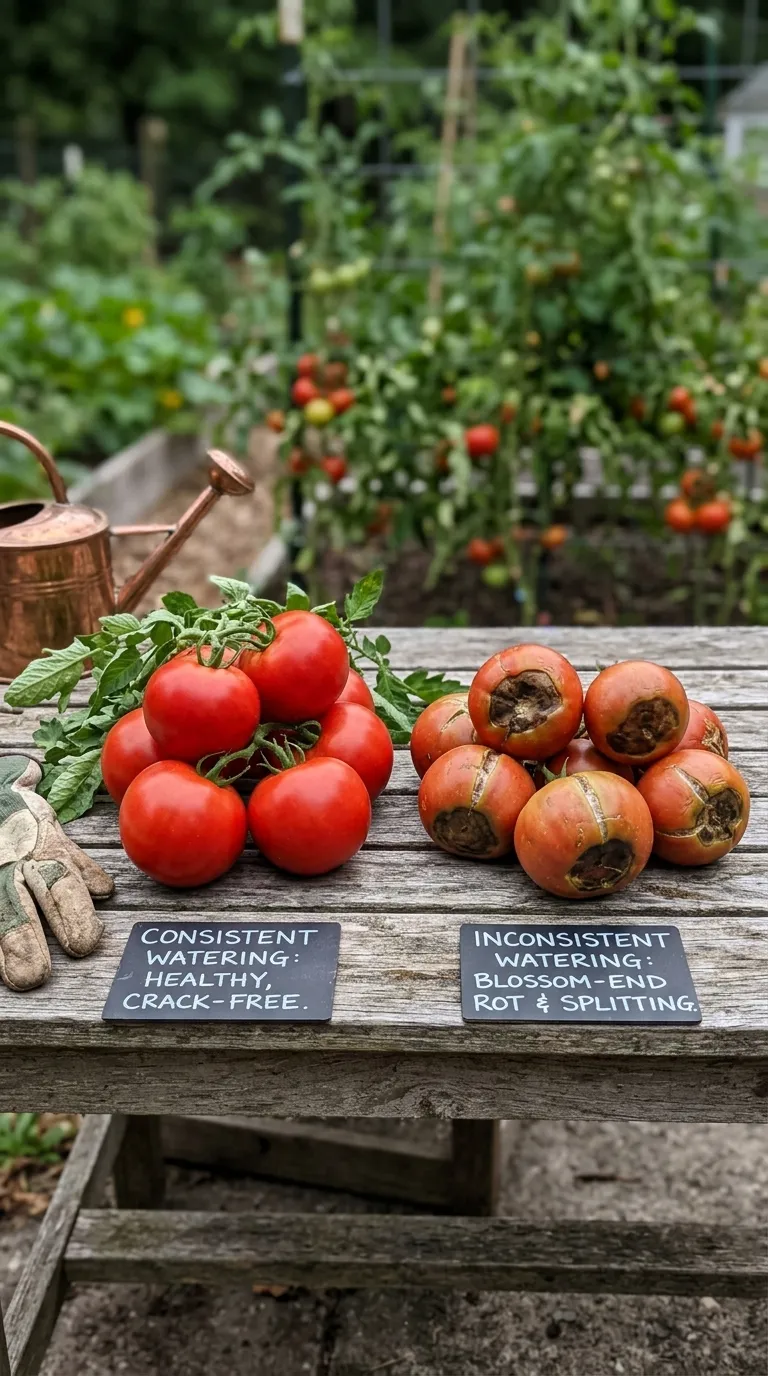
Tomatoes suffer far more from swings than from a precise number. That classic pair — blossom end rot (that leathery black patch on the bottom of an otherwise gorgeous Roma) and radial cracking that spirals from the stem — aren’t diseases. They’re calcium uptake failures and skin elasticity failures, both triggered by irregular moisture. When soil goes dry for three days, then gets flooded after a storm, calcium can’t ride the water highway to the fruit tip, and skins that hardened in drought suddenly try to stretch. The plant can’t keep up.
Even moisture keeps calcium moving and cell walls flexible. It’s quiet work, invisible, and it tastes like the difference between a watery cracked slicer and a dense, sweet, crack-free one that slices like butter. See how to grow tomatoes for how watering fits alongside feeding and support, and if you’re seeing pale leaves from drought or sogginess, my guide to tomato leaves turning yellow will help you sort which it is. For overall garden timing, see how often to water vegetables.
I think of consistent watering as a promise I make to the plant: I won’t let you panic about thirst or flood. And in return, the plant makes fruit that actually tastes like summer.
Watering by Growth Stage — From Seedling Sips to Summer Soaks
Every stage wants something slightly different. Here’s how I adjust through the season, and why it matters more than any calendar date.
The Seedling and Fresh Transplant Stage (Weeks 0-3)
Newly started seedlings and just-transplanted starts have tiny root systems — just a few inches deep — and they dry in hours, especially under grow lights or in black plastic pots. At this stage, I check daily, sometimes twice if it’s windy. I keep the top inch evenly moist, like a wrung-out sponge, never puddled. A gentle mist or a small watering can with a fine rose is better than a blasting hose that unveils roots.
Once transplanted outdoors, I water the hole before I plant, set the tomato deep (burying two-thirds of the stem so it roots along the buried hairs — my favorite trick), and then water again to settle soil around roots. For the next 7 to 10 days, I check that top inch every morning. The goal is established roots, not soggy feet. If you mulched too early before soil warmed, pull it back for a few days so sun can warm the root zone to 60°F.
The Establishing to First Bloom Stage (12-Inch Plant to First Flowers)
This is when many gardeners accidentally overwater by clinging to seedling habits. Once the plant is 12 inches tall and putting out flower buds, shift to deeper, less frequent sessions: about 1 inch per week in 2 deep soaks, letting the top 2 inches dry between. Encourage those roots downward. If you water and the soil is still dark and damp two inches down the next morning? Skip a day. Your future August self will thank you.
Do you notice inner leaves yellowing late in this window? Often it’s not disease yet — it’s the first signal that roots are staying too wet. Check drainage before you feed.
The Fruiting Stage — Where Consistency Matters Most
When fruits are walnut-sized and swelling fast in June to August, thirst peaks. This is when blossom end rot and cracking are waiting to pounce. I move to 1 to 1.5 inches per week in 2 to 3 sessions, and in a sustained heat wave above 90°F, up toward 2 inches total. That may sound like a lot, but one heavy thunderstorm can already deliver an inch in an hour — so track rainfall with a simple tuna can or rain gauge.
Quick math I use: 1 inch of water over a 3-by-3-foot area is about 5 to 6 gallons. So a single in-ground plant mulched and spaced roughly 3 feet apart wants roughly 3 to 6 gallons per week depending on heat, delivered in those deep sessions, not all at once. And please — how much per day? Tomatoes think in weeks, not days. Giving a measured gallon per plant every 2 to 3 days at the base, and letting the soil tell you when, beats a chart-perfect “half gallon daily” every time.
Watering by Soil & Setup — Because Soil Dictates Everything
Have you ever wondered why your neighbor waters twice a week and you need every other day, even with the same weather? It’s almost always the soil and the container.
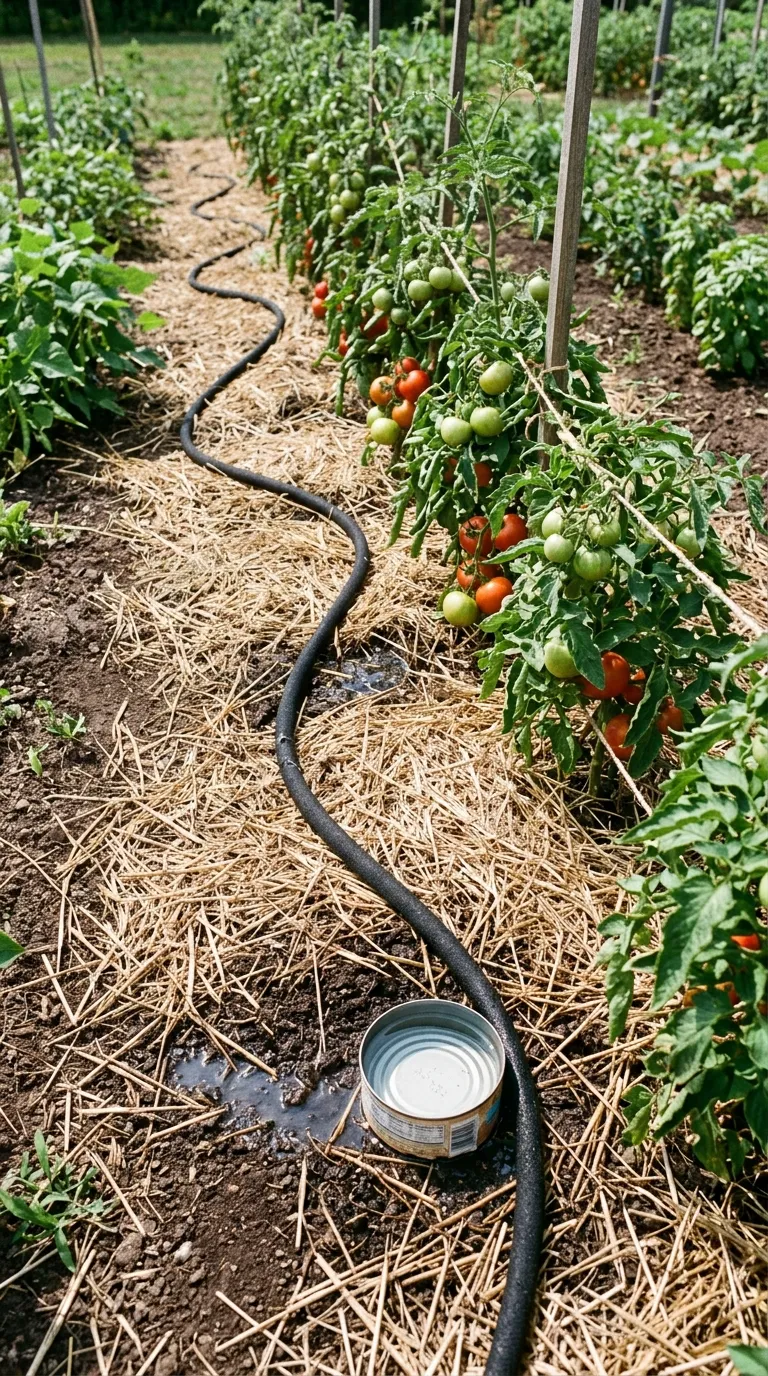
- In-ground loam (that lovely crumbly ideal): This is the forgiving middle. Give 1 inch per week in 2 deep sessions. Set a tuna can under the soaker; when it’s full, you’ve delivered an inch. Loam holds onto moisture like a good memory. Add compost annually and it gets better each year.
- Sandy soil (gritty, drains in minutes): Sand is generous and loose but thirsty — water rushes through like a sieve. Give 1.5 inches per week in 3 shorter, deep sessions. Mulch extra, 3 to 4 inches, to slow evaporation. I gardened on sand for years and learned that a single long soak just washed past roots; three moderate soaks held far better.
- Clay soil (heavy, glossy when wet, cracked when dry): Clay holds water tenaciously — almost too well. Give 1 inch per week in 1 to 2 slow sessions so water percolates instead of puddling. Avoid soggy crowns. If your trowel comes up glistening and smeared, wait. Raised beds or compost at planting dramatically improve clay structure for tomatoes. Consider mounding rows 6 inches high if water puddles more than an hour.
- Raised beds: My favorite for tomatoes, but they are the sports cars of drying: they drain and heat faster than in-ground. Check every 2 to 3 days as a rule, and mulch from day one after transplant. See raised bed gardening for soil mixes that retain moisture without swampiness.
- Containers (5-gallon buckets, fabric grow bags, patio planters): These are the divas. A 5-gallon pot in full July sun can go from perfectly moist at 8 a.m. to wilted at 3 p.m. Water daily until water runs freely from the bottom, and in extreme heat, check again by late afternoon — a second lighter watering is kinder than one heavy flood. Use a quality potting mix — see potting mix vs garden soil — not garden soil, which compacts in pots and suffocates roots.
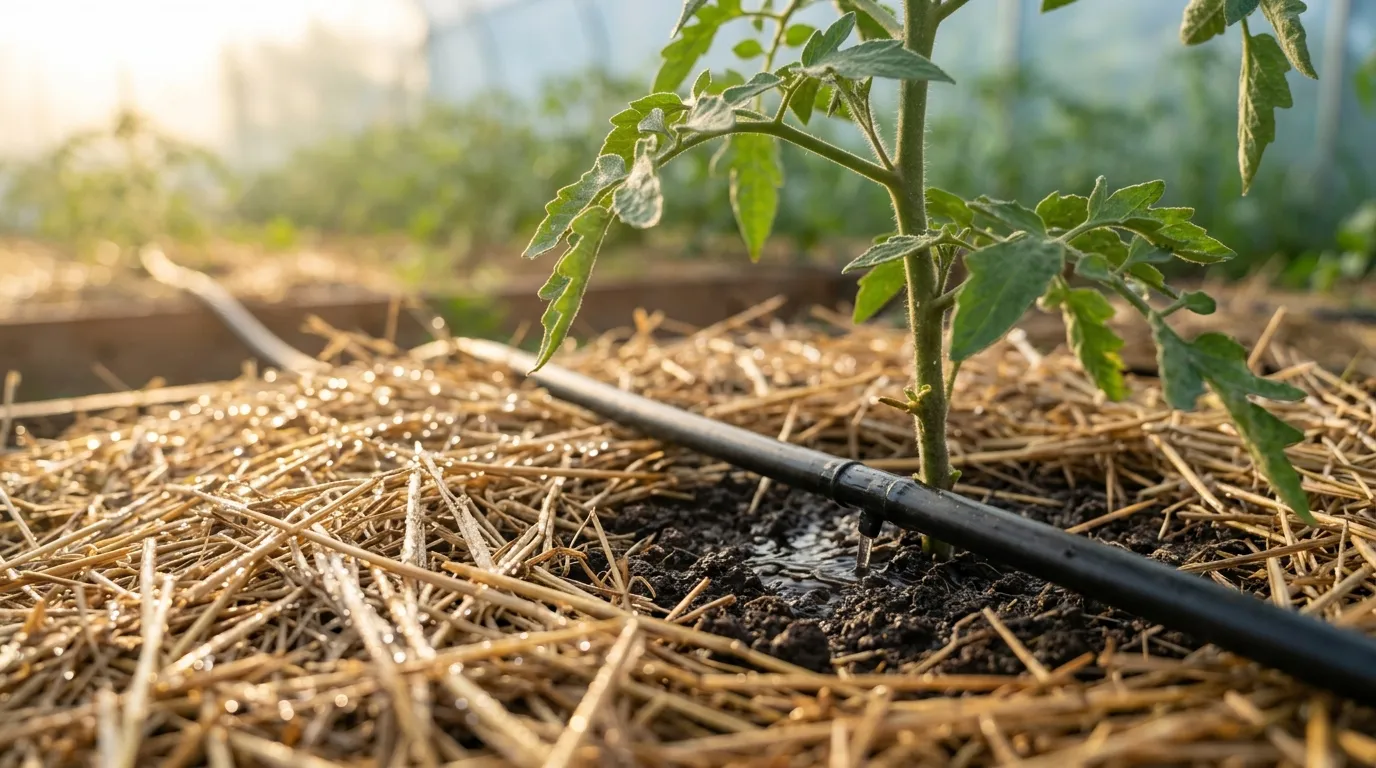
- Drip vs. sprinkler — and why it matters: Drip lines or soaker hoses at the base are the tomato gardener’s best friends. They deliver slowly, 8 inches deep, with foliage staying dry. Sprinklers, however romantic, wet leaves for hours and invite early blight and powdery mildew. I retired my overhead sprinkler for tomatoes years ago and my fungicide use dropped to near zero.
A little story: when I switched my main row to drip tape on a battery timer set to run 45 minutes at 6:30 a.m., my cracks all but disappeared and my harvest window stretched two weeks later into fall — all because moisture was finally even. Sometimes a $40 kit saves a $200 harvest.
Best Time & Technique — The Morning Ritual That Prevents Disease
When to water matters almost as much as how much. Water between 6 and 10 a.m. if you can. Why so specific? Three lovely reasons: cool morning soil absorbs slowly instead of flashing to steam, leaves have the whole day to dry (fungi hate dry leaves), and you lose far less to evaporation than at midday. If your mornings are rush-hour chaotic, evening is second best — just keep water strictly at the soil, not on foliage, so leaves aren’t wet all night. For a full timing guide, see how to test soil pH to pair water with nutrient uptake.
My technique: lay a soaker hose or drip line in a loose loop about 6 inches from the stem, covering the drip line of the canopy where feeder roots actually drink. Run it 30 to 60 minutes until a trowel shows moist soil 8 inches down. For hand-watering, remove the spray nozzle, let water run in a gentle flood at the base, count slowly to 25, pause to let it soak, then count another 15. That pause is the trick — it prevents runoff on clay or baked soil.
And mulch — please don’t skip it. After soil has warmed to about 60°F (I check with a cheap soil thermometer; no need to guess), tuck 3 inches of straw, shredded leaves, or clean wood chips around plants, leaving a 2-inch collar open around the stem so air circulates. That mulch cuts evaporation by roughly half, keeps roots cool, stops soil splash that spreads blight, and feels like tucking your plants in for the summer.
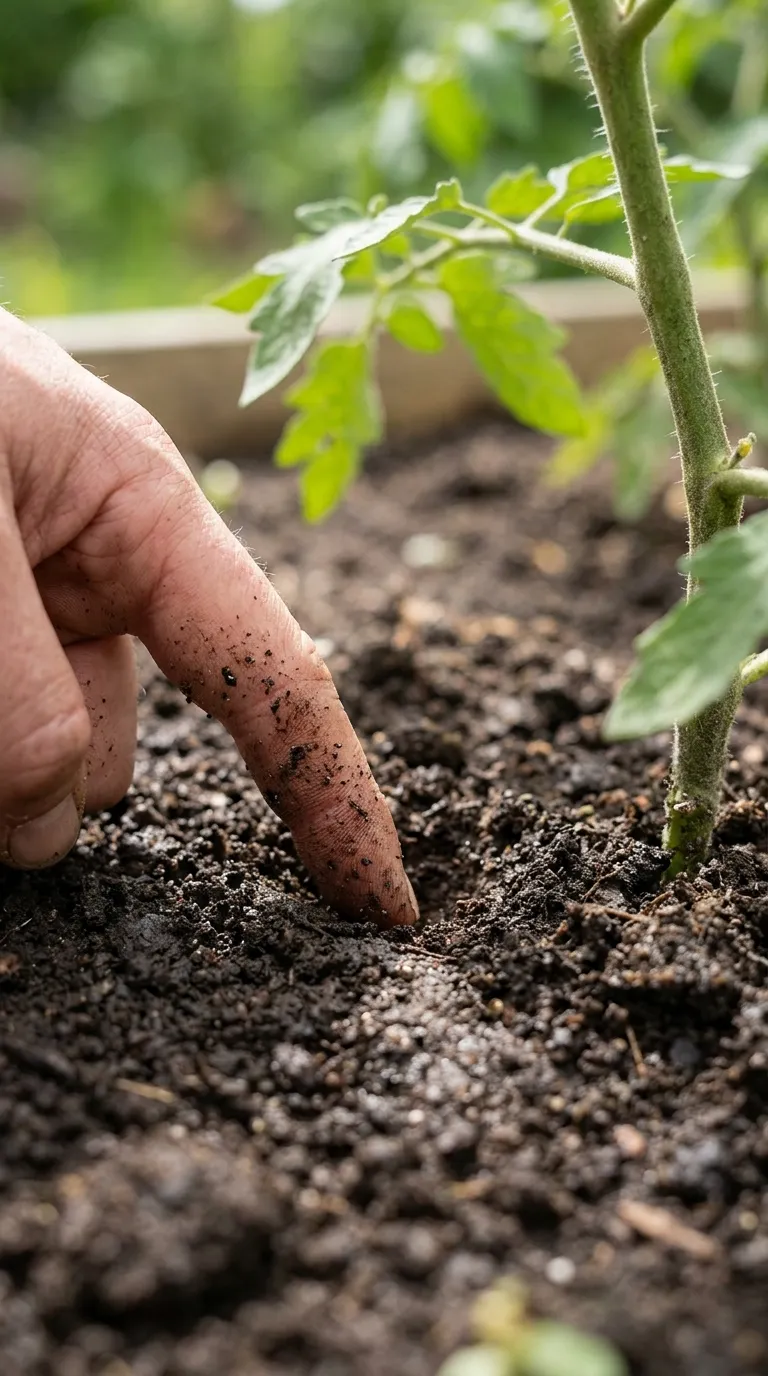
How to Check — The Finger, the Lift, and the Trowel (Zero Batteries Needed)
Sensors are nice, but these three zero-cost checks never run out of batteries:
- The finger test (my daily go-to): Push your index finger straight down to the second knuckle — about 2 inches. Feel cool and damp and see soil clinging? Wait. Feel dry, warm, and see little clinging? Water deeply today. Do this in 2 to 3 spots along the row; tomatoes don’t drink from just one point.
- The lift test for pots: Lift or tip the pot slightly. Light as a basketball? Thirsty. Heavy as a wet toolbox? Still good. After a few days you calibrate this to an art. A 7-gallon grow bag of ‘Sungold’ teaches you quickly.
- The trowel check monthly: Slide a trowel 8 inches down, 6 inches from the stem after watering. Is the soil uniformly dark and moist? Perfect. Dry at depth but wet on top? You sprinkled when you needed a soak — extend run time next session.
I also keep a tuna can nailed to a stake as a rain gauge. It’s shockingly accurate for “how much did that storm actually give me?” If it collected an inch overnight, I skip the next watering. If it collected a quarter inch and it’s 92°F, I carry on as if it hadn’t rained at all.
Signs of Too Much or Too Little — Reading Leaves Like Letters
Your tomato will tell you before fruit suffers, if you listen.
- Too little water: Wilting that starts at midday and recovers slightly by morning, edges of leaves curling inward like a taco, blossom drop, small or cat-faced fruits, and that dreaded black leathery patch of blossom end rot on the bottom of Roma types. Cracked fruits after a downpour following drought are also a tell — the skin hardened, then swell split it. See tomato leaves turning yellow for the full diagnostic.
- Too much water: Yellow, soft lower leaves (not crispy — soggy), soil that stays wet and even smells sour, a faint white mold or moss on the surface, and strangely, wilting even though soil is wet — because roots are rotting and can’t drink. Stop and let the top 2 to 3 inches dry; pull mulch back for a day to let air in, then replace.
Which one is yours right now? Walk out and touch the soil, then touch a yellowing leaf. Soft and soil is wet? Too much. Crispy and soil is dry? Too little. That pairing answers 90% of watering puzzles.
Common Mistakes — And the One-Sentence Fixes I Teach Every New Gardener
- Light daily sprinkle that wets only the top inch — grows shallow, heat-stressed roots. Fix: Water deeply 30 to 60 minutes, 2 to 3 times per week, so moisture reaches 8 inches.
- Wetting leaves with overhead hosing — invites early blight and septoria. Fix: Water the soil, always; lay hose on mulch and let it trickle at the base.
- Skipping mulch because “I’ll do it next weekend” — loses half your water to evaporation and cooks roots. Fix: Add 3 inches of straw after soil warms; leave a small collar at the stem.
- Ignoring containers because in-ground plants looked fine — pots dry 3 times faster. Fix: Check daily; water until it drains, and re-check by afternoon in heat.
- Watering on a calendar, not by feel — miss rain or heat spikes. Fix: Finger test daily; pair with a tuna-can rain gauge. Rainfall counts.
- Flooding a baked, cracked soil surface so water just runs off. Fix: Water in two pulses — a slow start to rehydrate the top, a 20-minute pause, then the main soak that actually penetrates.
Any of those sting a little with recognition? Mine did too, for years. The good news is they are all habits, not permanent flaws — and habits are rewirable in a week.
My Seasonal Watering Calendar — So You Can Plan Ahead, Not Panic
- Late spring (transplant to pre-bloom): Soil still cool, rain often ample. Check top 1 inch daily; keep moist but not sopping. This is the only window where daily light attention is correct.
- Early summer (first flowers to marble fruits): Shift to deeper sessions: 1 to 1.2 inches per week. Watch nights — if it’s muggy, water early so foliage dries fast.
- High summer (fruit swelling and ripening, 85 to 95°F): Peak thirst. 1.5 inches often, 2 inches in a brutal week. Drip daily at low volume beats a twice-weekly flood in extreme heat, but only if mulch is in place. Check containers morning and late afternoon.
- Late summer to early fall: As nights cool, ease back slightly to let existing fruits finish sweet rather than watery. Keep consistent — don’t suddenly drown plants before frost; they’ll crack. About 4 weeks before first frost, stop trying to push new growth and let plants focus on ripening what’s there.
Doesn’t having a seasonal arc like that feel calmer than asking “am I watering right?” every single morning?
Rain, Heatwaves & Vacation — Handling the Extremes Without Stress
Gardening rarely gives you perfect weeks, does it? One week it’s a soaker that drops two inches overnight and leaves puddles in the paths. The next it’s a heat dome that makes the hose hot to touch. Here’s how I ride those swings.
After a Heavy Rain
Don’t water just because it’s your “watering day.” Push that finger test. If the tuna can shows an inch after a storm, skip your next session entirely. If the soil is still soggy at two inches the next morning, pull mulch back slightly at the crown for a day so the canopy breathes. I also gently tap stakes after a storm to shake water off foliage — a small habit that reduces fungal hours. On clay, watch for standing water around stem bases. If it puddles for more than an hour, next spring consider mounding tomatoes up 4 to 6 inches.
During a Heat Wave Above 92°F
This is when even mulched, deeply watered plants can wilt by 3 p.m. Check both morning and evening. I shift drip timers from every 3 days to daily low-and-slow for that week — 30 minutes at 6 a.m. rather than one 90-minute blast. The goal is even, not extra. A 30% shade cloth slipped over the tops for the hottest three days can lower leaf temperature by 8°F, saving fruit from sunscald. Also, don’t fertilize in extreme heat — roots under heat stress don’t take up salts kindly. Water, shade, mulch — those are your tools.
When You’re Away for a Long Weekend
Tomatoes notice absence. If you’re gone 3 to 4 days in summer, deep soak the evening before, remulch to 3 inches if thin, set a battery timer on drip to run 45 minutes each morning, move containers to morning sun plus afternoon shade, and group pots together on a damp towel or tray — they create a humid microclimate. I once lost a patio ‘Celebrity’ because I skipped this for a wedding weekend. The timer that costs less than a nursery plant is still my favorite garden purchase.
What I Wish I Knew First — The Three Habits That Changed My Harvest
If I could send a note to year-one me, it would say: Buy straw, not more fertilizer. Put the hose on the ground. Trust your finger. Those three habits — mulching, watering at the base long enough to reach 8 inches, and checking with my finger instead of the calendar — took me from cracked, leggy, yellow-leaved tomatoes to harvests so abundant I learned to make sun-dried trays and pantry sauce. Not because I became a master gardener overnight, but because I stopped fighting the weather and started partnering with the soil.
Your tomatoes don’t need perfection. They just need that promise again: steady, deep, morning water, with a blanket of mulch to hold it. Can you give them that this week and see what changes?
Troubleshooting — Quick Answers When Something Looks Off
- Wilting in afternoon but perky by morning and soil is moist? That’s heat transpiration, not drought — the plant is pumping water faster than roots can keep up. Mulch and 30% shade cloth during the worst week helps more than extra water.
- Fruits cracking after a storm? That’s the drought-then-flood swing. Mulch evens it, and consistent deep watering between rains is the prevention.
- Blossom end rot on Romas/Pastas? Usually calcium movement failure from irregular moisture, not lacking calcium in soil. Keep even; don’t chase with extra lime unless a soil test says pH is low.
- Mulched bed still drying fast? Mulch may be too thin or chunky. 3 inches of straw holds best; coarse wood chips need 3 to 4 inches to match.
Behind the Scenes — Why These Details Matter More Than They Sound
I used to think all this talk about pH and spacing was fussiness. It’s not. It’s physics and biology you can feel with your hands.
Every time I pushed my finger 2 inches into soil and actually waited a day when it felt cool and damp, I saved a watering and a yellow leaf. Every time I buried a stem deep and watched those tiny hairs become roots, I gave the plant a second engine. Do you know that small thrill when you tug gently on a deep-planted tomato a week later and it doesn’t move? That’s roots holding.
We gardeners love to buy things. But the biggest yield bumps I have measured came from not buying — not buying extra nitrogen after bloom, not buying a daily sprinkle habit, not buying a spray when a shake would do. The restraint is the technique.
A Note on Microclimates — Your Garden Is Not My Garden
Your fence, your oak tree, your wind corridor between houses — they all tweak sun and airflow by an hour or two. That’s enough to shift watering needs by a full day. I now keep a $8 max-min thermometer at tomato height for a week in June. The night temperature I thought I had and the one my plants actually felt differed by 4°F. That 4°F was the difference between set and drop.
So take any schedule here — mine included — and test it against your finger, your trowel, your tuna can. The schedule is a starting point. Your hands are the final authority. Have you checked your actual canopy temperature yet? Try it tomorrow. You may be surprised.
The Soil Food Web You Can’t See But Can Feed
Compost is not just nutrients. It’s a city. Bacteria, fungi, earthworms — they glue soil into crumbs that hold air and water in the same pore. When you add 2 to 3 inches of compost, you aren’t just feeding tomatoes. You are housing the workforce that will feed them for you, slowly, all summer.
I learned to add compost in fall, not just spring. Fall compost sits, settles, and lets frost do the mixing. Spring compost I work lightly into the top 6 inches only. Deep turning every year hurts the very fungi that help tomatoes find phosphorus. Less tillage, more surface blanket — that’s been my quiet revolution.
Common Mistakes Revisited — The Subtle Ones That Creep In Year Two
We covered the big mistakes. Here are the sneaky ones that show up after you think you’ve mastered the basics.
-
Mulching too early when soil is still cold. You trap 48°F soil under a blanket and roots sit shivering for an extra two weeks. Warm to 60°F first, then tuck in.
-
Watering on a clock, not after rain. That Tuesday-and-Friday timer doesn’t know about Monday’s inch. Always check the tuna can first.
-
Feeding high-nitrogen “tomato food” that is actually lawn food in disguise. Read the first number. If it’s 20 or higher and the bag shows grass, put it down.
-
Pruning in wet weather. Cuts stay open and invite bacteria when leaves stay damp. Prune on dry mornings, 3 to 5 days after watering, with alcohol-wiped shears.
-
Saving seed without noting which plant actually yielded. Next year you grow the pretty one, not the productive one. Tag the winner with yarn at harvest.
Which of these feels familiar? I have done every single one, some twice. The fix is not shame — it’s one new habit for seven days until it sticks.
Seasonal Timeline — Week by Week When It Actually Happens
-
Late April: Cover future tomato row with black plastic for 7 days to push soil from 50°F toward 60°F. Chive clumps wake up; borage self-sows reveal themselves. This is anticipation, not planting.
-
Early May: Sow carrots and lettuce in future tomato alleys while hardening off seedlings. They germinate while tomatoes toughen outdoors a few hours daily.
-
Mid-May (after last frost, soil 60°F): Transplant deep, composted, balanced feed, staked, watered in. Basil companions go 12 inches south of each tomato. Marigolds at corners. Water hole before plant, then after.
-
Late May to Early June: Keep top inch moist but not soggy. Purple stems? Usually cold, not phosphorus. Wait for warmth rather than adding more food.
-
Early to Mid-June: Plants hit 12 to 18 inches. First light side-dress if needed, first sucker pruning below first bloom, mulch now after soil is warm. Daily finger checks become every other day.
-
Late June to Mid-July: First flowers open. Switch to low-nitrogen. Shake flowers at midday. Bees arrive and stay if you let one basil flower. Watch lower leaves for first spots — remove early.
-
Mid-July to Mid-August: Fruit swelling, peak thirst and hunger. Even moisture plus second low-nitrogen feed 3 to 4 weeks after first fruits if warm. Scout for hornworms weekly. Harvest cherries every 2 days.
-
Mid-August: Second sowing of spinach or lettuce in dappled shade under trellised tomatoes. Garlic gaps from July harvest get new basil transplants. The bed gives again without extra space.
-
Late August to September: Taper water slightly to concentrate flavor as fruits blush. Pinch new flower clusters 4 weeks before first frost. Stop fertilizing. Let ripening take center stage.
-
At First Frost Warning: Harvest all, including greens, ripen indoors on counters. Pull vines for trash if blighted, compost if healthy. Wash stakes in 10% bleach, sun-dry. Spread fall compost.
I tape this to the fridge. It turns “am I late?” into “oh, next is that — I can do it this weekend.”
Troubleshooting Deep Dive — Real Garden Conversations
Q: “My leaves yellow from the bottom but I’m sure I didn’t overwater.” Have you checked nights? Cold soil below 55°F mimics nitrogen deficiency because roots stall. Warmth often greens the next leaves without any feed. Cover at night, wait ten days, then reassess.
Q: “I watered evenly but fruits still cracked after that storm.” Mulch is the buffer between you and weather. Without 3 inches of straw, even perfect watering between rains can’t stop a 2-inch overnight deluge from splitting tight skins. Mulch evens the spike.
Q: “My cherry sets fruit but beefsteak doesn’t in the same bed.” Heat sensitivity differs. Cherries set at 92°F when beefsteaks stall above 90°F nights above 75°F. That’s variety genetics, not your care. Grow both and harvest across temperatures.
Q: “Can I fix blossom end rot with calcium spray?” Usually water is the fix, not calcium. Most soils have enough calcium; irregular moisture stops its ride to fruit tips. Even water plus mulch solves the next fruits. Only add lime if a soil test shows pH low.
Q: “Should I mist flowers to help pollination?” Please don’t. Wet pollen is dead pollen. Dry vibration at midday is the help. Keep water at soil.
If you answer your own garden with these prompts, you will hear what it’s actually asking for rather than what the internet shouted loudest yesterday.
What I Keep in My Apron — The Small Tools That Make Big Differences
- A $8 soil thermometer that tells me when 60°F is real, not calendar-guessed.
- A $6 packet of yarn to tag flower trusses the day I shake them.
- A cheap electric toothbrush in a zip bag for buzz pollination.
- A tuna can nailed to a stake as a rain gauge, shocking in its accuracy.
- A pocket notebook — one line per week: date, weather, what I did, what leaves looked like. By September, I have next year’s plan.
Could you assemble these this week? They cost less than one nursery tomato and save a season of guessing.
Quick Field Checklist — Tape This to Your Watering Can
- Sunday: finger test 2 inches, prune one spotted leaf if needed, note in book
- Midweek: shake tomato flowers at midday, check pepper undersides for aphids
- After rain: check tuna can, skip watering if inch collected, pull mulch back if soggy
- At first blush: pick promptly, leave a few to fully ripen for flavor test
- Before frost: pinch new flowers 4 weeks out, stop feeding, harvest all greens
This five-line loop replaces worry with rhythm. It takes six minutes and covers water, pruning, and pollination in one walk.
Small Tools, Big Payoff
A soil thermometer, yarn for tagging trusses, a $8 heat mat for pepper seeds, a tuna can gauge, and a pocket notebook. These cost less than two nursery plants and answer questions you would otherwise Google at midnight.
Frequently Asked Questions
Q: How often should you water tomato plants?
A: For most in-ground gardens, think twice to three times a week rather than daily — aiming for 1 to 1.5 inches total for the week, delivered deeply so moisture sinks 8 to 12 inches. The real boss is the finger test: poke two inches down each morning. Still cool and damp? Do something else and wait. Dry at that depth? Give a long, slow drink at the base and tuck that moisture in with mulch. Deep, spaced soakings invite roots downward where it’s cool and stable. Containers are the exception — a 5-gallon pot in July sun often truly wants water daily, sometimes twice. Raised beds split the difference: check every 2 to 3 days.
Q: How much water does a tomato plant need per week?
A: Give in-ground tomatoes 1 to 1.5 inches per week, about 3 to 6 gallons per plant depending on spacing and heat. Sandy soils need 1.5 inches split into 3 sessions, clay needs 1 inch slowly, and containers need daily water until it drains freely from the bottom. The key is not a daily amount but a weekly total delivered deeply. Mulch with 3 inches of straw? That single step can nearly halve your water needs because it keeps that weekly gallon where roots can actually use it instead of flashing off into hot air.
Q: What is the best time of day to water tomatoes?
A: Between 6 and 10 a.m., when the garden is still cool and quiet, is tomato paradise time for watering. The soil is receptive, evaporation is low, and because leaves dry quickly as the day warms, you starve fungal diseases of that lingering wet they crave. I set my battery timer for 6:30 a.m. and wake to the soft hiss of drip — the plants get their deep drink before I even make coffee. Evening is your backup slot — not terrible, just second-best, because foliage that stays wet all night invites blight. Lunchtime or afternoon? Only in emergencies.
Q: Can overwatering cause blossom end rot on tomatoes?
A: Yes, irregular watering causes blossom end rot even when soil calcium is adequate. Swings between dry and soaked prevent calcium from reaching fruit tips, creating leathery black patches. Keep moisture even with mulch and base watering to stop it. Even, deep moisture keeps calcium moving through the plant’s water highway to the blossom end. Fix watering first, test pH second, and only then consider calcium amendments. In most gardens, consistent moisture alone solves the next flush of fruit.
Related Articles
- How to Grow Tomatoes
- Vegetable Garden Fertilizer
- Best Soil for Tomatoes
- Tomato Companion Plants
- How to Prepare Soil for Planting
- Vegetable Garden Layout
Sources & References
- University of Minnesota Extension — https://extension.umn.edu/yard-and-garden/vegetables/watering-tomatoes
- Cornell Vegetables — https://www.vegetables.cornell.edu/crops/tomatoes/
- Iowa State University Extension — https://hortnews.extension.iastate.edu/water-requirements-tomatoes
- NC State Extension — https://content.ces.ncsu.edu/water-requirements
- University of California Agriculture and Natural Resources — https://anrcatalog.ucanr.edu/