For years I thought companion planting was a little bit folklore and a little bit wishful thinking — sweet, but not serious. Then one August, hornworms found my tomatoes and stripped a whole branch overnight, leaving those eerie, drooping leaf stems and a pile of frass beneath. The bed where I’d tucked basil between every tomato was barely touched. The bed where I hadn’t was ravaged. Same tomatoes, same sun, same year. The difference was 12 inches of basil and a border of marigolds humming with wasps.
Companion planting is not mystery. It is traffic control. It is the quiet work of scent and color and timing that tells pests to go elsewhere, invites pollinators and predators to stay, and uses space so that every inch of soil is doing at least two jobs. The right neighbors repel hornworm moths, confuse aphids, fix nitrogen tomatoes devour, and keep the soil alive under that heavy summer canopy. The wrong neighbors share blight, compete for the same nutrients, and invite the same worm to dinner.
Let’s build your 11 best companions — why each works, how far to plant it, and the layout I actually use in a 4 by 8 bed that feeds us from July to October without crowding.
Quick Answer: The best tomato companions are basil (repels whiteflies, aphids and hornworm moths within 12 inches), carrots (grow below while tomatoes grow above), French marigolds (suppress root-knot nematodes and attract pollinators), nasturtiums (trap aphids at the edge), parsley, chives, garlic (scent confusion and wasp habitat), lettuce & spinach (shallow quick harvest before shade), bush beans (fix nitrogen), borage (pollinator magnet that accumulates potassium), and oregano & thyme (living mulch). Avoid potatoes, fennel, mature brassicas, and corn near tomatoes — give antagonists at least 3 feet or a separate bed.
At a Glance
| Companion | What It Does for Tomatoes | Spacing to Tomato | My Take |
|---|---|---|---|
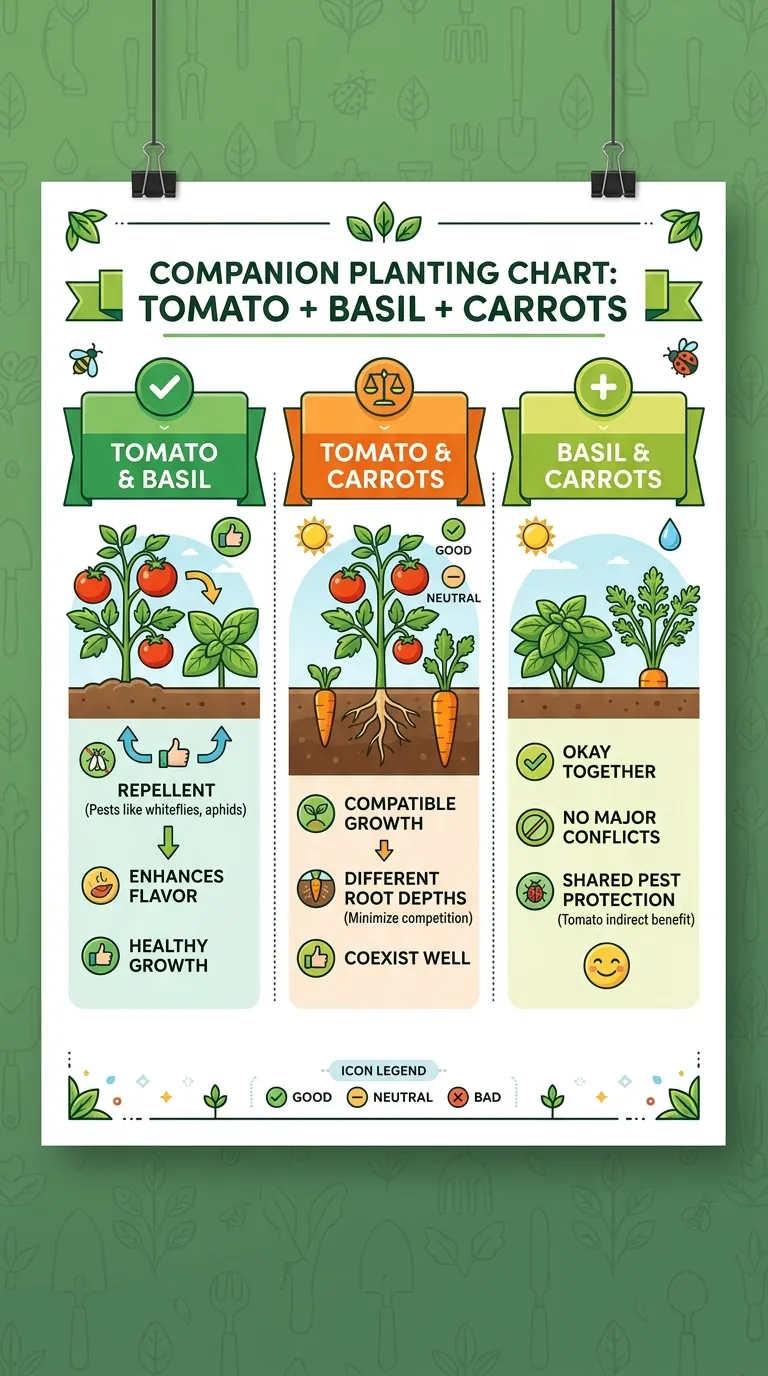
| Basil | Repels whiteflies, hornworm moths, aphids; attracts pollinators | 12 inches, 1 per tomato | The classic for a reason |
| Carrots | Loosen soil below, no light competition | 12 inches between rows | Sow while tomatoes are small, harvest before shade |
| French Marigolds | Thiophenes suppress root-knot nematodes | Edge, 2-3 per 4x8 bed | Not between every tomato — edges are enough |
| Nasturtiums | Trap crop — lures aphids away | Edge, away from tomatoes | Sacrificial beauty; let aphids have them |
| Parsley | Attracts parasitic wasps that eat hornworms | 10-12 inches | Let some flower — that’s when predators come |
| Chives & Garlic | Onion scent confuses aphids and spider mites | 12-15 inches or border | Perennial clump at corner works for years |
| Lettuce & Spinach | Shallow roots, harvest before canopy closes | 12 inches, early interplant | Spring greens in tomato alleys |
| Bush Beans | Fix nitrogen tomatoes consume heavily | 18 inches from stem | Don’t overfertilize where beans are |
| Borage | Bees adore it; accumulates potassium | 18-24 inches, 1-2 per bed | Fuzzy, blue, buzzing — pollinator magnet |
| Oregano & Thyme | Living mulch, deter whiteflies, suppress weeds | Edge or underplanting | Walk on thyme and scent releases |
| Radishes | Ultra-quick harvest before shade | Between young tomatoes | 21 days, out before tomatoes need it |
The 11 Best Tomato Companions — How and Why Each Works
1. Basil — The Soulmate
If you grow nothing else with tomatoes, grow basil. Its strong volatile oils — eugenol, linalool — seem to confuse whiteflies, aphids, and the sphinx moth that lays hornworm eggs. Studies are mixed on strength, but in practice interplanting one basil per tomato at 12 inches visibly reduces pest scouting, and the flowers — if you let one plant bolt — feed bees and parasitic wasps.
How I plant it: One Genovese basil per indeterminate tomato, 12 inches from stem, on the south side so basil gets full sun before the tomato towers. Pinch weekly just above a leaf pair; keep one plant to flower for pollinators. Both love sun and similar water — an inch per week, at the base. See how to grow basil.
2. Carrots — The Underground Neighbor
Carrots and tomatoes are perfect roommates because they don’t compete for the same real estate. Tomatoes grow up, carrots grow down. Carrot roots pry open and loosen soil beneath tomatoes, improving drainage where tomatoes need it most.
How I plant it: In a raised bed, I sow carrots in a band 12 inches from tomato transplant line in early May, while tomatoes are still small and light reaches soil. By late June tomatoes canopy, carrots are sizing and harvested at baby size by July — before shade becomes a problem. Keep soil moist for 14 days after sowing; I cover row with a board for 5 days — see how to grow carrots.
3. French Marigolds — The Nematode Guard
Not all marigolds are equal. French marigolds (Tagetes patula) are the ones that matter for tomatoes. Their roots release thiophenes that suppress root-knot nematodes — microscopic worms that cause knobby galls on tomato roots, stunt growth, and make a plant wilt even when watered. It’s one of the best-documented companion effects.
How I plant it: 2 to 3 French marigolds per 4 by 8 bed, at corners or along edge — not between every tomato. Crowding marigolds between tomatoes shades them and steals air. ‘Petite’ or ‘Single Gold’ French types are compact and floriferous. African marigolds (Tagetes erecta) are beautiful but larger and less effective in small beds.

4. Nasturtiums — The Beautiful Sacrifice
Nasturtiums don’t repel aphids; they invite them. And that’s the point. Aphids prefer nasturtiums to tomatoes, so a perimeter planting lures them away — a trap crop — where you can manage them. Bonus: nasturtiums are edible — peppery leaves and flowers.
How I plant it: At the bed perimeter, away from tomatoes, ideally on south edge where they cascade. Don’t coddle them; nasturtiums bloom best in poor soil. Too much nitrogen gives huge leaves, no flowers, and aphids with a five-star hotel.
5. Parsley — The Wasp Welcome
Parsley does something quietly heroic: when allowed to flower, its flat umbels feed parasitic braconid wasps and hoverflies whose larvae eat aphids and hornworms. I leave one parsley plant to bolt on purpose near tomatoes. Finding a hornworm covered in white wasp cocoons is gruesome and gratifying.
How I plant it: Curly or flat-leaf, 10 to 12 inches from tomatoes. Harvest outer stems, leave center. See how to grow parsley. In fall, I pot one up for windowsill and let garden one flower.
6. Chives & Garlic — The Scent Disguise
Tomatoes have a scent, and pests navigate by it. Onion-family volatiles muddle that navigation. Chives, with purple pom-pom flowers beloved by bees, are perennial — plant a clump at corner of tomato bed and it returns yearly. Bunching onions as a border row do same in one season, garlic planted in fall between future tomatoes harvested in July just as tomatoes need space.
How I plant it: A permanent chive clump at northeast corner or thin row of bunching onions 12 inches from tomatoes. Trim chives after first bloom for second flush. See how to grow garlic.
7. Lettuce & Spinach — The Quick, Shallow Harvest Before Shade
Tomatoes are slow to close canopy. Lettuce and spinach are fast and shallow. That timing gap is opportunity. I sow lettuce and spinach in alleys between young tomato transplants in early May. By late June, when tomatoes tower and shade that soil, greens are already harvested — cut-and-come-again lettuce at 30 days, spinach pulled whole — with no extra bed.
How I plant it: Broadcast in wide band 12 inches from tomato stems, thin lettuce to 6 inches, spinach to 4. In high summer, that same dappled shade beneath trellised tomatoes becomes the best place for a second sowing of lettuce that would bolt in open sun.
8. Bush Beans — The Nitrogen Fixers
Tomatoes are nitrogen-hungry; bush beans make nitrogen. Rhizobia bacteria on bean roots fix atmospheric nitrogen into plant-available form. Even if total transfer in one season is modest, the rotation benefit is real — beans followed by tomatoes is classic because soil after beans is richer without synthetic fertilizer.
How I plant it: 18 inches from tomato stems, after soil hits 65°F. Sow 4 inches apart, don’t fertilize heavily with nitrogen where beans are. I sow ‘Provider’ bush beans between determinate tomatoes and harvest handfuls every two days at peak.
9. Borage — The Pollinator Dynamo
Borage is not the prettiest herb in a traditional sense — fuzzy, sprawling, a little unruly — but step near it on a July morning and you will hear why it matters. The whole plant hums. Bees are obsessed with its star-blue flowers, and more bee visits mean better pollination and better fruit set, especially for early tomato flowers that can struggle in cool springs.
How I plant it: One or two plants per tomato bed is plenty — borage self-sows and one plant can sprawl 2 feet. Give it 18 to 24 inches from tomatoes at the corner where it can tumble over edge.

10. Oregano & Thyme — The Living Carpet
Low, creeping herbs that double as living mulch. Oregano and creeping thyme form dense mats that shade soil, keep moisture in, suppress weeds, and release strong oils when brushed that may confuse whiteflies and aphids drifting toward tomatoes. They’re perennial, drought-tolerant once established, and their tiny flowers feed beneficial insects.
How I plant it: Around sunny edge of tomato bed or between tomatoes where thyme can creep over paths. They want lean, well-drained soil. See oregano and thyme.
11. Radishes — The 21-Day Gap Filler
Radishes are the fastest companion. Sown between young tomatoes in early May, they germinate in 3 days, size in 21, and are harvested before tomatoes cast any shade. They loosen the top inch, mark rows, and give you an early harvest while you wait for tomato ambition to accelerate. Sow 2 inches apart, thin if needed, harvest promptly — overgrown radishes split and turn pithy.
What NOT to Plant with Tomatoes — And Why Distance Matters
Antagonism is chemistry and ecology.
Potatoes — share late blight. Phytophthora infestans moves heartbreakingly fast between potatoes and tomatoes. In a wet, cool week, one infected potato plant can shower spores onto adjacent tomatoes. Keep at least 10 feet or separate beds. Never compost diseased foliage.
Fennel — allelopathic inhibitor. Fennel exudes compounds that can stunt tomato growth. Give fennel its own corner or a pot, away from everything. I grow it at far end of herb garden.
Brassicas (Cabbage, Broccoli, Cauliflower at mature size) — heavy, competitive feeders. Mature Brassicas and tomatoes both want rich soil and lots of nitrogen; planted adjacent they compete rather than support, and Brassicas can shade low tomatoes. Keep them in separate rotation blocks.
Corn — shares the same fruitworm. Corn earworm and tomato fruitworm are same species (Helicoverpa zea). Planting corn directly beside tomatoes is invitation for moths to have two courses in one stop. Separate them, ideally with sunflowers or buckwheat between.
Keep the buffer at least 3 feet, ideally a path.
Layout Idea — My 4 by 8 Tomato-Centric Bed That Actually Works
North to south:
North edge (trellis): Two indeterminate tomatoes, 30 inches apart, trellised on 6-foot cattle panel.
Middle band, 12 inches south: One basil per tomato, interplanted, plus short band of carrots sown at transplant between basils. Carrots pulled before shade.
Center: Chive clump at northeast corner (permanent), French marigold at each north corner, borage at southwest where it can sprawl.
Edge/south border: Nasturtiums cascading over south edge, thyme creeping along path edge, and succession lettuce/spinach broadcast in any bare soil early.
Adjacent but separate: Garlic in row that will be tomatoes next year; bush beans in row tomatoes vacated last year.
This uses one 4 by 8 bed intensively without crowding — see layout ideas and companion planting — and it rotates cleanly.
Companion Myths vs. What I’ve Actually Seen
It helps to be honest about what companion planting can and cannot do.
Flavor improvement from basil: Cherished and persistent, with some small studies and many anecdotes. Mechanism not firmly established. What is firm is basil isn’t harming tomatoes, is repelling some pests, and is delicious beside them. I plant them together for those certainties and enjoy possible bonus as gift.
Marigolds repel all pests: No. Marigolds suppress specific nematodes and attract pollinators; they don’t magically repel hornworms from across the garden. Their power is local — roots where they grow.
Companion planting replaces crop rotation: It doesn’t. Rotation — moving tomato family crops yearly — is still the most powerful disease prevention. Companions help within a season; rotation helps across years. Do both.
How I Plant My Tomato Bed in a Real Spring
In late April, I cover tomato row-to-be with black plastic for a week to warm soil to 60°F. Chive clump is already up, borage self-seedlings showing, garlic from October a foot tall.
Early May, I sow carrots and broadcast lettuce in alleys of future tomato row. They germinate while I’m hardening off seedlings. Mid-May, after last frost, I transplant tomatoes deep with handful of compost and basil 12 inches south of each stem. Marigolds at corners, borage at southwest edge, thyme plugs along path.
I mulch 2 to 3 inches with straw a week later, once soil has warmed, keeping straw inches from stems. Water by soaker hose, morning only, never overhead — that one habit has prevented more disease than any companion ever could.
By June, I’m harvesting lettuce between tomatoes. By July, pulling carrots and pinching basil. Tomatoes are clean, pollinators constant, and I haven’t sprayed a thing.
Common Mistakes — Companion Planting Gone Awry
-
Crowding marigolds between every tomato. You steal light and air. Edge placement is enough.
-
Planting fennel in the vegetable bed “to save space.” Its allelopathy stunts neighbors. Isolate it.
-
Sowing carrots too late after tomatoes canopy. They need light for first 3 weeks. Sow at transplant time, not a month later.
-
Letting lettuce bolt and shade tomatoes. Harvest greens on time; don’t let them become competitors.
-
Thinking companions replace staking, mulching, and base watering. They support those habits; they don’t replace them.
Seasonal Calendar — Companion Timing
-
Fall: Plant garlic where tomatoes will be next year. Sow nothing else; let garlic over-winter.
-
Early Spring: Direct sow peas where tomatoes will go in May — cut at soil line, leave nitrogen nodules, transplant tomatoes into richer soil.
-
Mid-Spring: Sow carrots, lettuce, radishes in tomato alleys. Transplant tomatoes deep with basil companions.
-
Early Summer: Let one parsley and one basil flower for beneficials. Keep nasturtiums at edge, not inside.
-
High Summer: Harvest basil weekly, carrots by July, lettuce before shade. Let borage self-sow — pull extra seedlings where too many.
-
Late Summer: Sow second spinach/lettuce in dappled shade under waning tomatoes for fall.
Troubleshooting — When Companions Disappoint
-
Basil leggy and pale between tomatoes? Tomatoes shaded it too early. Plant basil south side, not north, and give 12 inches.
-
Marigolds huge and floppy, tomatoes leggy? You used African types and crowded. Switch to compact French.
-
Carrots didn’t germinate between tomatoes? Soil dried during 14-day germination. Cover row with board for 5 days to hold moisture.
-
Beans yellow next to tomatoes? Overwatered tomato bed may be soggy for beans. Mound beans slightly or water less frequently.

A Deeper Seasonal Lens — What Changes When You Watch Closely
I keep a waterproof notebook in my apron pocket. One line a week, no more. Date, weather, what I did, what leaves looked like.
That tiny log taught me more than any book. Because the garden repeats itself, softly. The same bed that yellowed after a four-day rain last July yellows the same week this July — unless I mulch higher and prune lower before the rain.
Try it this season. Just one line every Sunday. You will have a personal almanac by September.
Notes From My Notebook — Three Years That Shaped This Guide
Year one: I overwatered with love. Flag in bed: “DO NOT WATER UNTIL FINGER 2 INCHES.” Yield doubled.
Year two: pH 7.4 after liming for beans. No fertilizer greened top leaves until sulfur in fall.
Year three: Cold nights at 45°F. Peppers stalled until July. Tomatoes beside them merely slowed. Waiting an extra week after tomatoes for peppers became permanent rule.
Those three lines are why this guide insists on finger tests, pH kits, and patience.
Troubleshooting Appendix — More Real Dialogues
“My soil looks great but fruits still have green shoulders.” Often potassium-light or too much shade on tops. Ensure second-half feed has good K (last number) and thin lightly for light.
“I mulched and still got blight.” Mulch helps but doesn’t erase wind-borne spores. Prune lower leaves for airflow, water at base, rotate next year 2 to 3 years without nightshades in that bed.
“Can I use garden lime to stop blossom end rot?” Only if soil test shows low pH. Otherwise even water is the fix. Lime without need raises pH and locks iron.
“Do I need to buy bees?” Lovely for ecology, not required for tomatoes or peppers which self-pollinate. Wind and your midday shake are the engine. Wild bees are a bonus that companion herbs invite.
“What if I only have a balcony?” Containers are honest. They dry fast and leach fast. Choose 7 to 10 gallon fabric bags, quality potting mix, morning sun, and check lift test daily. You can grow a surprising harvest in two bags and a bucket of basil.
The Quiet Math of Even Moisture — Why Mulch Beats More Water
Bare soil at 90°F loses nearly half an inch of water a day to evaporation. Straw mulch cuts that by roughly half. So 3 inches of straw is effectively like getting an extra watering without turning on the hose.
It also keeps soil splash from reaching lower leaves. That splash carries blight, septoria, and bacterial spot spores that overwinter in soil. Mulch is a clean sheet between soil and leaf. I lay it after soil passes 60°F, keeping a 2-inch collar open at stems so crowns breathe.
Have you measured how fast your bare bed dries vs. mulched? Try two fingers, two spots, same day. You’ll see why mulch is the first line, not the last.
Container, Raised Bed, and In-Ground — How the Same Plant Tells Different Stories
Containers tell you quickly. They yellow fast when wet or dry, and they forgive fast when corrected. Check lift plus finger daily in July. Half-strength liquid feed weekly during heavy fruiting plus monthly granular side-dress keeps them green without burn.
Raised beds tell you in mid-summer. They leach nitrogen after heavy rain, so lower leaves fade uniformly. A light side-dress perks them back in days.
In-ground clay tells you slowly. It holds water longest, so overwatering yellowing lingers. If trowel shines with smeared clay two days after rain, wait despite calendar. Annual fall compost turns clay to crumbs over seasons.
Name your setup. The yellowing pattern narrows to two likely causes instead of eight.
Final Encouragement — The Gardener Learns Slower Than the Plant
The plant responds in days. The gardener learns in seasons. Be patient with yourself.
If you fix water this year and pH next year and pruning the year after, you will still harvest beautifully each year — just more beautifully as you go. I wish someone had told me that good gardening is cumulative, not perfect on the first try.
Pick one habit from this guide to practice this week. Just one. Water at base before 10 a.m., or shake flowers at midday, or lay that straw mulch. Do it for seven days. Look at new growth. That is your feedback loop, truer than any forum.
Frequently Asked Questions
Q: What are the best companion plants for tomatoes?
A: The best are basil for pest confusion and pollinators, carrots for soil loosening without competition, French marigolds for nematode suppression, plus nasturtiums as trap crops, parsley for parasitic wasps, chives for scent disguise, lettuce and spinach for quick harvest before shade, bush beans for nitrogen, borage as pollinator magnet, and oregano and thyme as living mulch. Together they repel some pests, attract beneficial insects, fix nitrogen tomatoes devour, and use space so every inch does two jobs. Choose 3 to 4 that fit your space rather than all 11 at once — basil, carrots, marigolds, and lettuce are the simplest starter quartet with proven payoff.
Q: What should not be planted next to tomatoes?
A: Avoid potatoes that share late blight — Phytophthora moves fast between them in wet weeks — plus fennel that inhibits growth allelopathically, mature brassicas like cabbage and broccoli that compete heavily for the same rich soil, and corn that shares the earworm/fruitworm. Keep at least 3 feet or a separate bed with a path between antagonists, and never compost diseased foliage from either. Good paths make healthy tomatoes; even a mulched walk plus an intervening row of flowers dramatically reduces disease splash and pest drift compared to shoulder-to-shoulder planting.
Q: Do marigolds really help tomatoes grow better?
A: Yes, but the right marigold in the right place. French marigolds — Tagetes patula, the small compact single-flowered ones — release thiophenes from roots that suppress root-knot nematodes, those soil pests that knot tomato roots into galls and stunt plants even when watered. It’s one of the better-documented companion effects and can linger after the marigold is gone. They also flower relentlessly and feed pollinators for months. You need French types, not tall African Tagetes erecta, and you don’t need them between every tomato — 2 to 3 plants at edges of a 4 by 8 bed is enough.
Q: Can you plant cucumbers and tomatoes together?
A: You can, and I do most years, but trellising and spacing are non-negotiable. Both love sun and steady even water, and both are vulnerable to foliar fungi when leaves stay wet, so give each a trellis, keep them 24 inches apart, and water strictly at the base — soaker hose or wand in the morning, never overhead sprinklers. Prune lower tomato leaves 12 inches up for airflow, keep cucumber vines tidy on their panel, and harvest both often so no overripe rotting fruit breeds disease. If your summers are extremely humid or you’ve battled blight, separate beds are simplest.
Related Articles
- How to Grow Tomatoes
- How Often to Water Tomato Plants
- Best Soil for Tomatoes
- Vegetable Garden Layout
- How to Prepare Soil for Planting
- Companion Planting
Sources & References
- Iowa State University Extension — https://hortnews.extension.iastate.edu/companion-planting-tomatoes
- University of Minnesota Extension — https://extension.umn.edu/yard-and-garden/vegetables/companion-planting
- Cornell Vegetables — https://www.vegetables.cornell.edu/crops/tomatoes/
- NC State Extension — https://content.ces.ncsu.edu/companion-plants
- Old Farmer’s Almanac — https://www.almanac.com/companion-planting-guide