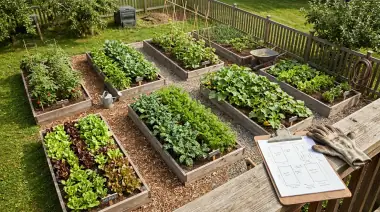
Where you put each plant decides how much sun it gets, how easily you can reach it, and whether pests and diseases gain a foothold from one year to the next. A little planning in spring saves you from a tangled, overcrowded patch in July. This guide covers vegetable garden layout planning from sun mapping to crop rotation, and it works for in-ground rows, containers, or raised beds.
Quick Answer: To plan a vegetable garden layout, choose a spot with 6-8 hours of direct sun, run rows north-south, and put tall crops like corn and trellised tomatoes on the north side. Space plants by their mature size, keep paths 24-30 inches wide, and rotate plant families so no family grows in the same spot more than once every 3-4 years.
At a Glance
| Fact | Detail |
|---|---|
| Sun | 6-8 hours of direct sun daily for most vegetables |
| Row orientation | North-south, with tall crops on the north end |
| Path width | 24-30 inches for comfortable walking and kneeling |
| Spacing rule | Base it on mature plant size, never seedling size |
| Square foot grid | A 4x4 or 4x8 bed divided into 1-foot squares |
| Crop rotation | Wait 3-4 years before a plant family returns to a spot |
| Succession planting | Replant quick crops every 2-3 weeks for steady harvests |
| Starter size | One 4x8 bed fits a beginner’s first garden |
Why Layout Planning Matters
A good layout is free productivity. Plants spaced correctly share sunlight, water, and nutrients fairly, avoid crowding out their neighbors, and leave you room to weed and harvest without compacting the soil [1] (Source: Penn State Extension). A bad layout creates the three classic disasters: shaded lettuce, tangled squash vines, and tomatoes you cannot reach to pick.
Step 1: Map Your Sun Exposure
Most vegetables need 6-8 hours of direct sun a day to grow and fruit well [2] (Source: North Carolina State Extension). Do not guess - spend one sunny day watching your yard and note where shadows fall at 9 a.m., noon, and 3 p.m. Fruiting crops like tomatoes and peppers need the full 6-8 hours; leafy greens tolerate about 4-6 hours and can fill shadier corners.
Step 2: Run Rows North-South, Tall Crops on the North Side
Rows running north-south capture sunlight evenly on both sides all day long, instead of one row constantly shading the next. Whatever the direction of your rows, position tall plants so they cannot shade shorter ones. Put corn, pole beans, sunflowers, and trellised or caged tomatoes on the north side of the garden, and keep low crops like lettuce, carrots, and bush beans to the south. For raised beds, our raised bed gardening guide has bed-size and placement tips that follow the same rule.
Step 3: Space Plants by Mature Size
Read the spacing on the seed packet or plant tag and follow the number for the fully grown plant, not the seedling in front of you. The crowd at transplant time looks empty for a few weeks - that is normal, and it prevents disease, competition, and shading later.
| Crop | Spacing between plants |
|---|---|
| Tomatoes (staked) | 18-24 inches |
| Peppers | 12-18 inches |
| Corn | 12 inches, in blocks for pollination |
| Bush beans | 4-6 inches |
| Carrots | 2-3 inches |
| Lettuce | 6-8 inches |
| Zucchini | 24-36 inches |
| Cabbage | 18-24 inches |
Square Foot Gardening
Square foot gardening is a simple way to keep spacing honest: divide a 4x4 or 4x8 raised bed into 1-foot squares and plant per square. As a rough guide, one tomato, pepper, or cabbage per square; 4 lettuce or 9 beets per square; and 16 carrots or radishes per square. Zucchini and other sprawling squash take 2-4 squares. The grid does the spacing math for you, and it fits a beginner garden perfectly.
Companion Planting Integration
Companion planting - pairing crops that help each other - fits right into a good layout. Basil alongside tomatoes, carrots with onions, and marigolds scattered through the bed are classic pairings. Treat companions as a bonus on top of proper spacing, not a substitute for it: a companion pair still needs its 6-8 hours of sun and room to grow. See our companion planting guide for pairings that actually work.
Crop Rotation Basics
Growing the same family in the same spot year after year lets soil-borne pests and diseases build up and lets one group of nutrients run low. Rotating crops keeps the soil healthier with zero extra cost. The basic rule: do not grow the same plant family in the same spot more than once every 3-4 years [3] (Source: Cornell University).
The main families to track:
- Nightshades: tomatoes, peppers, eggplant, potatoes
- Brassicas: cabbage, broccoli, kale, cauliflower, radishes, turnips
- Alliums: onions, garlic, leeks, shallots
- Legumes: beans, peas (which add nitrogen for the next crop)
- Cucurbits: squash, cucumbers, melons
- Root crops: carrots, beets, parsnips
Keep a simple map from year to year - even a rough sketch or a note in your phone is enough. Rotation also reduces pest pressure, so pair it with our vegetable garden pest guide, and it lowers disease carryover, covered in our vegetable garden diseases guide.
Paths and Access
Plan paths before you plant. Walkways 24-30 inches wide give you room to kneel, weed, and carry a harvest basket without crushing plants [4] (Source: University of Minnesota Extension). Never step into the growing bed itself: foot traffic compacts soil, which suffocates roots. Raised beds do the path work for you, which is one reason they are so beginner-friendly.
Succession Planting
A well-planned layout produces all season, not just in June. Succession planting means replacing a finished crop with a new one, and reseeding quick crops like lettuce, radishes, and bush beans every 2-3 weeks. Plan in time as well as space: put an early lettuce crop where a warm-season tomato or squash will go in late spring, then refill that square with fall greens after the summer crop finishes. Our when to plant vegetables guide gives the timing windows for each crop in your zone.
Sample Layout: A 4x8 Raised Bed
A simple sketch keeps the plan honest. Here is one classic arrangement - tall crops in the north half, low crops in the south, with a legume to feed the soil:
                    N (north)
+------------------------------------------+
| TOMATO  | PEPPER  | BASIL  | BASIL       |
| TOMATO  | PEPPER  | BASIL  | MARIGOLD    |
+---------+---------+--------+-------------+
| BEANS   | BEANS   | CARROT | CARROT      |
| BEANS   | BEANS   | CARROT | CARROT      |
+------------------------------------------+
S (south)- Tomatoes go north so the staked plants shade nothing; basil and marigolds are companions and pest deterrents.
- Beans fix nitrogen for the bed; carrots fill the low, sunny southern edge.
- Next year, shift every family one slot (tomatoes to the beans’ spot, beans to the carrots’ spot, and so on) to satisfy rotation.
Common Mistakes
- Spacing by seedling size. The fix: follow the mature spacing on the packet, even when the bed looks empty for a few weeks.
- Planting tall crops on the south side. The fix: keep corn, pole beans, and trellised tomatoes on the north side so they cannot shade the rest of the bed.
- Growing the same family in the same spot every year. The fix: rotate families on a 3-4 year cycle and keep a simple map.
- Skipping paths or making them too narrow. The fix: give yourself 24-30 inches and never walk on the growing bed.
- Planting everything at once. The fix: stagger quick crops every 2-3 weeks and replace finished crops right away.
- Forgetting the trellis footprint. The fix: measure the cage or trellis you will actually use, not just the plant, when you set spacing.
Troubleshooting and Seasonal Considerations
- Late in spring with empty space? Fill it with a quick crop like radishes or lettuce before the warm-season plant goes in.
- Shady spot found in week two? Move sun-hungry crops, and plant greens in the shade; they tolerate 4-6 hours.
- Mid-summer gaps after harvest? Immediately replant beans, lettuce, or carrots for a fall crop.
- In autumn, plan next year’s map while the beds are still visible. Sketch which family was where so rotation stays on track.
Frequently Asked Questions
Q: How much sun do I really need for a vegetable garden?
A: Most fruiting vegetables need 6-8 hours of direct sun daily. Leafy greens can manage with about 4-6 hours.
Q: Do rows have to run north-south?
A: North-south rows give the most even sun to both sides of each row, but the bigger rule is putting tall crops on the north side so nothing gets shaded.
Q: How far apart should I space my vegetables?
A: Follow the mature spacing on the seed packet. Tomatoes get 18-24 inches, peppers 12-18, lettuce 6-8, carrots 2-3, and zucchini 24-36.
Q: What is square foot gardening?
A: Dividing a bed into 1-foot squares and planting a set number of each crop per square - for example, one tomato per square or 16 carrots.
Q: How long before I can plant the same family in the same spot?
A: Wait 3-4 years. A simple map of what grew where keeps the rotation easy.
Q: Do I need paths in a small garden?
A: Yes. Even a small bed needs a 24-30 inch aisle so you can reach every plant without compacting the soil.
Q: What can I grow in a shady corner?
A: Leafy greens such as lettuce, spinach, and Swiss chard tolerate partial shade, while most fruiting crops need full sun.
Q: Can I rotate crops in a single small raised bed?
A: Yes - divide the bed into sections and shift each family one section every year. It is not perfect rotation, but it beats growing the same thing in the same square forever.
Related Articles
- Vegetable Gardening Guide
- How to Start a Vegetable Garden for Beginners
- Raised Bed Gardening
- Companion Planting
- When to Plant Vegetables
- Vegetable Garden Pests
- Vegetable Garden Diseases
- How to Prepare Soil for Planting