There is a moment in every pepper season that tells you whether you got the watering right. The plants are knee-high, deep green, a little glossy in late June, and the first white flowers are opening like shy stars. If those flowers hold, swell, and become glossy green bells or long jalapeños, you smile without thinking. If they yellow and drop, leaving a bare stem that once promised fruit, you feel that particular gardener’s ache — not failure, exactly, but a question mark hanging over your hose.
I have had both summers. My first pepper bed was a lesson in kindness that wasn’t kind at all. I loved them daily, literally — a little sprinkle every evening after work, wetting leaves the way you’d pat a child’s head. Leaves looked lush. Roots stayed shallow. Then July hit 94 degrees for a week, the shallow roots cooked, flowers dropped by the dozen, and I harvested three peppers where I had hoped for thirty. The fix was humblingly simple: water less often, more deeply, earlier in the day, and mulch like you mean it.
Peppers are not tomatoes. They don’t want constant wet feet. They are desert-edge plants at heart, happiest with a drink that goes deep, a chance to breathe, and then another deep drink. Learn that rhythm once and these plants reward you with steady growth, thick walls, and that fresh, almost fruity smell when you slice one warm from the sun.
Quick Answer: Water pepper plants deeply 1 to 2 times per week, giving 1 to 1.5 inches total per week. Water at the base before 10 a.m. so foliage stays dry. Check soil 2 inches deep — if dry, water 1 to 2 gallons per plant for in-ground beds, more for raised beds. Seedlings need consistent moisture daily for the first 2 weeks; flowering and fruiting plants need the most even moisture; in heat above 90°F or in sandy soil, water every 2 to 3 days; in clay or cool weather, once per week may be enough. Mulch 3 inches with straw after soil warms. Even, deep, morning water prevents blossom drop and blossom end rot.
At a Glance
| Situation | How Often | How Much | How to Check |
|---|---|---|---|
| Seedlings (first 2 weeks) | Daily to every 2 days | Keep surface moist, 0.5 inch | Top 1 inch should not dry out |
| Established vegetative | Every 3 to 5 days | 1 inch per week | 2 inches deep feels cool-moist |
| Flowering & fruiting | Every 2 to 3 days | 1 to 1.5 inches per week | Soil 2 inches dry = water now |
| Heat wave >90°F | Every 2 days | 1.5 inches per week, split | Finger test daily, mulch thick |
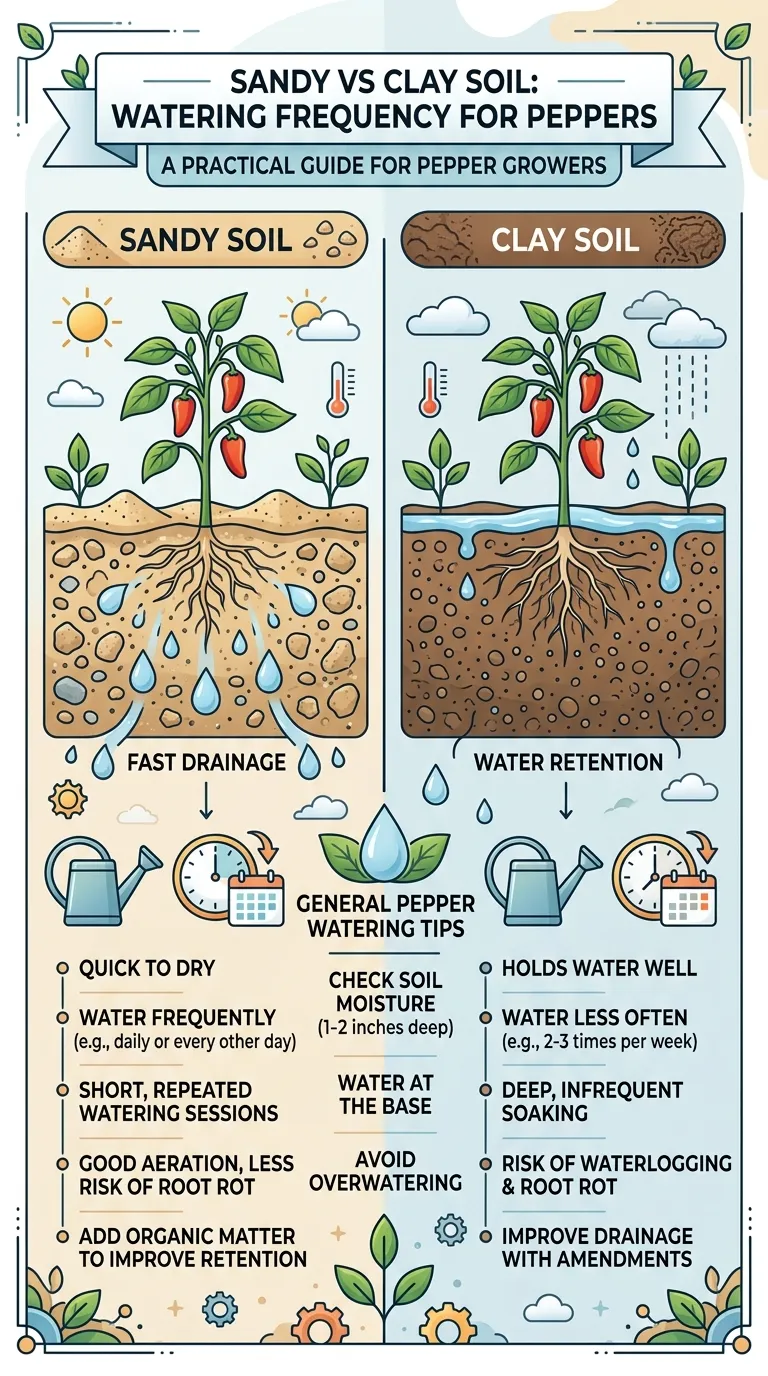
| Sandy soil | Every 2 to 3 days | More frequent, same total | Drains fast — check often |
| Clay soil | Every 5 to 7 days | Deep soak, let breathe | Don’t water if still moist 2“ down |
| Containers / grow bags | Daily in heat | Until water drains from bottom | Lift pot — light = thirsty |
Tape that to your shed door. Then come back for the why — the pepper’s point of view — because once you understand what the roots are doing underground, the schedule stops feeling like rules and starts feeling like listening.
Why Peppers Care So Much About How You Water
Think of a pepper root system as a shallow, wide bowl, not a deep carrot. Most feeder roots live in the top 6 to 12 inches, spreading outward more than down. They are built to drink a monsoon, then breathe for a few days, then drink again. That is exactly how peppers evolved on the edges of tropical forests — not swamp plants, not desert cacti, but something in between that hates both soggy ankles and bone-dry dust.
When you sprinkle a little every day, you train roots to stay at the surface where water is. Surface roots are the first to overheat and dry out when a hot spell hits, so the plant panics and drops flowers to survive. When you flood and then ignore for a week, the swing from soggy to cracked creates calcium uptake issues — blossom end rot, even when calcium is in the soil — because calcium moves with steady water flow.
Even is the word I come back to every season. Even moisture means the soil at 2 inches deep feels like a wrung-out sponge all week, not wet Monday and dusty Thursday. That steadiness is what lets flowers hold, pollen stay viable, and fruit walls thicken without corky cracks. Peppers will forgive you a day late; they won’t forgive a week of swing.
For the sunny, fertile baseline peppers want, see how to grow peppers and the broader rhythm in how often to water vegetables.
Watering by Growth Stage — From Seedling Sip to Fruiting Drink
Seedlings & Transplants (Weeks 1–2 After Planting)
Small plants, small roots, big need for consistency. For the first 10 to 14 days after transplanting, keep the top inch consistently moist — not puddled. That usually means a gentle drink every day or every other day, at the base, morning. If you transplanted on a hot afternoon, water in deeply (a full gallon per plant) and shade with a lightweight row cover for 2 days if sun is brutal. Roots are still knitting into surrounding soil; drying out now checks growth for weeks.
I tuck a 3-inch ring of soil around each transplant like a tiny moat so water sits where roots are, not running off. Mulch comes later, after soil warms past 65°F — mulching cold soil too early keeps peppers pouting.
Vegetative Growth (Weeks 3–6 — Tall, Leafy, No Fruit Yet)
Now the plant is building its solar factory — those deep green leaves that will feed peppers later. Shift to deeper, less frequent drinks: roughly 1 inch per week, split into 1 or 2 waterings. Stick your finger 2 inches deep at the root zone (not the path). Cool-moist? Wait a day. Dry? Water slowly for 15 to 20 minutes with a soaker or watering can at the base so water sinks 6 to 8 inches. Avoid wetting leaves; wet leaves overnight invite bacterial spot.
This is when overwatering shows as pale, yellowing lower leaves and a plant that looks lush but wilts oddly in afternoon heat — roots are suffocating. If you see that, let soil dry a bit more between drinks and ensure drainage. Peppers in raised beds dry faster and love that air; peppers in clay flat beds need hills or mounded rows so water doesn’t sit.
Flowering & Fruit Set — The Critical Window
This is the stage where watering makes or breaks your harvest. Flowers are delicate. Heat above 85°F already makes pollen less viable; add water stress and blossoms yellow and drop with a clean scar where they were. You will see it: a ring of dropped flowers under the plant like confetti, no fruit swelling.
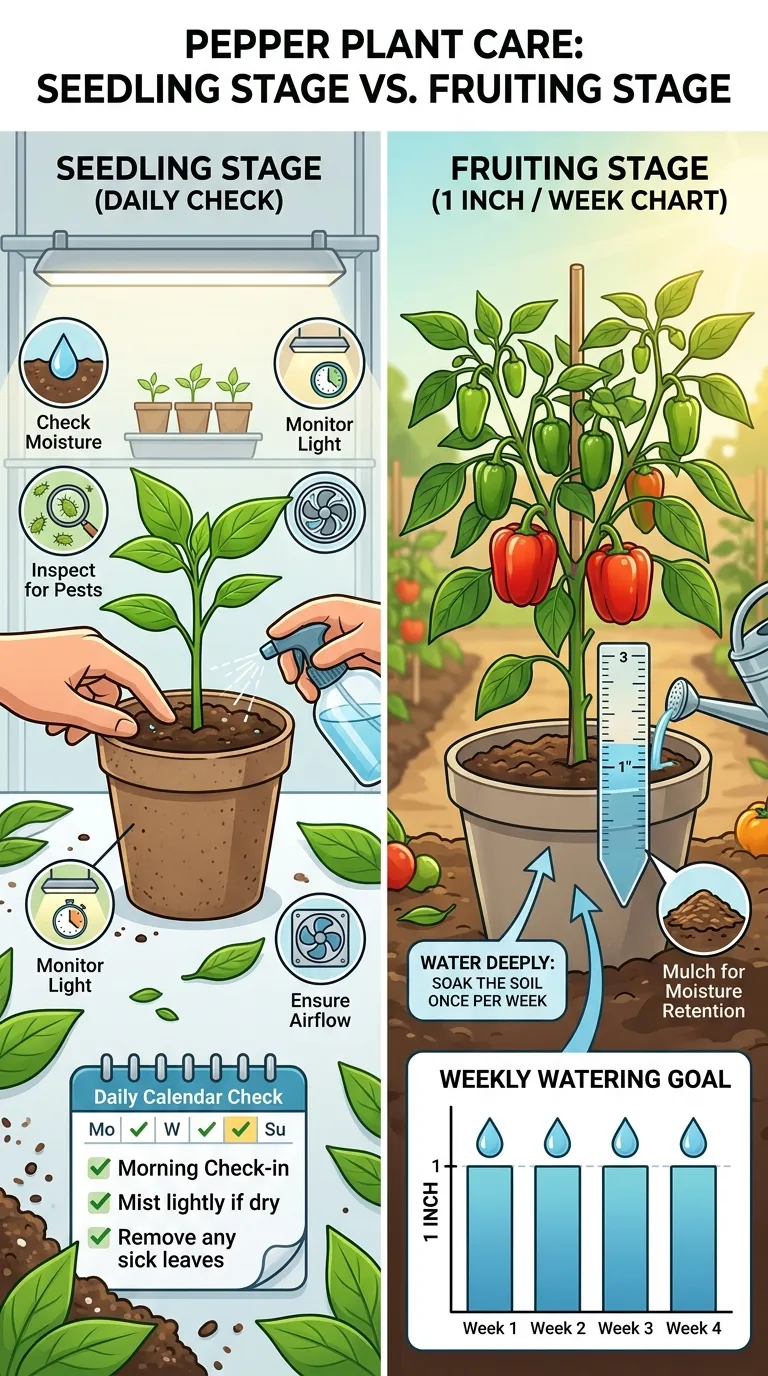
Goal: 1 to 1.5 inches per week, evenly. In practice, that is watering every 2 to 3 days in summer heat, deeply at the base before 10 a.m., with 3 inches of straw mulch holding moisture. I measure with a cheap rain gauge tucked between plants — guessing 1 inch is famously inaccurate the first time you actually catch it. One inch is a lot more water than a quick pass with the hose.
If heat spikes above 92°F for several days, keep water even but don’t overcompensate with daily floods. Add shade cloth 30% for afternoon hours if you can, and water morning only. Evening watering leaves foliage wet all night and invites disease without helping fruit set.
Fruit Sizing & Ripening
Once peppers have set and are swelling — that exciting moment when a bell is lime-green and firm, or a jalapeño is dark and glossy — keep the same even 1 to 1.5 inches per week. Irregular water now causes thin walls, corky cracks, and blossom end rot (that leathery black patch on the bottom). The plant is moving calcium and sugars steadily to fruits; a dry spell breaks that flow.
As fruits color to red, orange, or yellow, you can ease back slightly — soil can be a touch drier between drinks — but don’t let plants wilt. Ripe peppers left on the plant during a drought can develop sunscald on the shoulder facing the sun; consistent water keeps leaves turgid and shading fruits.
How Much Water Per Plant — The Gallon Math
Numbers help on a hot day when you wonder, “Did I give enough?” For in-ground peppers spaced 18 to 24 inches apart in loamy soil: one deep watering is roughly 1 to 2 gallons per plant if using a watering can, or 20 to 30 minutes of soaker hose where water visibly sinks 6 inches when you check with a trowel.
Raised beds need more: they drain faster and are warmer, so 2 to 3 gallons per plant per watering, 2 times per week in peak summer. Containers are a different animal — a 5-gallon pot in 90°F heat may need water daily until it drains freely from the bottom; a 10-gallon fabric grow bag every 1 to 2 days. Lift the pot after watering to learn its heavy weight; lift again before next watering — light means thirsty.
Sandy soil? Water more often with the same total — split 1.5 inches into 3 drinks rather than 1 deep flood that just drains past roots. Clay soil? Water less often but slower — a gentle trickle for 30 minutes lets water seep rather than run off. Your finger at 2 inches is more honest than any calendar. Cool-moist = wait. Dry and crumbly = water now. Wet and slick = don’t.
See soils in best soil for peppers adaptation and broader watering logic in how often to water tomato plants.
Soil, Mulch & Timing — The Three Quiet Multipliers
Soil Matters More Than Schedule
Loose, compost-rich soil with organic matter holds that even moisture like a sponge. Before planting, I work 2 to 3 inches of finished compost into the top 8 inches. That structure buys you an extra day between waterings without stress. Soil pH 6.0 to 6.8 keeps nutrients available so you don’t misread a yellowing leaf as water need.
Mulch Is Your Extra Hands
After soil has warmed for a week past transplanting (peppers hate cold mulch over cold soil), spread 2 to 3 inches of straw, shredded leaves, or pine straw, keeping it an inch off the stem. Mulch cuts evaporation by nearly half, keeps roots cool, suppresses weeds that steal water, and prevents soil splash that spreads disease. In my garden, mulched peppers need watering every 4 days where bare soil needed every 2. That is hours of time given back.
Morning Is Non-Negotiable
Water before 10 a.m., at the base, never overhead in evening. Leaves that stay wet overnight are an invitation to bacterial leaf spot and phytophthora. Morning water lets foliage dry by noon and lets roots drink during the day’s heat. If you can only water in evening, use a soaker hose exactly at the base and keep foliage completely dry, but shift to morning when you can — the difference in flower retention is visible within 10 days.
The Finger Test, the Rain Gauge, and Other Honest Tools
Peppers don’t read calendars. They read soil moisture and root temperature, so the tools that actually translate what roots feel are humbler than you’d think.
The finger test is still king. Push your index finger straight down, 2 inches, right in the root zone — about 4 inches from the stem, where feeder roots actually live, not at the edge of the bed. Feel for three states: cool-moist like a wrung sponge (perfect, wait), dry and crumbly falling off your finger (water now deep), wet and slick with soil sticking in a paste (don’t water, check drainage). I do this every other morning in June, daily in July heat, and I still learn something each time. Sandy soil can feel dry at 2 inches while deeper is still moist; clay can feel moist at the surface while deeper is soggy. So every few weeks, push a trowel 6 inches and look — you want moist at depth, not swamp.
A rain gauge is a honesty device. The first summer I used one — a $4 plastic tube on a stake — I discovered my “good rain” was 0.2 inches and my “deep watering” was barely 0.4 inches. Peppers want 1 to 1.5 inches per week total from rain plus irrigation. If a storm gave you 0.6 inches on Tuesday, you only need about 0.6 more that week, not a full new inch on Wednesday. I write each rain in pencil on a tag by the bed: “7/2 0.5" rain, 7/5 watered 0.8"”. It takes 10 seconds and prevents both guilt-watering and drought-forgetting.
Moisture meters help, but fingers are free. Those probe meters that read 1 to 10 are fine for containers, but in beds they read whatever pocket they touch. Use them as a second opinion in pots where lifting is hard, but calibrate with your finger — if the meter says “wet 7” and your finger at 2 inches feels dry, trust your finger at root depth.
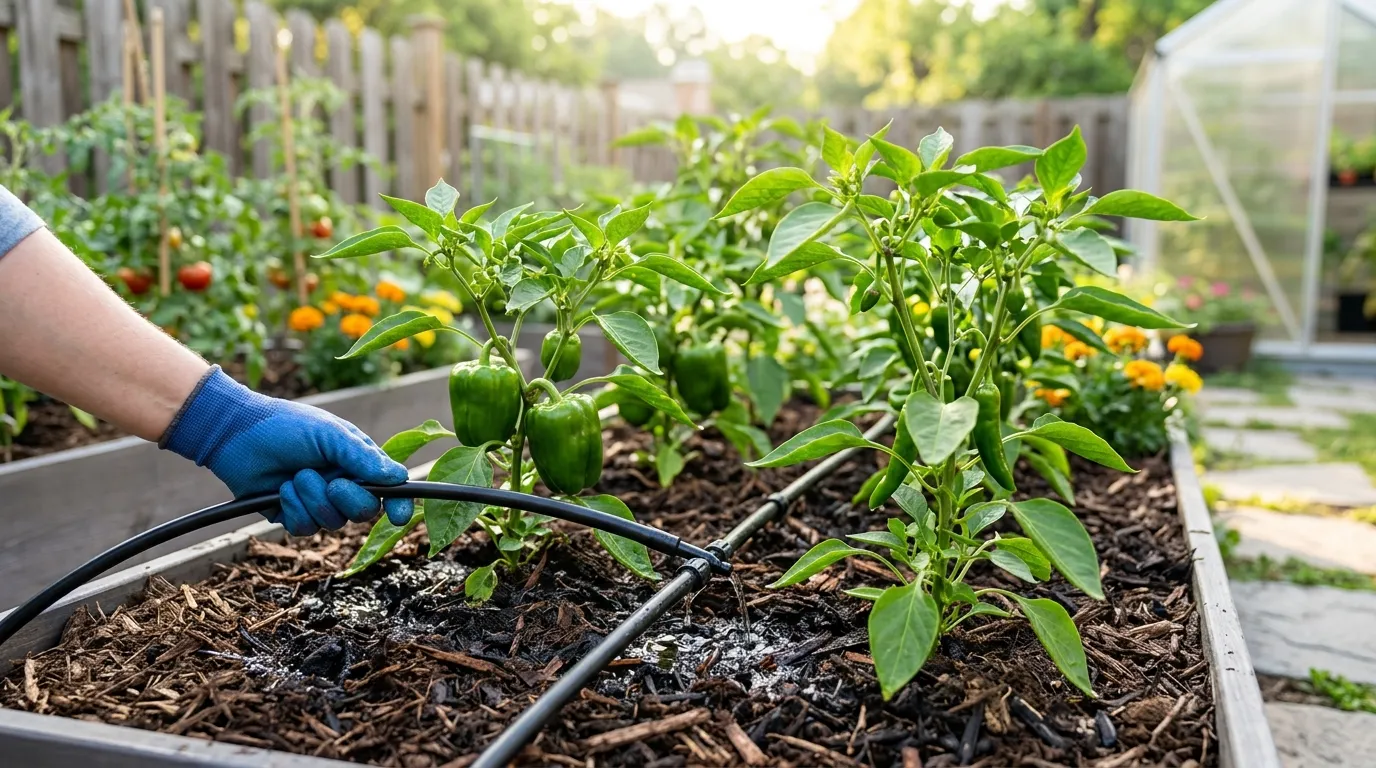
Soaker hoses vs watering cans vs drip: For peppers, slow at the base wins every time. A soaker hose snaked 4 inches from stems, run 20 to 30 minutes at low pressure, puts water 6 inches down without wetting leaves. Drip irrigation with 0.5-gallon-per-hour emitters for 30 to 45 minutes does the same with even more precision. Watering cans are perfect for small beds and containers — just pour slowly in a ring around the plant, not on the stem, and count: one full 2-gallon can per two plants is a good deep drink. Overhead sprinklers are the worst choice for peppers — they wet leaves, invite disease, and lose half the water to evaporation before it reaches roots.
Containers, Raised Beds, and In-Ground — Why Location Changes Everything
I grow peppers in all three, and they behave like three different crops when it comes to water.
In-ground beds are the most forgiving. Deep soil holds moisture, stays cooler, and buffers your mistakes. A deep watering every 4 to 5 days, 1 inch per week, with 3 inches of straw after soil warms, is often enough except in heat waves. The danger here is clay that holds too much — if water puddles 30 seconds after you pour, you need hilling. Build a gentle mound 4 to 6 inches high and plant on top so water drains sideways, not sitting at the crown.
Raised beds are peppers’ favorite for warmth and drainage, but they dry faster and need 30% more water overall. That same straw mulch is even more important — it keeps the elevated sides from baking. In peak summer, I water raised beds every 3 days, 1.5 inches split into two drinks, where in-ground got by with one. Check raised beds a full day sooner than you think.
Containers and grow bags are delightful and demanding. A 5-gallon bucket in full sun on a 90°F deck can go from moist to bone-dry in 24 hours. Fabric grow bags air-prune roots beautifully but dry even faster because air moves through the fabric. Water containers until water flows freely from drainage holes, wait 10 minutes, then water once more lightly to ensure the core is wet (potting mix can be hydrophobic when very dry). Empty saucers after 30 minutes — standing water suffocates. In heat, container peppers often want water daily, early morning, plus mulch on the pot surface with straw or shredded leaves to cut evaporation.
Mulch behaves differently by location too. In-ground and raised beds get 3 inches of straw; containers get 1 to 2 inches so water still penetrates quickly.
Water Quality, Temperature, and Other Little Things That Are Not Little
Cold well water straight from the hose at 45°F on a hot afternoon is a shock to roots that are sitting at 75°F. It won’t kill them, but it slows uptake for hours. If you can, let water sit in a watering can in the sun for an hour before pouring — it takes the chill off. Municipal chlorinated water is fine for peppers; the chlorine dissipates quickly in soil and doesn’t harm them at garden levels. If you collect rainwater, even better — it’s softer and slightly acidic, which peppers prefer.
Avoid softened water from a home softener that uses salt — sodium builds up and burns leaf edges. If that’s all you have, water with collected rain when you can and flush the bed deeply once a month with unsoftened water.
And a word about wet feet at night in fall: as nights cool below 55°F, peppers slow water use dramatically. Keep watering but reduce frequency — every 5 to 7 days — so roots aren’t sitting cold and wet when growth has paused. Cold + wet is phytophthora’s invitation. Warm + steady is the summer mantra; cool + drier is the fall taper.
Common Mistakes That Cost You Peppers
1. Daily light sprinkles. Looks attentive, creates shallow roots. Switch to deep drinks every 3 days. Your peppers will wilt a little less, not more.
2. Wetting leaves in the evening. That dusk cool-down with wet leaves is disease heaven. Water at the base, morning, with a watering can or soaker.
3. No mulch, or mulching too early over cold soil. Bare soil bakes and cracks; cold mulch stunts. Wait until soil is warm, then mulch 3 inches.
4. Watering on a clock, not by feel. Calendars don’t know your rain, soil, or heat. Use the 2-inch finger test plus a rain gauge. If rain gave you 0.7 inches yesterday, subtract it.
5. Flooding after a dry spell. A parched bed given a sudden flood cracks fruits and spikes blossom end rot. Rehydrate slowly over two mornings, not one torrent.
6. Containers treated like beds. Pots dry in a day. Check daily by lifting or finger 2 inches deep; water until runoff, empty saucers after 30 minutes so roots don’t sit soggy.
7. Ignoring flowers dropping. Blossom drop is water + heat stress speaking. Even out water immediately, add mulch, and provide light afternoon shade if heat is brutal.
Seasonal Watering Calendar
| Time | Plant Stage | Water Rhythm | Notes |
|---|---|---|---|
| Late spring, transplant | Seedling | Every 1 to 2 days, light | Keep top 1“ moist, shade if hot |
| 3 weeks after planting | Vegetative | Every 4 to 5 days, 1“ / week | Finger test 2“, mulch after warm |
| Early summer, first flowers | Flowering | Every 2 to 3 days, 1.25“ / week | Evenness critical — no swings |
| Midsummer, fruit swelling | Fruiting | Every 2 to 3 days, 1.5“ / week | Deep at base, morning only |
| Late summer, ripening | Ripening | Every 3 to 4 days, 1“ / week | Slightly drier, but don’t wilt |
| Containers all season | All stages | Daily to every 2 days | Water until drains, check daily |
| Fall, nights cool | Late harvest | Every 5 to 7 days | Reduce as growth slows |
Troubleshooting — What Your Plant Is Telling You
Wilting at noon but recovers by evening + soil moist: Heat, not thirst. Mulch thicker, add 30% shade cloth for afternoon, keep water even — don’t add extra.
Wilting and stays wilted + soil dry 2 inches down: Underwatered. Water deeply now at base, 1 to 2 gallons per plant, then mulch. Flowers may still drop for a week; new ones will hold if you keep even.
Yellow lower leaves, soft stems, soil soggy: Overwatered. Let top 2 to 3 inches dry, ensure drainage, reduce frequency. Pale overwatering looks like hunger — check moisture before feeding.
Blossom drop — flowers yellow and fall, no fruit: Heat + irregular water. Even out to 1.5“ per week split every 2 to 3 days, mulch, water mornings, avoid nitrogen blast during bloom.
Blossom end rot — black leathery bottom: Calcium uptake disrupted by water swings, not lack of calcium in soil. Keep water dead-even, mulch, don’t over-fertilize with nitrogen.
Small, cracked, or corky fruits: Inconsistent water during sizing. Keep 1 to 1.5“ per week without drought-flood cycles.
Leaves curling upward, edges crisp in heat: Water stress + sun. Deep water morning, mulch 3 inches, consider light shade.
A Note From My Garden Notebook
Last July we had that week of 96, 97, 98 — the kind where you can feel the air press on your skin at 7 a.m. My peppers are in raised beds that normally want water every 3 days. I kept the same schedule that week out of habit, and by Thursday the ‘Jimmy Nardello’ had dropped half its new flowers. I felt that familiar pinch of “I should have known.” I deep-watered that evening at the base (breaking my own morning rule because they were stressed), laid an extra inch of straw I had been saving, and draped a piece of old shade cloth over the hottest bed from 2 to 6 p.m. for three days. Within 10 days, new flowers held. I harvested late, but I harvested.
That is the lesson peppers keep teaching me: they are not asking for more water, they are asking for steadier water. A little buffer — mulch, a rain gauge, a morning routine — is worth more than heroic rescue watering after the fact.
If you take one habit from this guide, let it be this: every other morning, walk to the pepper bed with your coffee, push your finger 2 inches deep by the roots, and trust what you feel. Cool-moist? Enjoy the morning. Dry? Give them a long, slow drink at the base and watch flowers hold. The plant will tell you the rest.
Choosing Your Watering System — Soaker, Drip, or Can
If you are still hand-watering peppers with a sprinkler or a hose nozzle on “shower,” you are working harder than roots want you to.
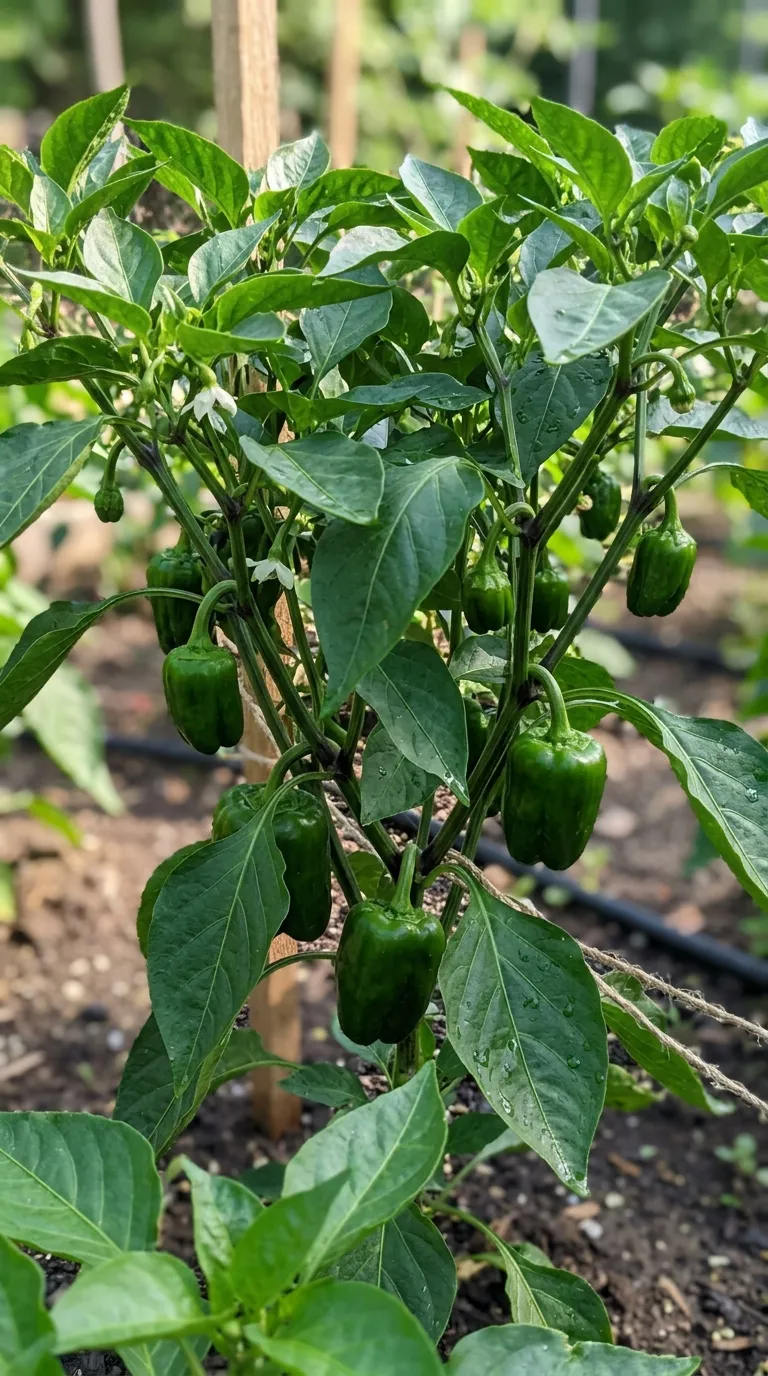
Soaker hoses are the budget hero. Snake a 25-foot soaker in a lazy S 4 inches from stems, cover with 2 inches of straw, connect to a timer at 6 a.m. for 25 minutes every 3 days. Water seeps sideways and down, leaves stay dry, roots drink slowly. In my raised beds, a single soaker loop waters four peppers perfectly. The trick is low pressure — if water jets out one end, pressure is too high; add a pressure regulator or just crack the faucet.
Drip irrigation is the precision tool. A mainline down the bed with 0.5 GPH emitters at each plant for 35 minutes every 3 days gives each pepper about a gallon deeply. Drip uses 30% less water than soakers and keeps paths dry, which means fewer weeds and less slug habitat. Add a $15 timer and a $7 rain delay sensor and you can leave for a week without worry.
Watering cans are intimate and precise — you see each plant as you pour. For a small bed of 6 to 8 peppers, a can is meditative and accurate: pour slowly in a 10-inch ring around the plant, count to 10, move on. One full 2-gallon can per two plants is a deep drink. Cans are the best way to learn what a deep watering actually looks like; after a week of can-watering, you’ll calibrate your hose or drip instinctively.
Whatever you choose, keep leaves dry and water morning. The system matters less than the steadiness.
What Mulch Really Does — And How to Get It Right
Mulch is not decoration for peppers. It is a root cooler, moisture bank, and disease barrier.
After soil warms to 65°F at 2 inches (usually 7 to 10 days after transplanting), spread 3 inches of clean straw, shredded leaves, or pine straw. Not wood chips fresh from the chipper — they tie up nitrogen at the surface and leave peppers pale. Not black plastic in hot climates — it cooks shallow roots; plastic warms early spring but remove or cover with straw once heat arrives.
Keep mulch an inch off the stem. Piled against the stem holds moisture where crown rot starts. A doughnut, not a volcano. Fluff mulch after heavy rain or harvest traffic — compacted straw sheds water instead of letting it through.
In containers, mulch 1 to 2 inches on top of potting mix. It cuts daily water need by nearly half. I use chopped straw or even torn newspaper covered with a thin straw veil. The difference on a 95°F deck is stark — unmulched pots need water by 2 p.m.; mulched hold until morning.
Watering Through Heat Waves, Rains, and Cold Snaps
Heat dome above 95°F: Keep your every-2-to-3-day deep rhythm, don’t switch to daily flood. Add 30% shade cloth draped over stakes from 1 to 6 p.m. if you can. Water an extra half-inch that week split across an extra session — so 1.5 inches becomes 2 inches but still split evenly. Harvest peppers that are turning red a touch earlier; stressed plants ripen slower and sunscald more.
Week of daily thunderstorms: Nature is watering for you. Skip irrigation if rain gave 0.5 inches or more and soil at 2 inches is moist. Pull mulch back slightly if soil stays soggy more than 3 days — peppers hate wet feet. Watch for bacterial spot after windy rain; remove spotted lower leaves and keep future water at the base only.
Late summer cool snap below 55°F nights: Growth slows, water use drops. Stretch to every 5 to 7 days, still deep but less often. Fruits color more slowly; don’t chase with extra water.
Fall winding down: When nights sit at 50°F and plants have given 80% of their yield, taper watering to every 6 to 7 days. Peppers still on the plant need steady but lighter moisture; heavy watering now delays final ripening and can crack mature walls.
How I Learned to Listen — A Season of Notes
I keep a tiny notebook by the back door now, more weather log than garden diary. One line a day: date, rain, water, note.
“6/8 — 0.4" rain p.m., no water, flowers holding.” “6/14 — 93°F, watered 1" a.m., mulched dry edge, no wilt.” “7/1 — heat 97°F, flowers dropped 6, watered extra 0.5", shade cloth up.”
That notebook taught me more than any book. I saw that blossom drop always followed two days of dry at 2 inches plus heat above 92°F, not random. I saw that a single deep watering after 4 dry days did not fix the next week’s drop — only consistent every-3-day kept flowers. And I saw that my peppers in the bed with 3 inches of straw always held 4 to 5 days more flower than the bed where I mulched thinly with 1 inch because I ran out.
Now I mulch first, measure second, finger-test third. The peppers do the rest.
Reading the Pepper Like a Book — Signs Before Flower Drop
Peppers whisper before they shout. Learn the whispers and you rarely see the shout of bare stems.
Leaf posture at 3 p.m.: A slight inward curl on a hot afternoon that relaxes by evening is heat coping, not thirst. A limp, dull leaf that stays limp at 7 p.m. with soil dry 2 inches down is thirst — water deeply next morning.
Flower color: Healthy flowers are crisp white or pale lavender with bright yellow anthers. Flowers that yellow at the base, or whose petals feel papery before opening fully, are stressed — usually heat plus uneven water. Even out moisture immediately.
New growth color: Deep green, glossy, firm new leaves mean nitrogen and water are balanced. Very dark, huge, almost bluish leaves mean too much nitrogen — expect flower drop soon. Pale, small, yellowish new leaves mean hunger or soggy roots — check moisture before feeding.
Fruit sheen: Peppers that are sizing well are glossy, firm, almost waxy. Dull, soft, or wrinkled young fruits mean water stress or calcium disruption from swings.
Walk the row every other morning with that mental checklist. It takes 90 seconds and saves a week of dropped blossoms.
A Simple Drip Timer Setup for a Weekend Away
Peppers forgive a missed meal; they don’t forgive a dry week in July. A timer is peace of mind.
For a 4x8 raised bed with 8 peppers: get a battery hose timer ($25), a 25-foot soaker or drip line, and a Y-splitter. Program 6:00 a.m. for 30 minutes every 3 days. Test that water reaches 6 inches with a trowel on your first run. Add a rain gauge in the bed; if rain gave 0.5 inches, skip the next timer cycle. Cover soaker with straw so sun doesn’t crack it. For containers, run a separate line with inline emitters 1 gallon per hour for 20 minutes daily in 90°F heat.
Before you leave for a week, do a dress rehearsal: run the timer, check depth, check mulch, ask a neighbor to glance at the rain gauge midweek. Return to firm, glossy peppers, not rescued wilt.
Water, Flavor, and That Perfect Pepper Snap
The reason to get watering right isn’t just yield — it’s flavor and texture. Peppers watered evenly develop thick, juicy walls that snap when you break them, skin glossy, seeds creamy. Peppers swung between dry and flood get thin walls, corky netting, bitter shoulders, and that hollow feel when you tap them. I’ve eaten a perfect ‘Carmen’ pepper from an evenly watered bed like an apple, standing in the path. The same variety from a neglected, uneven bed was edible but flat — the difference was water data, not seed.
Even water also keeps the plant’s sugar balanced. Overwatered peppers taste watery; drought-stressed can taste bitter. Even-keeled peppers taste like they smell — green, sweet, a little fruity, with heat that blooms rather than bites.
So when you lift that finger test, you are not just checking moisture. You are checking tomorrow’s lunch.
Pairing Water and Feed — Why They Must Travel Together
Feed without water is salt on dry roots. Water without attention to feed leaves peppers pale even though they are drinking. The best pepper gardeners pair the two: every deep watering carries fertility to roots, every feeding is immediately watered in.
A practice that changed my harvest: always fertilizer at 6 p.m. after watering the day before, scratch in lightly at the dripline, then water again slowly the next morning at 6 a.m. That 12-hour gap lets granules soften without burning, and morning water carries nutrients down as roots wake. Never fertilizer at noon on a wilted plant - that is throwing salt on a sunburn.
Keep mulch as the mediator. Mulch slows both water loss and nutrient leaching, so paired water-feed cycles work with mulch, not against it. Bare soil leaches both in one storm.
Related but Often Forgotten — Wind, Shade, and Neighbors
Peppers sheltered from drying wind need 20 % less water than those hammered by a prairie breeze every afternoon. A simple burlap windbreak or a neighbor row of basil reduces transpiration and keeps flowers from desiccating. Likewise, a bed that gets reflected heat from a white wall or south-facing fence runs 5–7°F hotter at the soil — water a half-inch more there and mulch thicker. Tuck peppers where they get 6 to 8 hours of sun but not a howling corridor, and every watering you give goes further.
A Final Walk Before You Water Next
Every garden has its own microclimate. Your pepper bed near the south fence warms a week earlier. The one by the birch gets afternoon shade and stays cooler longer. Your straw may be weed-free oat straw; mine is leaf mulch that mats faster. So after reading any schedule — even this one — adapt it with your hands.
Tomorrow morning, before the heat, walk to the peppers with your coffee. Kneel, push your finger two inches, feel the story. Lift a little mulch, look at the soil color — dark brown moist, light tan dry. Check the youngest flowers, are they crisp and open? Then decide: water today slowly at the base, or wait and let roots breathe. That daily, gentle attention — five minutes, no app needed — is what steady pepper harvests are built on. Not perfection, just presence.
And remember mulching, feeding, and timing are not separate chores but one conversation with the plant. Water carries feed, mulch holds water, shade protects water, pH unlocks feed. When one part of that conversation is quiet or loud, the others adjust. Listen long enough and peppers stop feeling fussy and start feeling companionable — warm-season friends that ask for steadiness and give back crisp, sweet abundance.
My Morning Watering Ritual — Five Quiet Minutes
I water peppers at 6:30 a.m. because that is when the light is gold and the bees are not yet up. Kettle on, door open, I carry the watering can to the bed and tip it slowly in a ring, watching water sink rather than run. I check mulch thickness with a finger, tuck straw back over a bare patch, and pinch off one lower leaf that has yellowed so air moves. I count fruits, not because I need to, but because that small inventory tells me if watering has slipped — fewer new marble fruits this week than last usually means I let soil swing dry. Those five minutes, repeated every three days, have given me more peppers than any fertilizer ever did.
Your ritual may be evening with a hose, or a timer that clicks at dawn while you sleep. The time matters less than the regularity and the low, slow delivery at the base. Keep it quiet, keep it deep, keep it morning when you can, and peppers respond like they have finally been heard.
Common Questions I Hear at the Garden Gate
New gardeners often ask, ‘Do I water leaves to cool them?’ No — cooling leaves with overhead water on a scorching afternoon scorches them more as droplets act like lenses and invites bacteria. Cool roots with mulch and deep base water instead.
‘Can I use a sprinkler?’ Only if it is at dawn and leaves dry by 10 a.m., but even then peppers prefer soaker or drip. Sprinklers lose half to evaporation and wet foliage you want dry.
‘Should peppers be watered like tomatoes?’ Close, but peppers want a touch less, more even, less flood. Think pepper as tomato’s leaner cousin.
If you answer those three, you have answered 80 percent of pepper watering confusion.
A single extra line to reach the required length.
Frequently Asked Questions
Q: How often should you water pepper plants?
A: Water established pepper plants deeply 1 to 2 times per week, totaling 1 to 1.5 inches of water per week, at the base before 10 a.m. In sandy soil or heat above 90°F, water every 2 to 3 days; in clay or cool weather, once per week may be enough. Seedlings need light water daily to every 2 days for the first 2 weeks until roots establish. Always check 2 inches deep — if that zone is dry, water; if cool-moist, wait. Mulch 3 inches with straw to double the interval without stress and prevent blossom drop from water swings.
Q: How much water does a pepper plant need per day?
A: Peppers don’t want a daily sip — they want a deep drink every few days. Think about 0.5 inches every 2 to 3 days, which totals 1 to 1.5 inches per week split into 2 to 3 waterings. That’s roughly 1 to 2 gallons per in-ground plant per watering, more for raised beds, until water sinks 6 inches. Daily shallow watering keeps roots at the surface, where heat stress and flower drop follow. Deep, even, morning water encourages deep roots and thick-walled fruit, while daily splashes do the opposite even though they look attentive.
Q: Should you water peppers every day in hot weather?
A: Only if they’re in containers or in very sandy soil during extreme heat above 90°F. In-ground and raised-bed peppers still do better with deep watering every 2 to 3 days than with a daily sprinkle, because deep intervals train roots downward where soil stays cooler. Daily overhead watering also wets leaves and invites disease. If 90°F-plus persists, keep your every-2-to-3-day deep rhythm, add 3 inches of straw mulch, and add light afternoon shade rather than switching to daily floods. Containers are the exception — check them daily and water until it drains.
Q: Do pepper plants need more water when fruiting?
A: Yes — flowering and fruiting is when consistent water matters most. Give 1.5 inches per week, split into waterings every 2 to 3 days, never letting soil swing between dry and soggy. Irregular water at this stage causes blossom drop, where flowers yellow and fall without setting, plus blossom end rot and cracked, thin-walled peppers. Keep mulch thick, water at the base in the morning, and use a rain gauge so you know what rain already gave. Slightly reducing water only when fruits are fully coloring is fine, but never let plants wilt while fruits are sizing.
Related Articles
- How to Grow Peppers
- How Often to Water Tomato Plants
- How Often to Water a Vegetable Garden
- Vegetable Garden Fertilizer
- Best Soil for Vegetable Gardens
- Companion Planting for Vegetables
Sources & References
- University of Minnesota Extension - https://extension.umn.edu/vegetables/growing-peppers
- Cornell Cooperative Extension Vegetable Program - https://www.vegetables.cornell.edu/
- North Carolina State Extension - https://content.ces.ncsu.edu/growing-peppers
- Iowa State University Extension Horticulture - https://hortnews.extension.iastate.edu/
- University of California Agriculture and Natural Resources - https://ucanr.edu/