Does Vinegar Kill Weeds? Honest Answer + Proven Recipe

Ask five gardeners how to kill weeds without chemicals, and four will say vinegar. It is cheap, it is in every pantry, and the videos of weeds wilting and browning within hours are universally satisfying.
But vinegar has real limits, and knowing exactly what it can and cannot do is the difference between a weed-free path and six wasted vinegar bottles. This guide gives you the honest, science-based answer to the question every gardener asks: does vinegar kill weeds?
Quick Answer: Vinegar kills the above-ground parts of weeds by burning their leaves with acetic acid, but it does not kill roots or prevent regrowth. It works fast on young annual weeds on sunny days, but established perennial weeds grow back from their roots within weeks. Household vinegar (5%) only works on seedlings; horticultural vinegar (15–30%) handles tougher weeds but requires safety gear.
How Vinegar Kills Weeds
Vinegar is a dilute solution of acetic acid in water. When sprayed onto a weed, the acetic acid burns through the leaf cuticle — the thin waxy layer protecting plant leaves. The acid disrupts leaf cells, causing them to dehydrate, collapse, and turn brown.
Three conditions determine effectiveness:
-
Concentration. Stronger vinegar = faster, deeper burn. Kitchen vinegar (5%) is gentle; horticultural vinegar (15–30%) is a real herbicide.
-
Age of the weed. Young seedlings with tiny root systems can be killed outright. Larger weeds outgrow the burn because deep roots send up recovery growth.
-
Weather. Heat, direct sun, and low humidity supercharge the burn. Rain within hours washes it off and undoes most of the effect.
Vinegar is a contact herbicide with no residual effect. Once it dries, it stops working. It never moves into the soil or harms future plants — which is both its strength and weakness.
What Vinegar Kills — And What It Doesn’t
| Weed Type | Example | Vinegar Effect | Verdict |
|---|---|---|---|
| Young annual seedlings | Chickweed, tiny crabgrass | Dies within a day | Works brilliantly |
| Established annuals | Mature crabgrass, pigweed | Foliage burned, reseeds later | Temporary |
| Young perennials | First-year dandelions | Top dies, often regrows | Weak |
| Established perennials | Mature dandelion, thistle | Top burns, roots regrow | Does not work |
| Grasses | Bermuda grass, quackgrass | Top browned, runners survive | Does not work |
| Moss and algae | Moss on paths | Dies and dries quickly | Works well |
| Waxy-leaf weeds | English ivy, dock | Acid beads off surface | Poor |
Pattern: The deeper the root system, the less vinegar matters. For strong perennial roots, vinegar is a weekly chore rather than a cure.
Which Vinegar to Use for Weeds
| Vinegar Type | Acetic Acid % | Best For |
|---|---|---|
| Household white distilled | 5% | Tiny seedlings only |
| Cleaning vinegar | 6% | Marginally better on seedlings |
| Horticultural vinegar | 15–30% | Established weeds on paths/patios |
| Industrial vinegar | 30%+ | Farm use, rarely needed for yards |
Recommendation: For paths, patios, and gravel, use 20% horticultural vinegar. For tiny seedlings in garden beds, 5% household vinegar is sufficient.
Vinegar Weed Killer Recipe (The One That Works)
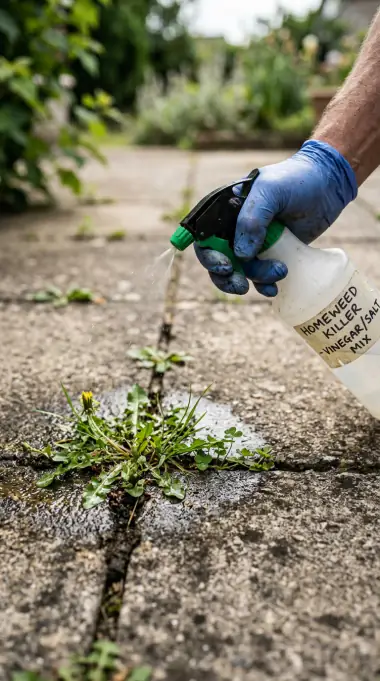
For paths, patios, gravel, and cracks — not lawns:
- 1 gallon (3.8 L) of 20% horticultural vinegar
- 1 tablespoon dish soap (helps it stick to waxy leaves)
- Do NOT add salt unless the area is gravel you never want to plant (salt sterilizes soil for years)
Instructions:
- Mix outdoors with gloves and goggles
- Pour into a clearly labeled pump sprayer
- Spot-spray leaves until glistening on a calm, sunny morning
- No rain for 24 hours
- Expect brown, wilted leaves in 2–6 hours
- Re-check in 10–14 days and repeat on regrowth
How to Use Vinegar as a Weed Killer
-
Choose your day. Pick a calm, sunny day with no rain forecast for 24 hours.
-
Protect desired plants. Vinegar is non-selective — it burns everything it touches. Shield wanted plants with cardboard.
-
Spray saturating, not misting. Coat each leaf fully until it glistens, including undersides.
-
Add dish soap (optional). Soap breaks surface tension and helps vinegar cling to waxy leaves.
-
Wait and repeat. Check in 10–14 days and repeat on regrowth. Stubborn areas often need 3–4 passes.
Does White Vinegar Kill Weeds?
Standard 5% white distilled vinegar kills only very young seedlings — chickweed, tiny crabgrass, seedling dandelions — usually within a day on a hot, sunny afternoon. It browns the leaves of bigger weeds but they regrow because 5% acid can’t destroy established roots.
Cleaning vinegar at 6% is marginally better on seedlings and equally weak on perennials.
Will Vinegar Kill Grass?
Yes — vinegar is non-selective and kills any grass it touches as fast as it kills weeds. That includes bermuda grass: the tops brown, the runners survive, and the weed comes back among damaged turf.
Never blanket-spray a lawn with vinegar. Hand-pull lawn weeds instead, and reserve vinegar for cracks, paths, patios, gravel, and fence lines.
Vinegar in Garden Beds: A Word of Caution
In garden beds with plants you want, vinegar has two serious drawbacks:
- Non-selectivity. A drift of vinegar across a lettuce row burns the lettuce as fast as the weed.
- Soil effect. Acetic acid temporarily lowers soil pH, stressing beneficial soil organisms.
For bed weeding: Use hand-pulling, hoes, and mulching instead. Save vinegar for paths, patios, and gravel.
What Vinegar Cannot Do
Three myths to retire:
-
It cannot kill roots. Vinegar only burns foliage it contacts. Perennial roots survive and regrow.
-
It does not prevent weeds. Spraying an area doesn’t stop seeds germinating next week.
-
It won’t kill weed seeds in soil. Acetic acid has no effect on dormant seeds buried in the ground.
Natural Weed Control Alternatives Compared
| Method | Best For | Kills Roots? | Effort | Cost |
|---|---|---|---|---|
| Vinegar (spot spray) | Young weeds, paths | No | Low | Low |
| Hand pulling | Any weed, anywhere | Yes | Medium | Free |
| Hoeing | Beds, young weeds | No | Low–medium | Free |
| Boiling water | Paths, shallow cracks | Weak | Low | Free |
| Mulching | Beds, borders | Stops growth | Medium once | Low |
| Corn gluten meal | Seed prevention in lawns | Prevents germination | Low | Medium |
| Flame weeding | Paths, gravel | No | Medium | One-time |
Vinegar Weed Control by Season
Spring is vinegar’s best season. Most spring weeds are young annuals with fragile root systems. Warm sun maximizes the burn.
Early summer requires repeat sprays every 2–4 weeks. Established weeds regrow from roots.
Late summer and fall are vinegar’s weakest season. Perennial weeds have deep roots and stored energy.
Winter in mild climates is vinegar’s quiet phase. Cold slows growth and weakens the burn.
Safety: Vinegar Is an Acid
Household vinegar is safe on salad, but horticultural vinegar requires respect:
- Wear chemical-resistant gloves (nitrile, not cotton) and safety goggles
- Wear long sleeves and long pants
- Spray only outdoors — fumes from high-strength vinegar irritate breathing
- Keep away from kids and pets during application
- Store locked away and clearly labeled
Frequently Asked Questions
Does vinegar kill weeds permanently?
No. Vinegar kills leaves it contacts but doesn’t kill roots or seeds. Young annuals may die outright, but established weeds regrow from roots within weeks.
What kind of vinegar kills weeds best?
Horticultural vinegar at 15–30% acetic acid kills established weed foliage quickly. Household vinegar at 5% only kills very young seedlings.
How long does vinegar take to kill weeds?
Leaves turn brown and wilt within 2–6 hours on a warm, sunny day. Small annual seedlings may die within a day. Established perennials regrow from roots in 10–14 days.
Is vinegar weed killer safe for the soil?
Vinegar breaks down quickly and doesn’t accumulate like synthetic herbicides, but it temporarily lowers soil pH where sprayed. In garden beds, use spot treatments, not blanket sprays.
Does vinegar kill weeds in grass lawns?
Yes — vinegar kills grass it touches as quickly as it kills weeds, leaving yellow dead spots. Hand-pull weeds in lawns and use vinegar only on paths and gravel.
How do you use vinegar without killing surrounding grass?
Spray only weed leaves with a narrow nozzle on a calm day, shield grass with cardboard, and never blanket-spray. For lawns, hand-pull instead.
Is horticultural vinegar dangerous?
Yes. 20–30% acetic acid can cause skin burns, eye damage, and respiratory irritation. Wear gloves, goggles, and long sleeves. Use outdoors only.