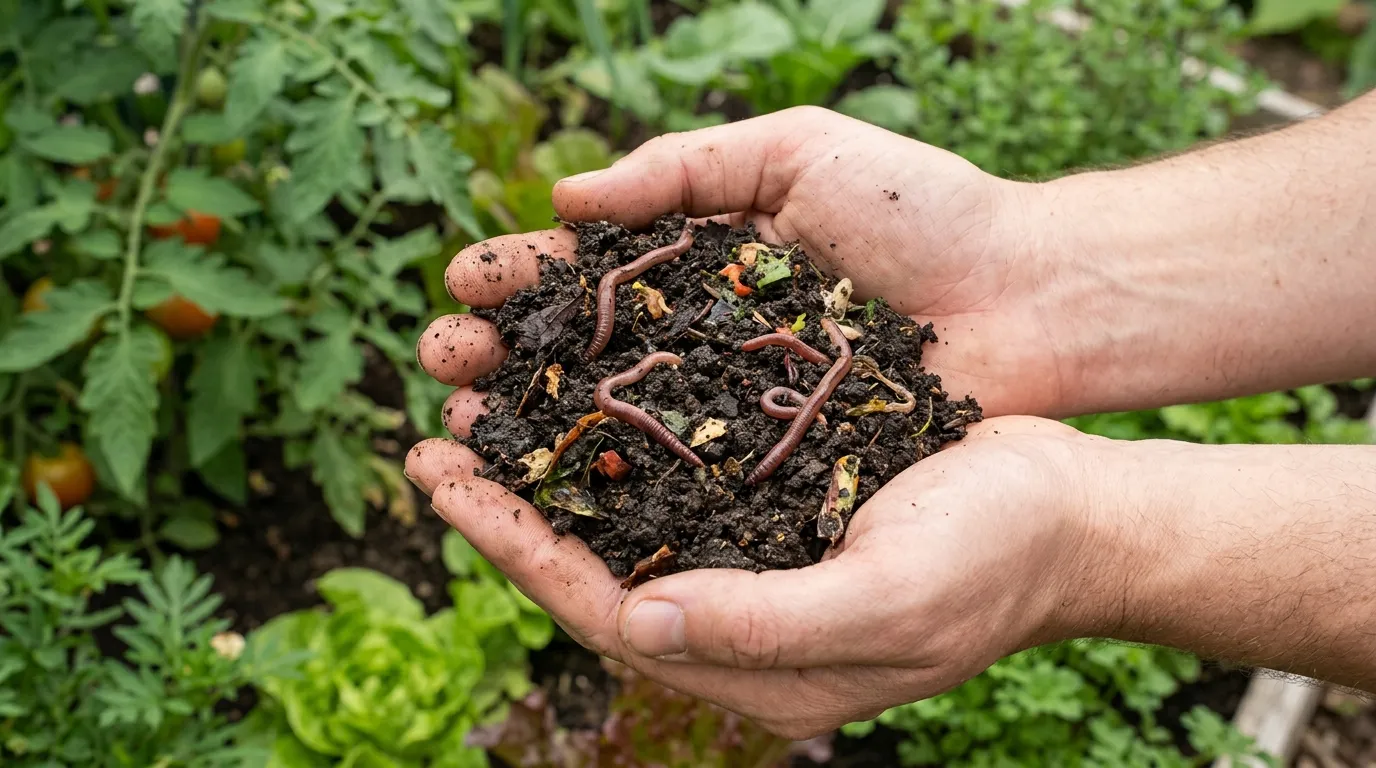
The spring I really learned soil, I wasn’t trying to learn soil at all. I was trying to grow carrots. I’d sown a perfect row, thinned dutifully, watered, waited — and pulled short, forked, pale things that looked like they’d hit a wall at 3 inches. Which, it turned out, they had. I dug a trowel down and hit gray, dense clay at 6 inches that smeared like pottery and smelled faintly sour. My seeds hadn’t failed. My soil had.
I’d been gardening on top of soil, not in it. Vegetables don’t grow in bags or labels; they grow in the living world beneath them — that impossible city of bacteria, fungi, and earthworms that turns dead leaves into plant food, holds water like a sponge, and keeps air pockets open so roots can breathe.
When I finally stopped hunting for a miracle fertilizer and started building loam — that sweet, crumbly, forest-floor-smelling blend that is part mineral, part life, part air — the same carrots went straight and sweet to 7 inches, the lettuce doubled, and the tomatoes, same sun, same water, made twice the fruit. Soil was the difference, not effort.
Quick Answer: Build vegetable garden soil as 60% screened topsoil + 30% finished compost + 10% perlite or coarse vermiculite, pH 6.0–7.0, depth 12–18 inches. Blend on a tarp, incorporate 3 inches of compost into the top 8 inches at planting if amending ground, or fill raised beds in 6-inch lifts watering to settle. Mulch 3 inches with straw after seedlings are 3 inches tall, and top-dress 1–2 inches compost yearly rather than tilling. For containers, use potting mix; for beds, use this loam.
At a Glance: Vegetable Garden Soil Choices
| Soil Option | Best For | pH Target | Depth | How It Feels & Performs |
|---|---|---|---|---|
| 60% topsoil +30% compost +10% perlite | Raised beds & amended in-ground | 6.0–7.0 | 12–18″ | Moist sponge that crumbles — airy, dark, earthy; holds 1″ water ~7 days |
| 100% high-quality potting mix | Containers only | 6.0–6.5 | 8–12″ | Light, fluffy, drains fast; perfect for pots, costly for beds |
| Bagged “garden soil” alone | Only as base to amend | Variable | 12″ min if amended | Dense when wet, dusty when dry; needs compost + perlite |
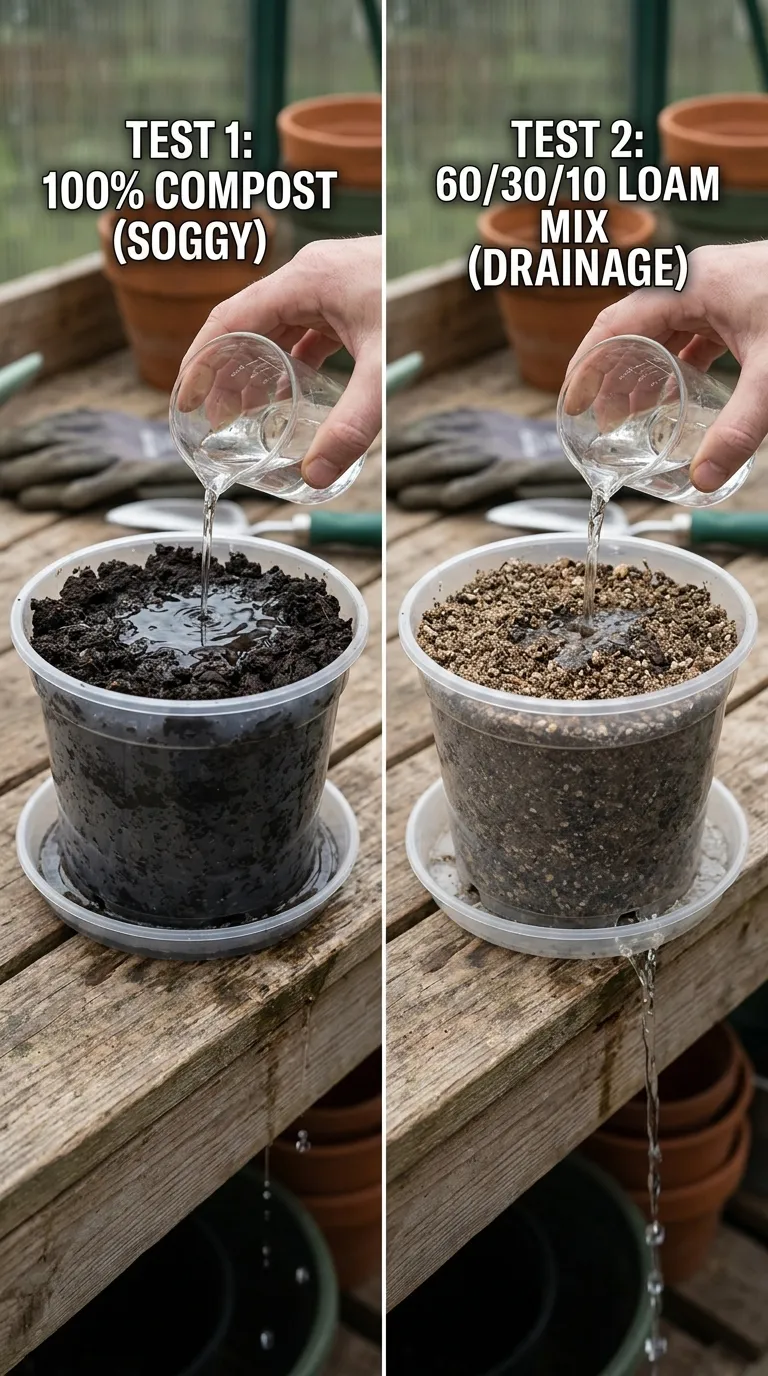
| 100% compost | Not recommended alone | Often 7.0–8.0 | — | Holds too much water spring, crusts summer, shrinks, low mineral |
| Native clay or sand alone | Amend, don’t use pure | Clay often acidic, sand variable | — | Clay: shiny ribbon >2″; Sand: gritty, dries in hours |
Remember: topsoil = structure, compost = life, perlite = air.
Why 60/30/10 Works — The Sponge You Can Plant In
Ideal vegetable soil is a wrung-out sponge. Pick it up and it’s cool and moist but not dripping. Squeeze and a few drops fall, then it springs back full of tiny air pockets. That’s what roots crave — moisture plus oxygen at once. Soggy soil drowns roots; dusty sand starves them. Loam does both.
60% topsoil is the mineral skeleton — sand, silt, and a touch of clay plus the trace minerals compost alone can’t give: iron, calcium, the grit that keeps soil from collapsing after rain. Good screened topsoil smells faintly mineral, not sour. Ask for “screened loam,” not fill dirt — fill is subsoil, pale and lifeless.
30% compost is the living pantry. Finished compost — dark, crumbly, smelling of earth — holds moisture up to seven times its weight, feeds earthworms and mycorrhizae, buffers pH, and releases nitrogen, phosphorus, and potassium slowly, the way plants prefer. It’s food for the soil food web that in turn feeds the plant. Homemade from leaves and kitchen scraps is wonderful; bagged composted cow or mushroom compost is reliably good — just ensure it’s fully finished.
10% perlite or coarse vermiculite is the permanent air. White, crunchy bits keep the mix open even after a hard rain. In heavy clay I use 15% in the lower half; in hot sand I drop to 5% and add extra compost because sand already has air but needs water-holding. Perlite never decomposes; vermiculite holds a bit more water.
Together they form the loam that in trial after trial doubles yields versus unamended clay or sand — not magic, just roots finally able to breathe, forage, and drink steadily.
Know What You’re Starting With — Two-Minute Field Tests
Before buying anything, get acquainted.
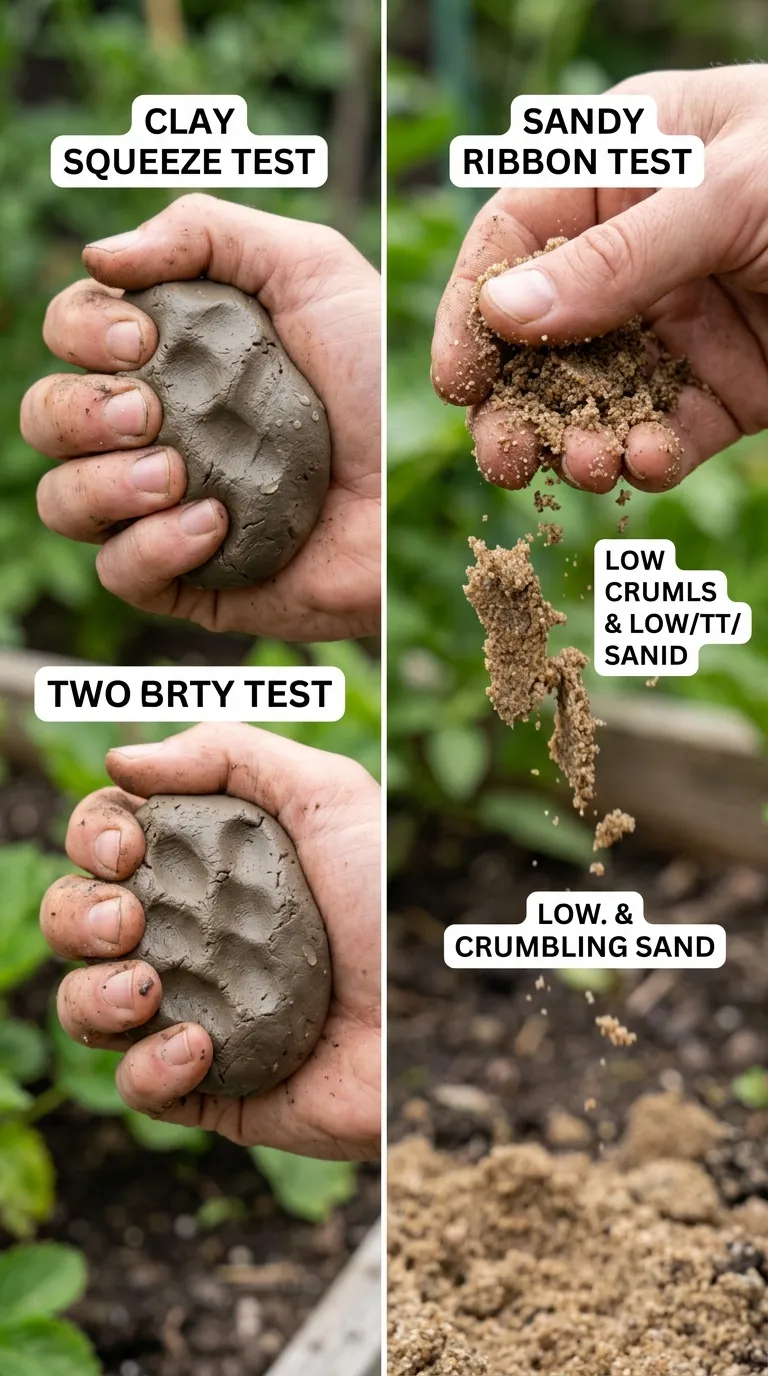
Squeeze test: Take moist (not wet) soil, squeeze. Tight shiny ball that doesn’t crumble when poked = heavy clay. Falls apart instantly = sand. Holds a ball then crumbles when prodded, slightly gritty-smooth = loam already.
Ribbon test: Push that ball between thumb and forefinger. Clay makes a ribbon >2 inches before breaking; silty loam makes a fragile ribbon <1 inch; sandy loam barely ribbons.
Smell test: Healthy soil smells earthy-sweet like mushrooms after rain. Sour, swampy, or ammonia means anaerobic, compaction, or unfinished compost.
Drainage test: Dig 12-inch hole, fill with water, let drain, fill again and time. Second fill draining 1–3 inches per hour is vegetable-friendly. Faster than 4″/hr = too sandy; slower than 0.5″/hr = compaction/clay — wants raised beds.
For numbers — pH, phosphorus, potassium, organic matter — get a $15–25 extension soil test. Test every 2 years; pH drifts silently until leaves yellow.
See how to test soil pH and how to prepare soil for planting.
Building It — Raised Bed vs. In-Ground
Ratio and depth are the same; order differs.
For a New Raised Bed (Easiest on Clay)
- Clear and mark. Choose 6–8 hours sun, near hose. Lay overlapping cardboard over grass/weeds, wet well. Set frame 12–18 inches high — 4×8 ft ideal.
- Blend off-bed. On a tarp, measure by 5-gallon bucket: 6 topsoil, 3 compost, 1 perlite. Blend until uniform. Tarp blending gives even 60/30/10; mixing in the bed leaves dense pockets.
- Fill in lifts. 6 inches, water deeply to settle naturally, 6 more, water. Surface 1–2 inches below rim to hold mulch. Don’t stomp.
- Mulch after establishment. At 3–4 inches tall, mulch 2–3 inches straw/shredded leaves. Keeps inch of water from evaporating and feeds microbes.
- Don’t till next spring. Top-dress 1–2 inches compost and rake lightly. Broadfork gently if compacted, but don’t invert — preserve fungal networks.
For Amending an In-Ground Bed
- Test, then clear. Remove weeds, test pH/texture first.
- Spread and fork in. Spread 3 inches compost + 1 inch perlite, fork/broadfork into top 8–10 inches to create 60/30/10 character in the top foot. Heavy clay: extra half-inch perlite; sand: extra inch compost instead.
- Mound if drainage poor. If water puddled in drainage test, crown bed 6–8 inches above path so roots don’t sit wet.
- Mulch and maintain as above.
Either way, you can plant immediately. Loam is ready the day you build it.
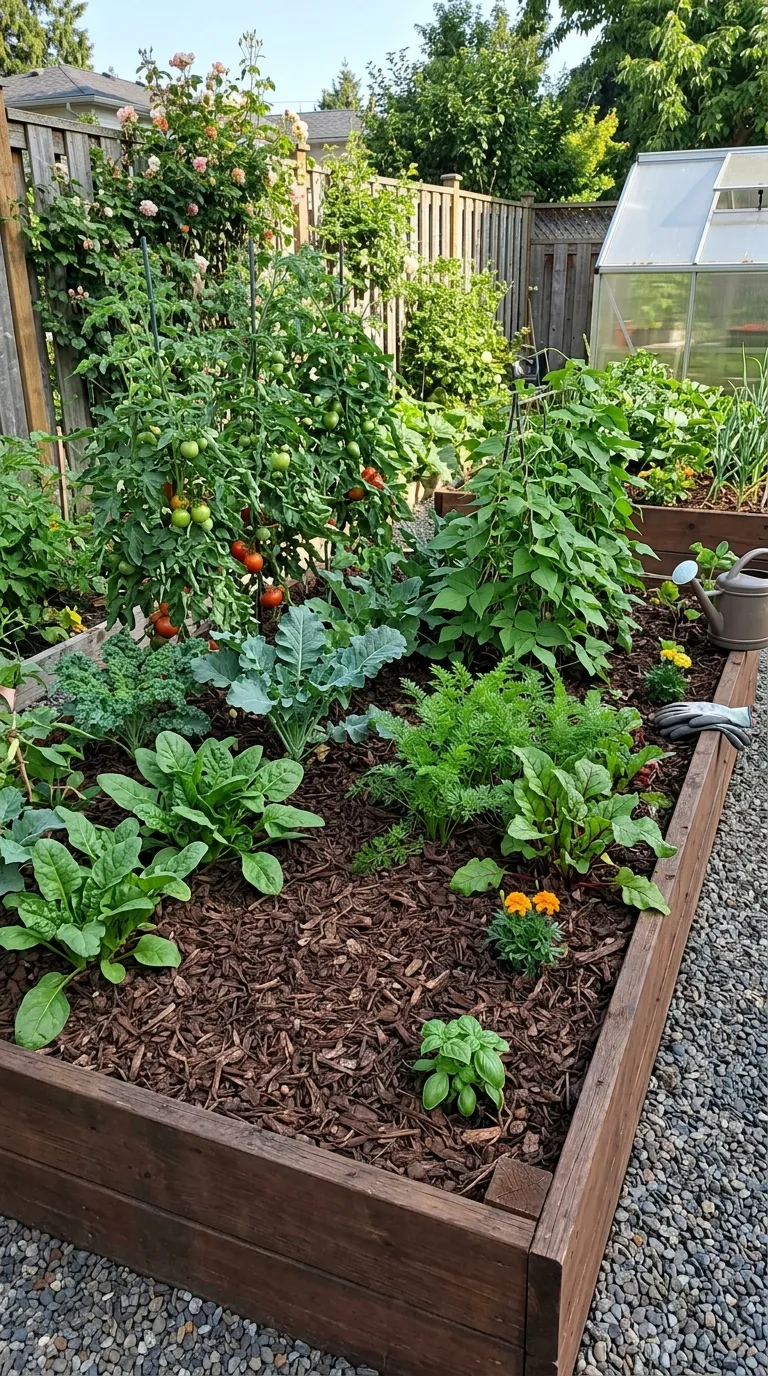
pH & Nutrients — The Invisible Dial
Vegetables want pH 6.0–7.0 where nutrients are available. Outside, nutrients are present but locked.
- Below 6.0 acidic: Phosphorus, calcium, magnesium hide. Poor fruit set, blossom end rot even with good water, stunted growth. Below 5.5, aluminum can toxicity appears.
- Above 7.5 alkaline: Iron, manganese, zinc hide. Leaves yellow between veins (chlorosis) while veins stay green.
Gentle correction per soil test only:
- To raise pH: Garden lime (calcium carbonate), often 5–10 lbs/100 sq ft per 0.5 point. Apply in fall — lime is slow and needs months.
- To lower pH: Elemental sulfur, often 1–2 lbs/100 sq ft per 0.5 point. Needs warm soil and microbes, so apply months ahead.
Yearly compost buffers pH toward neutral in either direction — another reason that spring top-dress matters more than a one-time fix. Fertilize per soil test: tomatoes/squash heavy feeders, beans/peas light — see vegetable garden fertilizer.
How Deep? Deeper Than You Think
Even lettuce sends fine roots 8 inches down; tomatoes can go 24 inches if allowed. Shallow 6-inch good soil over compacted subsoil stunts, dries in a day, heats/cools wildly.
Minimums I use:
- 12 inches for lettuce, spinach, beans, peas, herbs, radishes, bush cucumbers — holds moisture a week.
- 15–18 inches for tomatoes, peppers, squash, brassicas — anchorage and sustained moisture.
- 18 inches for carrots, beets, parsnips, potatoes — any hard pan forks roots or traps water under tubers; raised beds guarantee depth.
On clay, building up is kinder than digging down 18 inches into infertile subsoil. Fill a raised frame and let earthworms incorporate below over seasons. Vegetables need depth now.
Mulch, Water & Season-Long Feeding
Mulch 3 inches after establishment: Wait until 3 inches tall, then straw heavily — 10°F cooler in July, holds inch of water at roots, becomes humus. Replenish when bare.
Water deeply, less often: Loam holds water 7 days only if you soak 6–8 inches deep. Light daily sprinkle wets top inch, encourages shallow roots, evaporates by noon. Water at base mornings with soaker/wand until trowel shows moisture 6 inches down, then wait till top 2 inches dry. See how often to water vegetables.
Feed yearly, not constantly: Top-dress 1–2 inches compost each spring, plus half-inch between successions (e.g., after pulling radishes). Often enough in good loam. Supplement with organic granular per test at planting if low nitrogen/potassium, but compost is the foundation.
Don’t till wet clay: If you can form a shiny ball, it’s too wet. Working wet clay smears platelets into pottery that bakes hard. Wait till crumbly — a day or two after rain. In raised bed loam, you rarely need to till at all.
Common Mistakes That Undo Good Soil
100% garden soil in containers: Compacts to airless mud without deep drainage/worms — roots rot. Use potting mix in pots; save loam for beds. If you must stretch, cut 50/50 with potting mix + perlite.
100% compost in raised beds: Holds too much spring water, crusts summer, shrinks and leaves bed half-empty by fall, low mineral anchorage — the sinking bed signature. Blend 60/30/10 so volume holds and drains like loam.
Never testing pH: Silent yield loss. Fertilizer added at pH 5.2 can’t be taken up. $20 test every 2 years prevents guessing. I mark even springs as “soil birthday.”
Tilling wet or over-tilling dry: Both destroy structure. Wet clay clods bake; over-tilled loam pulverizes to dust then crusts. Use broadfork to lift/crack without inverting. My best soil was forked only.
Leaving beds bare / walking on them: Bare soil dies — microbes exposed, moisture gone, crust forming. Mulch after planting, path beside beds, and if empty >1 week sow cover crop (crimson clover/oats) or mulch and rest.
Chasing perfection: Perfect test doesn’t exist. Aim for pH 6.0–7.0, organic matter 4–8%, depth 12–18″, earthy smell. Build that, mulch, add compost yearly, adjust per test. My first beds were 50/30/20 from what I could source — they grew beautiful food. Better is good; perfect not required.
My Spring Ritual
Mid-March, I pull back winter straw — tulips nosing up, soil beneath dark and threaded with worm casts. No till. Broadfork step-rock to crack without flipping; soil sighs and that fungal earthiness rises.
Spread 1-inch compost blanket (last year’s leaves + kitchen scraps + neighbor’s aged cow compost), rake into top inch — tickling, not burying. Lime, if due, went on in November so winter rain worked it through.
Check depth — settled >2 inches? Top up with 60/30/10. Water bed deeply day before sowing so seeds meet moist, settled soil not fluffy dry pockets. Three 4×8 beds takes an afternoon, a wheelbarrow, and tea. That afternoon is my most important gardening of the year, though it looks like nothing. Vegetables think it’s everything.
If starting from scratch, build one bed right — full 60/30/10, full depth, well mulched — and plant intensively with succession. One excellent bed outgrows two mediocre and builds confidence for the next.
Seasonal Soil Calendar
Fall (best build time): Test pH if due; add lime/sulfur per test (months to work); spread 2 inches shredded leaves/straw winter mulch after harvest; sow cover crop if empty — oats winter-kill to mulch by spring; rye overwinters, cut at 8 inches and compost.
Late winter: Order topsoil/compost/perlite early — sell out by April. Check compost maturity: earthy, not ammoniacal, no recognizable bits.
Spring (4 wks before last frost): Broadfork, top-dress 1–2 inches compost, rake level, water in. Warm-season beds can be built now and planted 2 weeks later.
At planting: Mix half-inch compost into top 3 inches for seedlings; transplant tomatoes/peppers into deeper holes with handful of compost.
Midsummer between successions: Pull, add half-inch compost, sow again — no tilling. Keep mulch 3 inches.
Every 2 years: Retest pH/nutrients, adjust gently, log in journal — trends tell more than any single number.
Deep Dive: Field Tests, Amendments & Organic Matter
Expanded Field Tests You Can Do Today
- Jar test: Fill jar 1/3 soil, water, shake, settle 24h - sand sinks bottom, silt middle, clay top cloudy. Ideal loam ~40% sand, 40% silt, 20% clay.
- Worm count: Dig 12-inch cube - 5+ earthworms = healthy biology; 0 = needs compost and mulch urgently.
- Infiltration: Pour 1 inch water in 6-inch ring - drain 1-3 inches/hour is ideal. Time it.
Amendment Guide by Deficiency
- Low organic matter (<3%): 2-3 inches compost forked 8 inches, then yearly 1-2 inches. Mulch always.
- Compaction (<0.5 inch/hr drainage): Broadfork 8-10 inches when moist-not-wet, add 10-15% perlite, crown bed 6 inches.
- Too loose/droughty (>4 inch/hr): Add 2 inches compost + coir, reduce perlite to 5%, mulch 3 inches, build depth to 12-18 inches.
- pH off: Lime/sulfur per lab in fall; compost buffers either direction.
Organic Matter Target: 4-8%
Lab reports show organic matter. Below 3% yields suffer; 4-8% is sweet spot where water-holding and air both excel. Above 10% in beds often means too much compost - add topsoil to rebalance to 60/30/10.
Seedbed Prep in Improved Soil
- Rake to fine tilth top inch only; deeper is already loose.
- Water deeply day before sowing so seeds meet moist settled soil not fluffy dry.
- For tiny seeds (carrots, lettuce), sprinkle 1/4 inch vermiculite over row to keep moist without crust.
Rotation & Cover Crops to Sustain
- Do not plant same family twice in row: follow roots (carrots) with legumes (beans fix nitrogen) then greens.
- Overwinter rye/oats/clover stitch soil open and add biomass - cut at 8 inches and compost or mulch.
One bed improved fully - 2 inches compost, pH 6.4, 18 inches deep, mulched - will outgrow two thin beds and prove soil is the highest-return investment in the garden.
My Costly Early Mistakes So You Don’t
- Impulse bag grab: 12 bags garden soil that was wood fines - yellow plants, wasted $120. Now I buy bulk loam + compost, check label.
- No pH test for 3 years: pH drifted to 5.3 invisible while I fertilized extra - $30 fertilizer wasted, $20 test would have shown. Now even springs test.
- Tilling wet April: Smeared clay into brick clods that lasted two seasons. Now I wait till crumbly, broadfork only.
- Bare winter beds: Lost inches of topsoil to rain, weeds took over. Now straw 3 inches or oats cover - soil stays.
Variety Matching to Soil
- Heavy clay improved still best for brassicas and beans - forgive some density.
- Sandy improved best for carrots/beets/potatoes - loose rewarded.
- Loam perfect for all - but tomatoes and lettuce show difference most dramatically: even water + air = no cracking, no bitterness.
Build soil to 60/30/10 12-18 inches and you stop matching variety to soil - all varieties finally grow as bred.
One-Bed Transformation Timeline
Week 1: Cardboard + frame + 60/30/10 in lifts watered, planted lettuce/radish. Week 4: Lettuce 4 inches, straw mulch 3 inches, carrots thinned. Week 8: First radish harvest, lettuce outer leaves, beets golf ball. Month 4: Tomatoes flowering, mulch holding moisture, no weeds. Fall: Top-dress 1 inch compost, plant garlic, mulch overwinter.
Soil work upfront = season of ease after.
Quick Shopping List
- Bulk screened loam, finished compost, coarse perlite (10% of total)
- Straw bale, pH kit, broadfork or garden fork, soaker hose, 5-gal bucket
- Optional: soil thermometer, mycorrhizae inoculant for legumes
Start with one bed’s worth - prove to yourself, then scale.
Printable One-Page Checklist
Copy this onto an index card and tape inside your shed.
- Sun mapped (9am, noon, 4pm) - 6-8 hrs for fruiting, 3-4 for greens
- Soil test every 2 years - pH 6.0-7.0, organic matter 4-8%
- Bed depth 12-18 inches, width 4 ft max, never walk inside
- Mix 60/30/10 topsoil/compost/perlite blended on tarp, filled in 6-inch lifts watered
- Compost 1-2 inches yearly top-dress, not till
- Mulch 3 inches straw after 3 inches tall, replenish when bare
- Water deeply to 6-8 inches, then wait till top 2 inches dry (chopstick test)
- Thin on time: carrots 2 inches, lettuce 8 inches, tomatoes 18-24 inches
- Succession sow every 10-14 days for greens/radishes
- Cover crop or mulch any bed empty >1 week
- Log pH, compost, varieties, harvest notes each season
Next Steps & Related Reads
If this article helped, these build directly on it:
- Best Soil for Vegetable Gardens - the full 60/30/10 loam explanation
- How to Improve Garden Soil - 10 easy ways to build loam over seasons
- Best Soil pH for Vegetables - testing and adjusting pH 6.0-7.0
- Raised Bed Soil Mix - DIY recipe with bucket math and sourcing
- Best Soil for Raised Beds - ideal ratio, depth and maintenance
- When to Plant Vegetables - timing by frost date and succession
A Final Note From My Garden
I still keep the first carrot that grew straight after I fixed soil - it dried on the windowsill, crooked in the way memory is, reminding me that good gardening is not about being perfect the first time.
It is about noticing what soil is telling you - the smell after rain, the way water drains, the worms that appear when you mulch - and responding with one small, steady habit at a time.
You do not need a perfect garden this season.
You need one bed, one handful of compost, a pH strip, and the willingness to kneel a little longer and watch.
Soil will do the rest.
It always does, if we let it.
Quick Troubleshooting Reference
| Symptom | Likely Cause | Quick Fix |
|---|---|---|
| Yellowing lower leaves | Nitrogen leached or pH low | Top-dress 1 inch compost, test pH, feed per test |
| Yellow between veins | High pH iron lock or soggy roots | Test pH, add sulfur if >7.5, improve drainage |
| Stunted, purple tinge | Low phosphorus / acidic pH | Lime per test, ensure 6.0-7.0, even water |
| Wilting despite moist soil | Root rot from compaction/soggy | Broadfork when moist, add perlite, mulch, stop overwatering |
| Forked carrots | Shallow/stony/compacted soil | Deepen to 18 inches, sieve stones, thin to 2 inches |
| Bolting lettuce bitter | Heat + inconsistent water | Shade afternoon, water evenly, harvest young |
| No fruit set | pH off, overcrowding, heat | Test pH 6.0-7.0, space 18-24 inches, hand-pollinate |
Year-One Success Plan
Month 1: Test pH, build or amend one bed 60/30/10 12-18 inches, mulch path. Month 2: Sow succession greens/radishes, trellis north side peas/cucumbers. Month 3: Deep water to 6 inches, keep mulch 3 inches, thin ruthlessly. Month 4: Side-dress heavy feeders only if test says, harvest outer leaves, log notes. Fall: Top-dress 1-2 inches compost, test pH if due, mulch 3 inches or cover crop.
Consistency beats intensity. One bed done right teaches the system.
Variety Spotlight: My Top 3 For Beginners
If overwhelm hits, start with these three — forgiving, high reward, and they teach you the habits.
- Lettuce ‘Salad Bowl’ - cut-and-come-again, shade tolerant, 30 days to first snip.
- Carrot ‘Chantenay’ - short, sweet, forgives shallow beds a bit, straight in 60/30/10.
- Tomato ‘Celebrity’ or Pepper ‘Gypsy’ - determinate/bush, heavy in 12-18 inch loam, caged early.
Grow these well and you have learned 80% of vegetable soil and water rhythms.
What I Wish I Knew Earlier
Soil work looks like nothing - spreading compost, tucking straw - but it is everything. The bed you feed in October feeds you in July. Mulch is not decoration, it is moisture insurance. pH is not chemistry class, it is the key that unlocks the pantry. And thinning feels ruthless until you taste the uncrowded harvest.
Start small, be consistent, and let soil teach you season by season.
Gentle Evening Ritual
I walk beds at dusk with a trowel, not to work but to notice. Where straw has thinned, I tuck more. Where a carrot shoulder shows, I cover. The soil exhales after a day of sun, cool and damp under mulch, and earthworms begin to work the surface. That five-minute noticing prevents most problems before they start — and it turns gardening from tasks into relationship.
A Last Encouragement
If your ground is hard and pale now, it will not stay that way. One inch of dark compost forked in this month is already different by next month — softer underfoot, darker when you lift mulch, more worms when you dig. Soil wants to be alive. Give it cover, food, air, and the right pH, and it comes back quickly, season by season, until the trowel slides in and you smile at how easy it feels.
That ease is the point. Good soil makes vegetables easy, and easy gardens get tended.
Frequently Asked Questions
Q: What is the best soil for vegetable gardens?
A: The most reliable is a loam built as 60% screened topsoil, 30% fully finished compost and 10% perlite or coarse vermiculite at pH 6.0–7.0 and at least 12–18 inches deep. Topsoil gives mineral structure and staying power, compost brings humus that holds moisture for a week and feeds the microbes that make nutrients plant-available, and perlite keeps air pockets open after heavy rain. Together they feel like a wrung-out sponge — cool, moist, crumbly — and hold about an inch of water for a week while draining so roots breathe.
Q: What soil pH is best for vegetables?
A: Most vegetables are happiest at pH 6.0–7.0 where nitrogen, phosphorus, potassium, iron and calcium are all available rather than chemically locked. Below 6.0 phosphorus and calcium hide causing poor fruit set and blossom end rot; above 7.5 iron and manganese hide causing yellow leaves with green veins. Test every 2 years via extension and adjust gently — garden lime to raise pH, elemental sulfur to lower — per test rates, ideally in fall so weather works it through. Yearly compost also buffers toward neutral.
Q: Can you use potting mix in a vegetable garden?
A: In containers — pots, window boxes, fabric bags — potting mix is exactly right: light, fluffy, drains quickly and won’t compact without worms. In raised and in-ground beds, straight potting mix is too light, too costly at scale and dries bizarrely fast on hot days because it has almost no mineral weight. Pure garden soil in pots has the opposite problem — it compacts into airless mud and drowns roots. For beds, 60/30/10 gives weight, minerals, biology and air; for pots, use potting mix. Many bagged “raised bed mixes” are essentially potting mix at garden-soil price — blending bulk is often cheaper and better.
Q: How deep should vegetable garden soil be?
A: At least 12 inches of loose, humus-rich loam for most vegetables — lettuce, beans, herbs, radishes — and 18 inches for root pushers and heavy vines: carrots, beets, parsnips, potatoes, tomatoes and winter squash. Shallow soil stunts roots, dries in a day and swings hot-cold, while deep soil holds moisture for a week, stays even-tempered and lets roots forage. If native soil is heavy clay or shallow over hardpan, build a raised mound or frame 12–18 inches deep — guarantee depth now without digging into subsoil — and keep it mulched and unstepped.
Related Articles
- How to Grow Tomatoes
- How Often to Water a Vegetable Garden
- Vegetable Garden Fertilizer
- Tomato Companion Plants
- How to Prepare Soil for Planting
- Vegetable Garden Layout
Sources & References
- University of Minnesota Extension — https://extension.umn.edu/vegetables
- Cornell Vegetables — https://www.vegetables.cornell.edu/
- NC State Extension — https://gardening.ces.ncsu.edu/
- Iowa State University Extension — https://hortnews.extension.iastate.edu/
- Old Farmer’s Almanac — https://www.almanac.com/