I learned about pH the way most of us do — by doing everything else right and still getting yellowing leaves. Compost was good, water was even, sun was full, but tomatoes set poorly and the veins stayed green while the leaf yellowed between them. I added fertilizer, then more, and nothing changed except my frustration.
A $20 soil test explained it in one line: pH 5.3. My soil was acidic enough that phosphorus and calcium were chemically locked — present in the ground, invisible to roots. I’d been feeding soil that couldn’t eat. A single fall application of garden lime, measured per that report, nudged pH to 6.4 by spring, and the next tomatoes didn’t just recover — they doubled. Leaves stayed deep green, fruit set cleanly, blossom end rot vanished.
pH isn’t glamorous. It doesn’t photograph like a raised bed or smell like compost. But it’s the invisible dial that decides whether all that other good work — compost, mulch, deep loam — actually reaches the plant. Get it to 6.0–7.0 and vegetables finally taste the buffet you’ve laid.
Quick Answer: Keep vegetable soil at pH 6.0–7.0 (slightly acidic to neutral) where nutrients are most available. Test every 2 years (home kit plus lab every 2 years), raise acidic soil with garden lime (5–10 lbs/100 sq ft per 0.5 point) and lower alkaline soil with elemental sulfur (1–2 lbs/100 sq ft per 0.5 point) per lab rates, ideally in fall months before planting. Yearly 1–2″ compost buffers pH toward neutral naturally.
At a Glance: Vegetable pH Guide
| pH Range | Status | What Happens to Vegetables | What to Do |
|---|---|---|---|
| <5.5 | Strongly acidic | P lockup, Ca/Mg shortage, Al toxicity possible, poor fruit, blossom end rot | Lime per test, add compost, retest 6 months |
| 5.5–6.0 | Moderately acidic | Borderline for most; still low Ca/P for tomatoes | Light lime; compost; good for potatoes/blueberries |
| 6.0–7.0 | Ideal for most vegetables | All nutrients available, vibrant growth | Maintain with yearly compost, retest every 2 yrs |
| 7.0–7.5 | Slightly alkaline | Iron/chlorosis may begin on sensitive crops | Compost; sulfur only if lab says >7.5 and chlorosis shows |
| >7.5 | Alkaline | Iron, Zn, Mn locked; yellow between veins | Sulfur per test; compost; avoid over-liming in past |
Vegetable-specific sweet spots: Most want 6.0–7.0; potatoes 5.0–5.5 (scab suppression); blueberries 4.5–5.5 (not vegetables but often nearby); legumes 6.0–7.0 (best nodulation).
What pH Actually Does
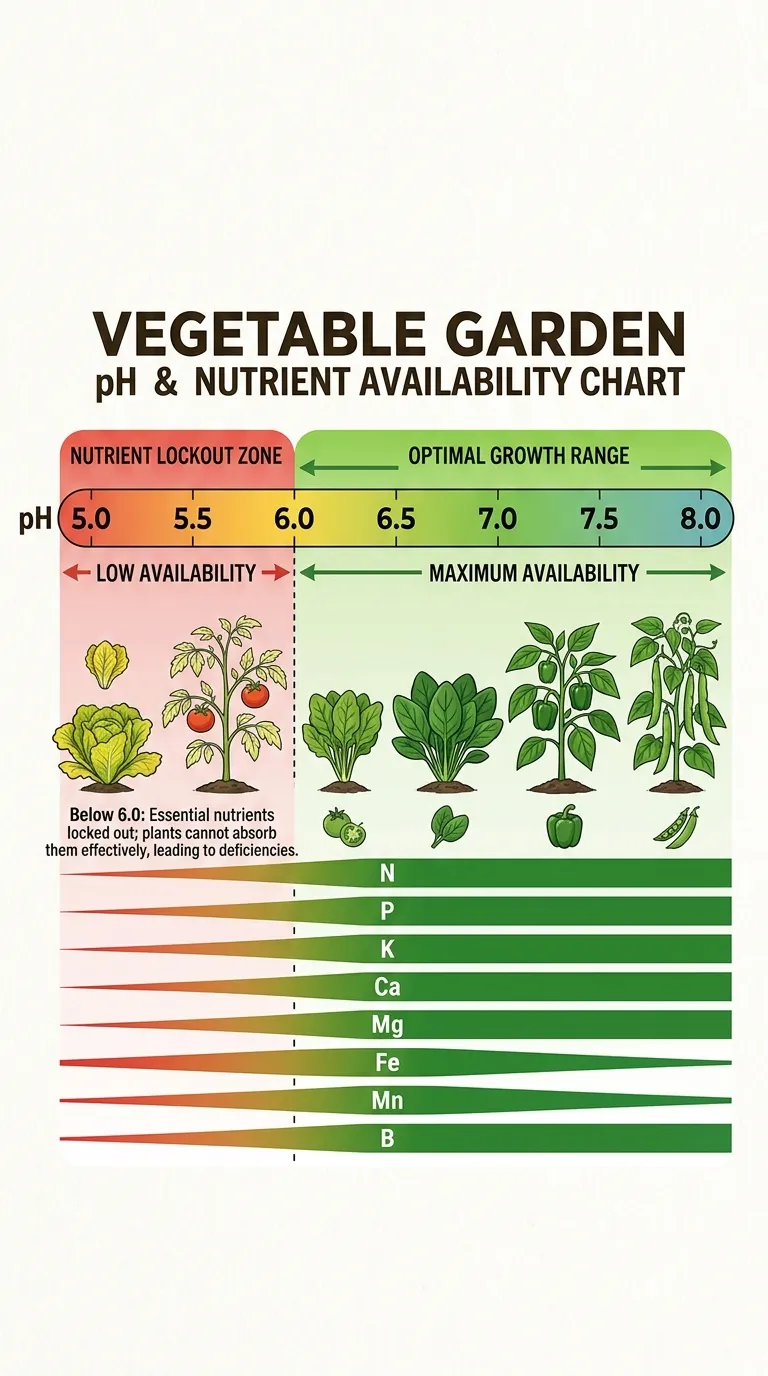
pH measures how acidic (0–7) or alkaline (7–14) soil water is. That acidity governs chemistry: at low pH, phosphorus binds tightly to iron/aluminum; calcium leaches; aluminum can become soluble and toxic to roots. At high pH, iron, zinc, and manganese form insoluble minerals roots can’t absorb — even though they’re physically there.
Think of pH as the bouncer at the nutrient door. Compost and fertilizer stock the buffet, but pH decides who gets in. That’s why two gardens with identical fertilizer can grow utterly differently — one at pH 6.4 thriving, one at pH 5.2 stalled, with the same “fertility” on paper.
Signs pH is off:
- Acidic (<6.0): Stunted growth, poor fruit set despite flowers, blossom end rot even with even water, red/purple tinge on leaves (phosphorus hunger).
- Alkaline (>7.5): Interveinal chlorosis — yellow between green veins, especially on young leaves (iron/manganese hunger), slow growth, pale.
Only a test knows for sure — symptoms overlap with other issues, but testing is cheap and decisive.
How to Test — At Home and Via Lab (Do Both)
Home Test: Quick Check
When: Fall or 4 weeks before spring planting, when soil is moist but not sopping.
How:
- Walk the bed in a zigzag, take 8–10 small cores/scoops 6 inches deep across the area — not just one spot.
- Mix in a clean bucket, remove stones/roots, let air-dry on newspaper.
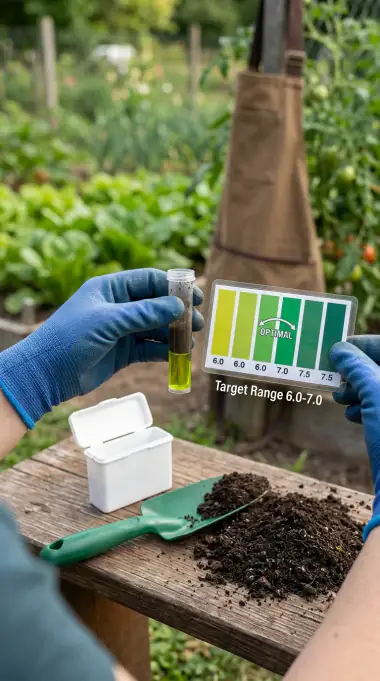
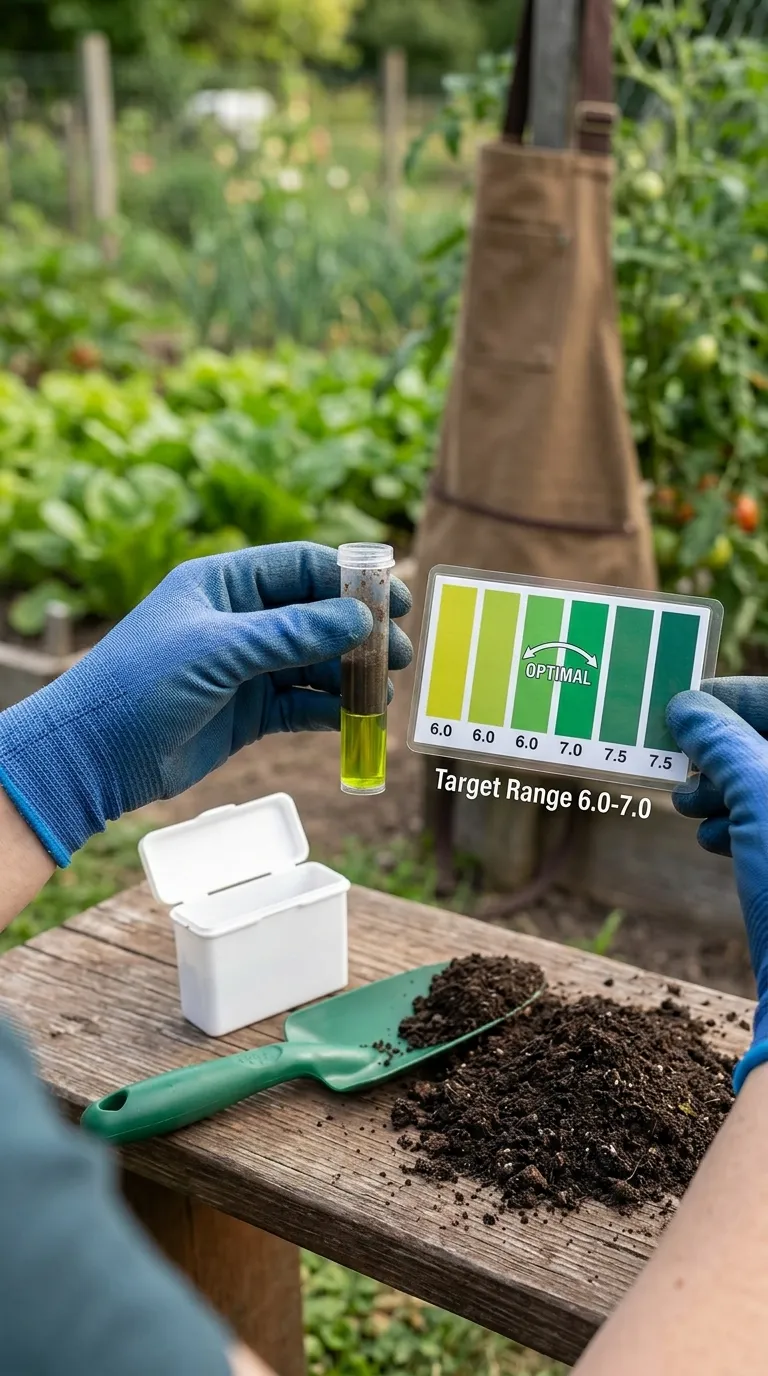
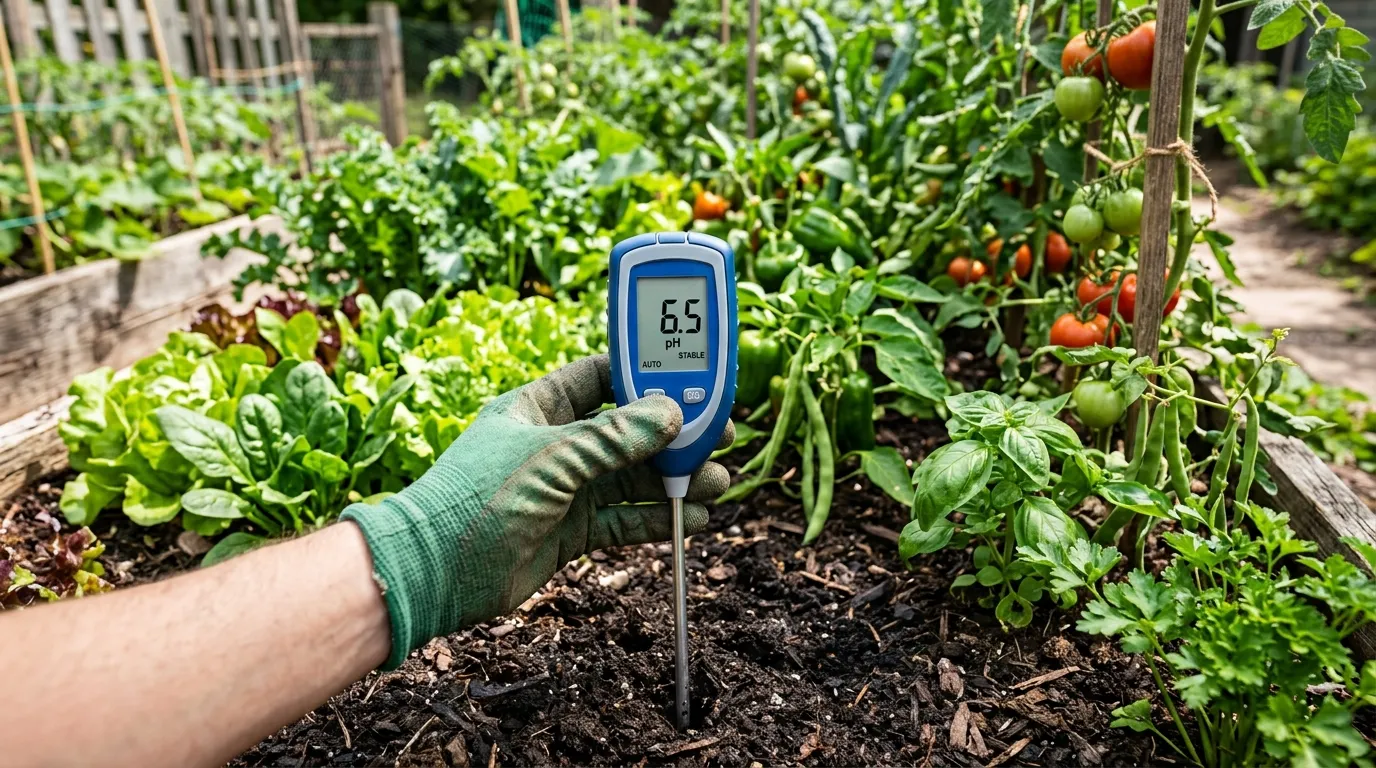
- Use a colorimetric kit or probe per instructions — distilled water, shake, compare color or read meter. Note pH to 0.2 accuracy.
Home kits are great for tracking trends, but their lime/sulfur recommendations are often vague.
Lab Test: The One That Guides Amendments
Every 2 years, send that mixed, dried sample to your cooperative extension ($15–25 in the U.S.). You’ll get precise pH, buffer pH, organic matter, phosphorus, potassium, and a lime/sulfur rate tailored to your soil type — clay needs more than sand to move the same 0.5 point.
Keep the report. Trends over 4–6 years tell you more than any single number — whether pH is drifting steadily acidic (common under mulch and rain) or holding.
See how to test soil pH and best soil for vegetable gardens.
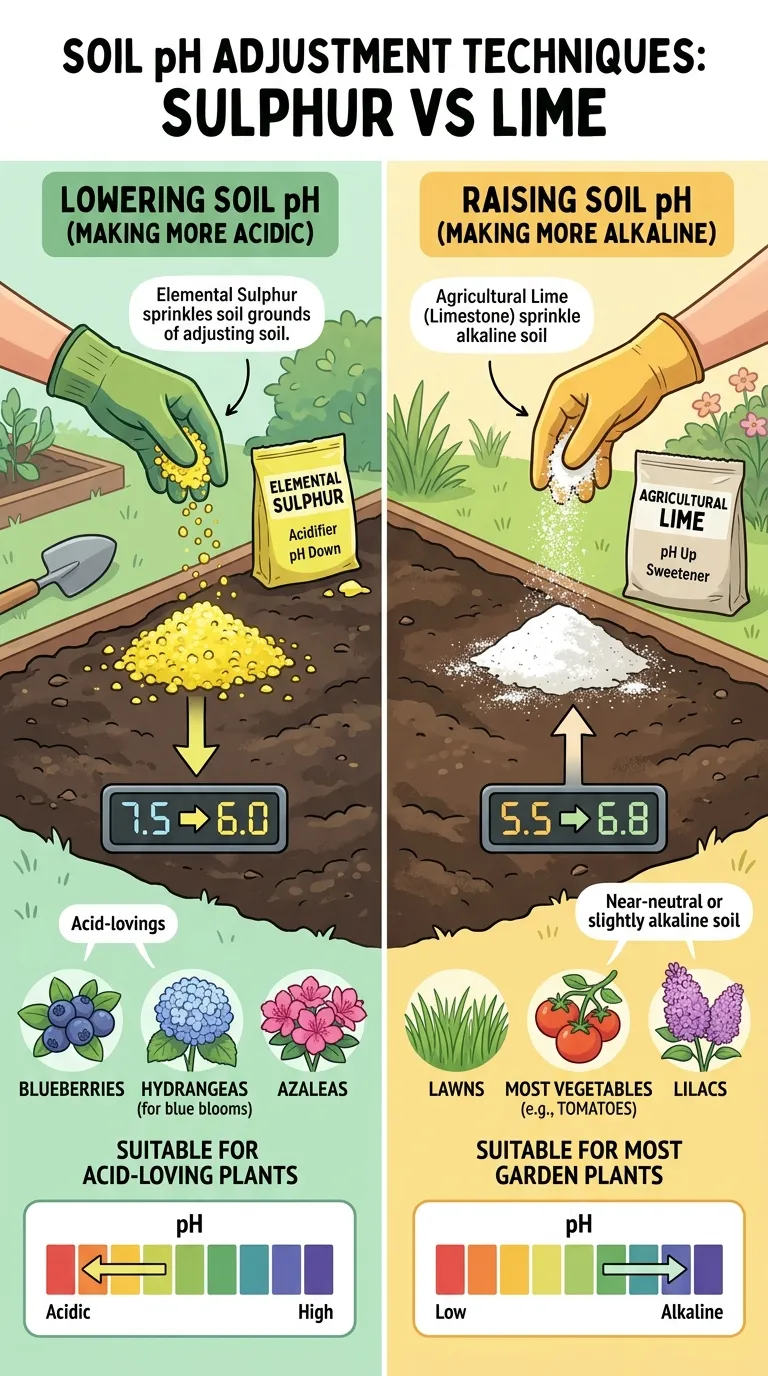
How to Raise pH (Make Less Acidic) — With Lime
If test says 5.2 and you want 6.5, you typically need 1.0–1.5 points. Clay needs more than loam; loam more than sand — another reason lab rates matter.
Garden lime (calcium carbonate) is gentle, slow, and safe:
- Rate often 5–10 lbs per 100 sq ft per 0.5 pH point, depending on soil type and buffer. A 4×8 bed (32 sq ft) rising 0.5 point often needs 1.5–3 lbs.
- Types: Calcitic lime (calcium) for most; dolomitic lime (calcium + magnesium) if soil test shows low magnesium. Don’t guess — use test notes.
- When: Fall is ideal — lime needs 3–6 months of moisture and biology to react. Spring is second best; it still helps but less before planting.
- How: Spread evenly on dry soil, rake lightly into top 3 inches, water in. No tilling storm needed. Avoid breathing dust; wear mask/gloves.
Over-liming warning: It’s easy to add, hard to remove. Going from 6.5 to 7.8 with heavy lime can lock iron for years. Go half-rate, retest next season, then fine-tune. Yearly compost helps hold pH without big lime swings.
How to Lower pH (Make More Acidic) — With Sulfur
More common in arid and alkaline regions where pH sits 7.5–8.2 and leaves go chlorotic.
Elemental sulfur (priced as “soil sulfur”) is the standard:
- Rate often 1–2 lbs per 100 sq ft per 0.5 point, per lab — sandy soil needs less, clay more.
- Needs warmth and microbes: Soil bacteria convert sulfur to sulfuric acid over 8–12 weeks warm (soil >60°F). Apply in fall for spring planting or early spring for summer crops.
- How: Spread on dry soil, incorporate top 3–4 inches, water lightly. Don’t use aluminum sulfate routinely — it’s faster but can build aluminum.
Compost buffer: 1–2 inches compost yearly helps nudge alkaline soil toward neutral while adding iron-chelate-friendly organic matter that keeps iron available even at slightly high pH.
Extreme alkaline (>8.0): Sulfur alone is slow. Combine with organic matter, avoid lime-containing water if possible, and consider raised beds with imported 60/30/10 loam at pH 6.5 to sidestep native alkalinity.
Vegetables and Their pH Preferences
Most vegetables overlap at 6.0–7.0, but knowing the edges helps you group beds if your soil runs a bit acidic or alkaline.
| Crop Group | Preferred pH | Notes |
|---|---|---|
| Tomatoes, peppers, eggplant | 6.0–6.8 | Need calcium; blossom end rot often pH + water, not just calcium |
| Lettuce, spinach, chard | 6.0–7.0 | Sensitive to strong acidity; tip burn links to Ca lockup |
| Beans & peas | 6.0–7.0 | Best nodulation; acidity reduces nitrogen fixation |
| Carrots, beets | 6.0–7.0 | Even moisture + correct pH prevents forking/bitterness |
| Brassicas (cabbage, broccoli) | 6.0–7.5 | Clubroot is worse <6.0; slight alkalinity deters clubroot |
| Potatoes | 5.0–5.5 | Scab suppression; grow slightly acidic, lime lightly |
| Garlic, onions | 6.0–7.0 | Need steady Ca; don’t over-lime |
| Blueberries (fruit, not veg) | 4.5–5.5 | Very acidic; keep separate bed; don’t lime near them |
If you grow potatoes and tomatoes in the same bed over rotation, aim 6.0–6.5 — a compromise that keeps both happy and suppresses scab somewhat while keeping tomatoes productive.
Maintaining pH — The Yearly Rhythm That Prevents Drift
pH never stays put. Rain leaches calcium, mulch acidifies slightly, compost buffers, and fertilizer can nudge. The yearly habits that keep you in range without drama:
- Yearly 1–2 inch compost top-dress — buffers toward neutral from either side.
- Mulch 3 inches straw — moderates leaching and feeds the microbes that regulate pH.
- Test every 2 years — retest 6 months after any lime/sulfur adjustment to confirm.
- Water with awareness: Very hard, alkaline well water can slowly raise pH — if that’s your water, test more often and favor compost over lime.
- Don’t chase 6.5 exactly every season. Stable 6.2–6.8 is better than yo-yoing between 6.0 and 7.0 with heavy amendments.
My calendar: even-numbered springs I test. Odd-numbered falls I apply if needed, so winter does the work. The journal entry is just “pH 6.4 — no lime” — thirty seconds that saves a season of guessing.
Common Mistakes and How to Avoid Them
Amending by habit, not test. “I always lime in spring” is how 6.4 becomes 7.8. Test first, apply only per rate. Over-liming is the hardest pH mistake to undo.
Liming and fertilizing heavily at once. Heavy fertilizer + lime can push salts high. Space applications 2 weeks apart, and prefer compost as the gentle base.
Using wood ash as casual lime. Wood ash is alkaline (pH 10–12) but wildly variable — a shovelful can swing a bed a full point if soil is light. If you use it, test after, apply thinly (1–2 lbs/100 sq ft), and never combine with lime same season.
Expecting overnight change. Lime needs months, sulfur needs warmth and weeks. Applying a week before planting and expecting new pH is why fall application matters.
Testing one spot. One scoop near the compost pile reads higher than the bed average. Zigzag 8–10 cores for a true average or you’ll under/over-correct the rest of the bed.
Ignoring water pH. If your irrigation water is pH 8.0+, you’ll fight upward drift yearly. Mention water source on your lab submission — they can factor it.
Seasonal Calendar
| When | Do |
|---|---|
| Fall (best) | Take lab sample if 2-year mark; apply lime or sulfur per rate; top with 1–2″ compost after; mulch 3″ |
| Late winter | Order amendments; check compost maturity; review last report for trend |
| Early spring (4 wks pre-plant) | Broadfork, top-dress 1″ compost; if you missed fall lime, apply now but expect slower response |
| At planting | Recheck home pH if you amended; don’t re-lime same season |
| Midsummer | Keep mulch 3″; note any chlorosis/blossom end rot — flag for fall test |
| Every 2 years | Lab test; log pH and amendments; note water source changes |
Troubleshooting: Quick Diagnostics
Leaves yellow between green veins, young leaves first: Likely high pH iron chlorosis (>7.5). Test, apply sulfur per lab, add compost, ensure not waterlogged (which also yellows). Foliar iron chelate is a temporary rescue, not a fix.
Poor fruit set, blossom end rot despite even water: Check acidic pH (<6.0) locking calcium/phosphorus. Test, lime per rate in fall, ensure even deep watering and mulch — pH + water together solve most cases.
Fertilizer seems to do nothing: Classic pH lockup. Stop adding more fertilizer, test pH, correct, then feed per test. More fertilizer at wrong pH is salt stress, not help.
pH won’t rise after liming: Rate too low for clay/buffer, or lime was coarse and slow, or soil is very acidic and needs 2 applications 6 months apart. Use lab buffer pH rate, ensure fine garden lime (not pelletized coarse chunk), and retest.
pH bounced too high after amending: Over-limed. Add compost, water deeply to leach lightly if sandy (not clay), apply sulfur only if lab says >7.5 and symptoms show — otherwise wait; pH often drifts down slowly with rain/mulch. Patience beats another heavy correction.
The Quiet Confidence of Knowing Your Number
Knowing your pH — a single number, updated every two years — is like knowing your garden’s blood pressure. It tells you whether all that good compost and careful watering can actually reach roots. When it’s 6.4 and you spread compost and mulch, you feel the quiet confidence that what you add will be available, steady, and kind to plants.
If you haven’t tested this year, let this be the invitation. One mixed handful from 6 inches down, one envelope to extension, one line back that says “6.1” or “7.2” — and suddenly you garden with clarity instead of guessing. That clarity tastes like a tomato that set every fruit and a lettuce that stayed green to the heart.
Deep Dive: pH Myths, Water & Long-Term Stability
Myth Busting
- Myth: ‘Lime every spring regardless.’ Truth: Test first; over-liming to 7.8 locks iron for years.
- Myth: ‘Wood ash is same as lime.’ Ash is pH 10-12 variable; a shovelful can swing point in light soil - use sparingly and test after.
- Myth: ‘Sulfur works overnight.’ Needs 8-12 warm weeks and bacteria; fall application matters.
- Myth: ‘pH 7.0 is always best.’ Potatoes 5.0-5.5 deter scab; blueberries 4.5-5.5; mixed bed 6.0-6.5 is pragmatic compromise.
Water pH Often Overlooked
- Hard well water pH 7.5-8.2 slowly raises bed pH yearly - test water and note on lab form; may need more frequent testing.
- Rain is 5.6 acidic - naturally nudges pH down over seasons, especially under mulch.
- If water is alkaline and soil 6.4, favor compost buffering over aggressive sulfur - gently counter drift.
Reading Your Lab Report Beyond pH
- Buffer pH: Indicates lime requirement precisely - clay needs more than sand for same point change.
- Organic matter %: Aim 4-8%; low OM means pH swings faster - compost stabilizes.
- Phosphorus/Potassium: Categories (low/optimum/high) guide whether fertilizer needed or just compost + pH.
Long-Term Stability Without Yo-Yo
- Compost yearly 1-2 inches buffers both sides toward 6.5 naturally.
- Mulch 3 inches moderates leaching that pulls calcium and raises acidity.
- Avoid heavy ammonium fertilizers that acidify quickly; prefer compost/organic granular per test.
- Log pH and amendments yearly - trend beats single snapshot; you will see if lime every 2 vs 3 years is enough.
Quick Correction Reference (per 100 sq ft, always per lab)
- Raise 0.5 point: 5-10 lbs lime (clay high end, sand low).
- Lower 0.5 point: 1-2 lbs elemental sulfur.
- Example 4x8 bed (32 sq ft) raise 0.5: ~1.6-3.2 lbs lime. Measure, do not eyeball.
Emergency Rescue (Without Overcorrecting)
- Chlorosis at 7.8: foliar iron chelate greens leaves in days but does not fix soil - add sulfur per lab for next season and compost now.
- Blossom end rot at 5.2: improve pH fall with lime and keep even deep water + mulch - fruit recovers next flush.
Knowing your number every 2 years replaces guessing with calm, measured feeding - and vegetables taste the difference.
Regional pH Tendencies
- Northeast/Midwest clay loam: Naturally 5.5-6.5, often acidic under rain + mulch - lime every 2-3 years common.
- Southeast sandy: 5.0-6.0 acidic, needs lime but sand needs less - follow buffer rate.
- Arid West (AZ, CO, CA): 7.5-8.2 alkaline, sulfur + organic matter needed; consider raised bed with imported loam to sidestep.
- Pacific Northwest: 5.2-6.2 acidic under conifers - lime and compost help, but blueberries love it as is.
Test, don’t assume by region.
pH and Fertilizer Interaction
- Acidic <6.0: Phosphorus locked even if fertilizer added - pH first, then feed.
- Alkaline >7.5: Iron foliar spray greens quickly but soil sulfur + compost fixes root cause.
- Balanced pH 6.4: Half fertilizer needed vs pH 5.4 - you save money when pH right.
Always correct pH before increasing fertilizer rate.
Kid-Friendly Test Activity
Mix soil with distilled water, dip pH strip, compare color chart. Log 6.0 vs 7.0 colors. Simple science that builds intuition - and kids love the color change.
Long-Term Journal Example
2024: pH 5.8, added 3 lbs lime/100 sq ft fall. 2025: pH 6.3, no lime, compost 2 inches. 2026: pH 6.4, no lime, stable.
Trend shows lime every 2-3 years suffices - calm, not yo-yo.
When Separate Beds Make Sense
Potatoes at 5.2 next to tomatoes at 6.5: keep two beds 2 points apart if you grow both heavily. Blueberries at 4.8 always separate. For most home gardeners one bed 6.2-6.5 compromise works - rotate families, not pH.
Know your number, buffer with compost, adjust gently - pH becomes a background habit, not a stress.
Printable One-Page Checklist
Copy this onto an index card and tape inside your shed.
- Sun mapped (9am, noon, 4pm) - 6-8 hrs for fruiting, 3-4 for greens
- Soil test every 2 years - pH 6.0-7.0, organic matter 4-8%
- Bed depth 12-18 inches, width 4 ft max, never walk inside
- Mix 60/30/10 topsoil/compost/perlite blended on tarp, filled in 6-inch lifts watered
- Compost 1-2 inches yearly top-dress, not till
- Mulch 3 inches straw after 3 inches tall, replenish when bare
- Water deeply to 6-8 inches, then wait till top 2 inches dry (chopstick test)
- Thin on time: carrots 2 inches, lettuce 8 inches, tomatoes 18-24 inches
- Succession sow every 10-14 days for greens/radishes
- Cover crop or mulch any bed empty >1 week
- Log pH, compost, varieties, harvest notes each season
Next Steps & Related Reads
If this article helped, these build directly on it:
- Best Soil for Vegetable Gardens - the full 60/30/10 loam explanation
- How to Improve Garden Soil - 10 easy ways to build loam over seasons
- Best Soil pH for Vegetables - testing and adjusting pH 6.0-7.0
- Raised Bed Soil Mix - DIY recipe with bucket math and sourcing
- Best Soil for Raised Beds - ideal ratio, depth and maintenance
- When to Plant Vegetables - timing by frost date and succession
A Final Note From My Garden
I still keep the first carrot that grew straight after I fixed soil - it dried on the windowsill, crooked in the way memory is, reminding me that good gardening is not about being perfect the first time.
It is about noticing what soil is telling you - the smell after rain, the way water drains, the worms that appear when you mulch - and responding with one small, steady habit at a time.
You do not need a perfect garden this season.
You need one bed, one handful of compost, a pH strip, and the willingness to kneel a little longer and watch.
Soil will do the rest.
It always does, if we let it.
Quick Troubleshooting Reference
| Symptom | Likely Cause | Quick Fix |
|---|---|---|
| Yellowing lower leaves | Nitrogen leached or pH low | Top-dress 1 inch compost, test pH, feed per test |
| Yellow between veins | High pH iron lock or soggy roots | Test pH, add sulfur if >7.5, improve drainage |
| Stunted, purple tinge | Low phosphorus / acidic pH | Lime per test, ensure 6.0-7.0, even water |
| Wilting despite moist soil | Root rot from compaction/soggy | Broadfork when moist, add perlite, mulch, stop overwatering |
| Forked carrots | Shallow/stony/compacted soil | Deepen to 18 inches, sieve stones, thin to 2 inches |
| Bolting lettuce bitter | Heat + inconsistent water | Shade afternoon, water evenly, harvest young |
| No fruit set | pH off, overcrowding, heat | Test pH 6.0-7.0, space 18-24 inches, hand-pollinate |
Year-One Success Plan
Month 1: Test pH, build or amend one bed 60/30/10 12-18 inches, mulch path. Month 2: Sow succession greens/radishes, trellis north side peas/cucumbers. Month 3: Deep water to 6 inches, keep mulch 3 inches, thin ruthlessly. Month 4: Side-dress heavy feeders only if test says, harvest outer leaves, log notes. Fall: Top-dress 1-2 inches compost, test pH if due, mulch 3 inches or cover crop.
Consistency beats intensity. One bed done right teaches the system.
Variety Spotlight: My Top 3 For Beginners
If overwhelm hits, start with these three — forgiving, high reward, and they teach you the habits.
- Lettuce ‘Salad Bowl’ - cut-and-come-again, shade tolerant, 30 days to first snip.
- Carrot ‘Chantenay’ - short, sweet, forgives shallow beds a bit, straight in 60/30/10.
- Tomato ‘Celebrity’ or Pepper ‘Gypsy’ - determinate/bush, heavy in 12-18 inch loam, caged early.
Grow these well and you have learned 80% of vegetable soil and water rhythms.
What I Wish I Knew Earlier
Soil work looks like nothing - spreading compost, tucking straw - but it is everything. The bed you feed in October feeds you in July. Mulch is not decoration, it is moisture insurance. pH is not chemistry class, it is the key that unlocks the pantry. And thinning feels ruthless until you taste the uncrowded harvest.
Start small, be consistent, and let soil teach you season by season.
Frequently Asked Questions
Q: What is the best soil pH for vegetables?
A: Most vegetables thrive at pH 6.0–7.0 where nitrogen, phosphorus, potassium, calcium, iron and zinc are all most available. Below 6.0, phosphorus and calcium lock up causing poor fruit set and blossom end rot; above 7.5, iron, zinc and manganese lock up causing yellow leaves with green veins. A few exceptions like potatoes prefer 5.0–5.5 for disease suppression, but for mixed vegetable beds aim for the 6.0–7.0 window and test every two years to stay there.
Q: How do you test soil pH at home?
A: Zigzag the bed and collect 8–10 small cores 6 inches deep, combine in a clean bucket, remove stones, air-dry, then test with a colorimetric kit or meter per instructions using distilled water. Home kits show trends well but lack precise amendment rates, so every two years send the same mixed, dried sample to your extension lab for $15–25 — they return pH, buffer pH, organic matter and exact lime or sulfur per 100 square feet tailored to your soil type for accurate correction.
Q: How do you raise or lower soil pH?
A: To raise acidic soil, spread garden lime (calcium carbonate, calcitic or dolomitic per test) at typically 5–10 pounds per 100 square feet per 0.5 pH point; to lower alkaline soil, spread elemental sulfur at typically 1–2 pounds per 100 square feet per 0.5 point, both per lab rate and soil type. Apply in fall ideally, rake lightly into top 3 inches, water in and wait 3–6 months for lime or 8–12 warm weeks for sulfur to react, then retest before adding more.
Q: How often should you adjust soil pH?
A: Test every two years and amend only when the report says you’re outside 6.0–7.0, not by habit. Yearly 1–2-inch compost top-dressing plus 3-inch straw mulch naturally buffers pH toward neutral from either side, so many gardens need only small lime or sulfur every 2–3 years. Over-liming is hard to reverse and can lock iron for seasons, so go half-rate if unsure, retest in six months and adjust gently — stability beats chasing a perfect 6.5 every season.
Related Articles
- Best Soil for Vegetable Gardens
- How to Test Soil pH
- How to Improve Garden Soil
- Best Soil for Raised Beds
- How Often to Water Vegetables
- Vegetable Garden Fertilizer
Sources & References
- University of Minnesota Extension — Soil pH — https://extension.umn.edu/yard-and-garden
- Cornell Cooperative Extension — Vegetables & Soil — https://www.vegetables.cornell.edu/
- Oregon State University Extension — Gardening — https://extension.oregonstate.edu/gardening
- Iowa State University Extension — Horticulture — https://hortnews.extension.iastate.edu/