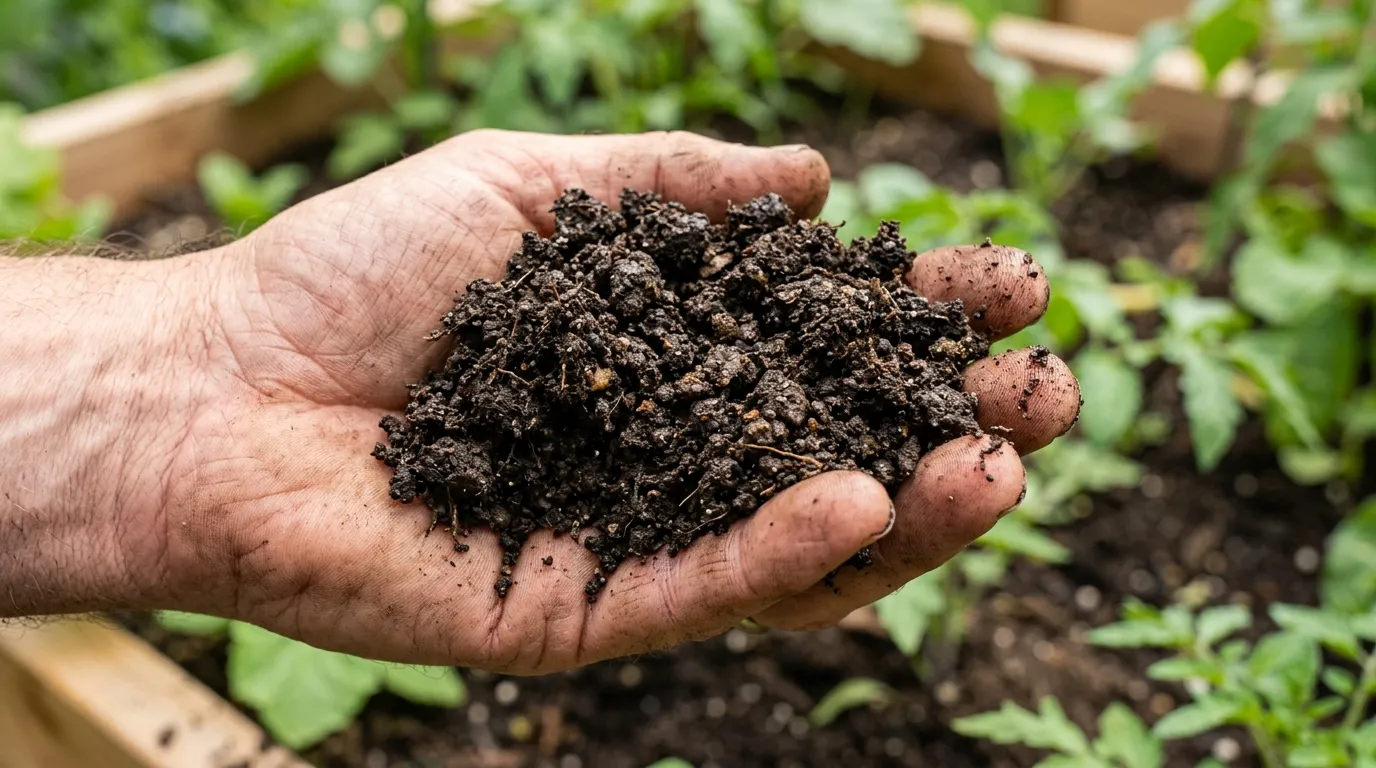
I used to think raised bed soil was just “good dirt you buy.” Fill the box, plant, done. Then I watched two beds, side by side, tell a different story. Both were 4-by-8, same sun, same tomatoes. One I’d filled with a bulk “garden soil” that looked dark and promising out of the truck — dense, a little sticky when wet, dusty when dry. The other I’d mixed to that 60/30/10 ratio a neighbor taught me — 60 percent screened topsoil, 30 percent compost, 10 percent perlite — the one that smells like a forest floor and crumbles like chocolate cake.
By July, the difference was humbling. The dense bed stayed soggy three days after rain, then cracked. The tomatoes were pale, with curled leaves and blossom end rot. The 60/30/10 bed drained the next morning but was still moist six inches down a week later. Those tomatoes were stocky, dark green, and loaded. Same variety, same water, utterly different world underneath.
Soil isn’t filler. It’s the whole environment. In a raised bed, you get to build that environment from scratch — a perfect loam that ground soil takes years to become. Get the ratio, depth, and pH right once, and the bed forgives a lot of other small mistakes for years.
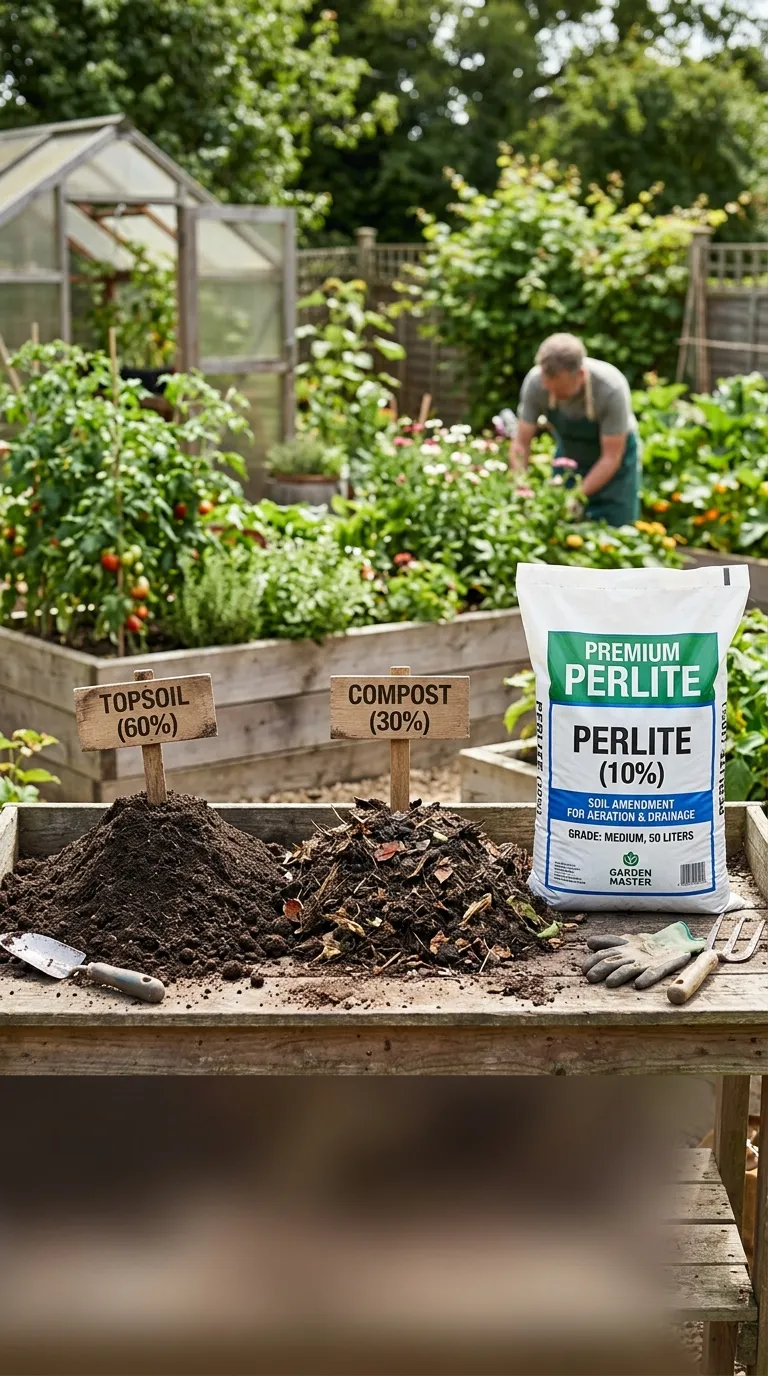
Quick Answer: The ideal raised bed soil is 60% screened topsoil + 30% finished compost + 10% perlite or coarse vermiculite, pH 6.0–7.0, depth 12–18 inches. This loam drains within hours but holds ~1 inch of water for a week, stays airy for roots and earthworms, and feeds microbes that feed vegetables. Blend on a tarp, fill in 6-inch lifts watering to settle, mulch 3 inches with straw after seedlings establish, and top-dress 1–2 inches compost yearly instead of tilling.
At a Glance: Ideal Raised Bed Soil
| Component | Ratio | Best Choice | pH | Depth | Feel |
|---|---|---|---|---|---|
| Topsoil (screened loam) | 60% | Bulk screened loam, not fill dirt | 6.0–7.0 target | 12–18″ | Gritty-smooth, holds shape then crumbles |
| Compost (finished) | 30% | Aged cow/mushroom or homemade | Buffers to neutral | — | Dark, earthy, no recognizable bits |
| Perlite / Vermiculite | 10% | Coarse perlite for drainage | — | — | White, crunchy, stays permanent |
| Overall Mix | 60/30/10 | Loam | 6.0–7.0 | 12–18″ | Wrung-out sponge: moist, airy, crumbly |
| Pure garden soil alone | — | Not recommended alone | Variable | — | Compacts in beds, poor air |
| Pure compost alone | — | Not recommended alone | Often 7.0–8.0 | — | Holds too much water, shrinks |
| Potting mix alone | — | For pots only | 6.0–6.5 | — | Too light, dries fast, costly |
Remember: topsoil = structure, compost = life, perlite = air.
Why 60/30/10 Works: The Sponge You Can Plant In
Think of ideal loam as a wrung-out sponge you can squeeze. Cool, moist, a few drops fall, then it springs back full of air pockets. Roots want exactly that — moisture on demand plus oxygen. Soggy soil drowns them; dusty sand starves them. Raised beds live or die on this balance because they’re isolated islands — no surrounding ground to buffer mistakes.
60% topsoil is the skeleton. It’s the mineral mix — sand, silt, a touch of clay — plus the trace elements compost alone can’t provide: iron, calcium, the grit that keeps soil from collapsing after rain. Good screened topsoil feels like brown sugar, not pottery clay. If you can roll a wet ribbon longer than 2 inches, it’s too clay-heavy — cut with extra perlite or source a sandier loam. If it falls apart before you make a ball, it’s too sandy — add extra compost.
30% compost is the pantry and the workforce. Humus holds up to seven times its weight in water, so that inch of weekly rain stays available for days, not hours. It feeds earthworms and mycorrhizae that in turn feed plants, buffers pH toward neutral, and releases nitrogen-phosphorus-potassium slowly, the way vegetables prefer. Fully finished compost smells sweet-earthy, never sour or ammonia — if you can name what went in, it’s not ready.
10% perlite is the permanent air. Those white bits don’t decompose. They keep the mix open after a downpour and prevent the bed from setting like brick in July. In truly heavy clay regions I use 15% in the bottom half; in sandy, hot zones I drop to 5% and add a bit of coconut coir for water.
Together they become loam that holds moisture for a week, drains in hours, and stays crumbly enough for carrot roots to go straight 7 inches without forking — which is exactly why best vegetables for raised beds are so much easier in boxes.
Buying Smart: What to Ask For
Walking into a landscape supply yard can feel intimidating. Here’s the language that gets you the right pile, not the cheapest one.
Say: “I need screened loam / screened topsoil and finished compost for a raised vegetable bed, 60/30/10.”
Ask: Is the topsoil screened? Is the compost fully finished (no recognizable feedstock, earthy smell, no heat)? Can you deliver mixed? Many yards will blend 60/30 for you — you then add 10% perlite at home.
Avoid: “Fill dirt,” “unscreened topsoil,” “composted wood fines” sold as compost, or “mushroom soil” that is mostly straw. Wood-heavy mixes rob nitrogen as they decompose — leaves yellow despite watering.
Test before you commit: Grab a handful, wet it, squeeze. It should form a ball that crumbles when poked, not a shiny, sticky ribbon. Smell it — sour or rotten-egg means anaerobic and compacted.
How Deep? Deeper Than You Think
Raised beds are your chance to guarantee depth that in-ground rarely offers.
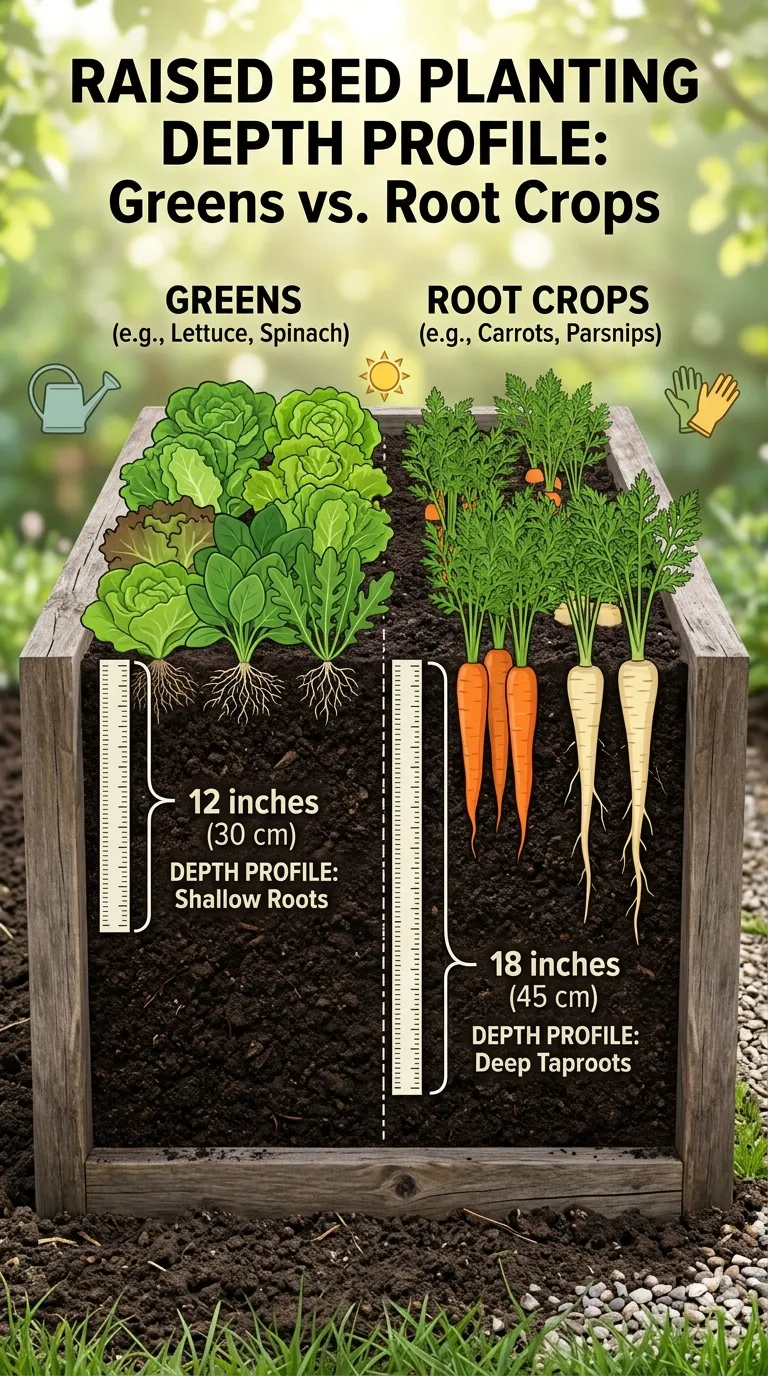
- 8–12 inches: Enough for lettuce, spinach, radishes, herbs. They’ll produce, but you’ll water more often and beds dry fast.
- 12 inches: Minimum for most vegetables — beans, peas, peppers, bush cucumbers. Holds moisture for a week with mulch.
- 15–18 inches: Ideal for tomatoes, squash, carrots, beets, potatoes. Carrots need 18 inches of stone-free loam to be straight; tomatoes need it for anchorage and stable water that prevents blossom end rot.
If you’re on heavy clay or shallow over hardpan, don’t dig down 18 inches into infertility. Build up. An 18-inch frame with open bottom lets earthworms incorporate slowly below over seasons while vegetables get depth now. Place cardboard over grass, set frame, fill — the sod becomes food.
My rule: if you can afford one bed at 18 inches or two at 10 inches, build the one deep bed. It will outyield both shallows combined.
pH: The Invisible Dial
Raised bed loam should sit at pH 6.0–7.0, slightly acidic to neutral, where nutrients are actually available. Outside that, nutrients are present but chemically locked.
- Below 6.0 (acidic): Phosphorus, calcium, magnesium hide. Fruit set drops, blossom end rot appears even with good water, growth stalls. Below 5.5, aluminum can turn toxic.
- Above 7.5 (alkaline): Iron, manganese, zinc hide. Leaves yellow between veins (chlorosis), flavor suffers.
Test every 2 years via cooperative extension ($15–25) — it’s the cheapest yield booster. Adjust per lab rates:
- To raise pH (less acidic): Garden lime (calcium carbonate), typically 5–10 lbs per 100 sq ft per 0.5 point, applied in fall so winter rain works it through.
- To lower pH (more acidic): Elemental sulfur, typically 1–2 lbs per 100 sq ft per 0.5 point, needing warm soil and months to work.
Compost annually buffers pH toward neutral naturally, which is another reason that spring top-dress matters more than a one-time fix. See soil pH guide.
Building & Filling Without Compacting
The order matters as much as the ratio.
- Cardboard base. Overlap plain cardboard over grass/weeds inside the frame, wet thoroughly. No need to dig sod — worms do it.
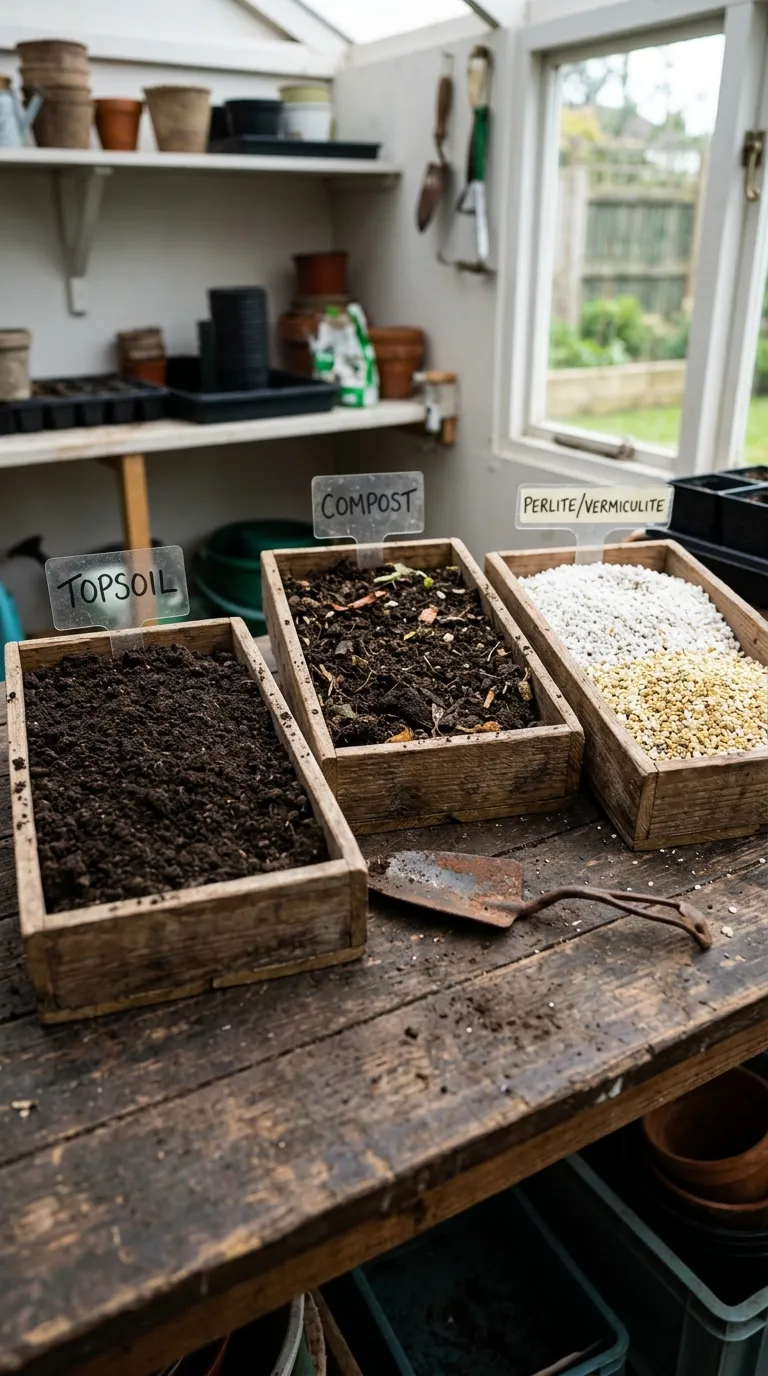
- Blend off-bed. On a tarp, measure by 5-gallon bucket: 6 topsoil, 3 compost, 1 perlite. Blend until color uniform. Blending on tarp gives even 60/30/10 throughout; mixing in the bed leaves dense pockets.
- Fill in lifts. Add 6 inches, water deeply to settle naturally, add 6 more, water again. Surface should sit 1–2 inches below rim to hold mulch. Never stomp — foot compaction erases perlite’s work.
- Plant immediately, mulch after. Seeds and transplants go in now. Once seedlings are 3–4 inches, mulch 2–3 inches with straw, shredded leaves, or grass clippings. Mulch isn’t decoration; it keeps that inch of water from evaporating in a day and becomes humus.
- Don’t till next spring. Top-dress 1–2 inches compost and rake lightly into top inch. Broadfork only if compacted — lifting, not inverting, preserves fungal networks and worm channels.
Maintenance: Keeping Loam Lively
Raised beds don’t stay perfect by accident — they stay perfect with tiny, consistent care.
Mulch 3 inches. I mulch after planting, not before, and replenish when I see bare soil. Straw is my favorite — light, clean, easy to pull aside for succession sowing. It keeps soil 10°F cooler in July and suppresses weeds that love fluffy soil.
Water deeply, less often. That loam holds water 6–8 inches down when watered properly. A light daily sprinkle wets only the top inch and encourages shallow roots. Soak at the base mornings, until a trowel shows moisture 6 inches down, then don’t water again until top 2 inches are dry. Even depth prevents blossom end rot and cracking — see how often to water vegetables.
Top-dress yearly compost. That’s often the only feeding needed in good loam. Heavy feeders (tomatoes, squash) may want an organic granular side-dress at flowering per soil test, but compost is the diet — fertilizer is the adjustment.
Don’t let beds sit bare. Bare soil is dying soil — microbes exposed, crust forming, moisture gone. If empty more than a week, sow crimson clover or oats as cover crop, or mulch and let it rest. Roots stitch soil open even when you’re not planting.
Common Mistakes That Undo Good Loam
Filling with pure garden soil or pure compost. Pure garden soil — even “good” — compacts in an isolated box without deep earthworm activity; pure compost holds too much spring water, shrinks 30% by fall, and crusts in summer. The 60/30/10 compromise is the fix.
Buying bagged “raised bed mix” without reading. Many are potting-mix-light wood fines at loam price — they dry bizarrely fast and need constant feeding. Blending bulk on a tarp is cheaper and better controlled.
Bed too shallow. A 6-inch box is a lettuce-only box. It dries daily and limits roots. Go 12 inches minimum, 18 for carrots and tomatoes. Your back will thank you for the height anyway.
Walking in the bed. One season of stepping where you grow erases a year of structure. Keep beds 4 feet wide max so you reach from paths, and never step in.
Skipping pH test. pH drift is silent — yellowing, poor fruit, endless fertilizer that can’t be taken up at pH 5.2. Test every even spring; it’s your soil’s birthday.
Over-watering daily lightly. The number one killer I see in raised beds. Deep weekly-ish soaks beat daily sprinkles. Mulch and check with a trowel, not a calendar.
Seasonal Calendar
| Season | Action |
|---|---|
| Fall (best build time) | Test pH if due; add lime/sulfur per test; build/fill beds; mulch 3″ straw or sow cover crop; plant garlic cloves |
| Late winter | Order topsoil/compost early (sell out by April); check compost maturity |
| Spring (4 wks pre-last frost) | Broadfork lightly, top-dress 1–2″ compost, rake, water deeply day before sowing |
| At planting | Mix 1/2″ compost into top 3″ for seedlings; mulch 3″ after 3″ tall |
| Midsummer succession | Pull, add 1/2″ compost between rows, sow again; keep mulch 3″ |
| Every 2 years | Retest pH/nutrients, adjust gently, log results in journal |
Troubleshooting
Bed drains too fast, dries in a day. Mix too sandy or perlite too high (especially in arid zones). On next top-up, reduce perlite to 5% and add extra compost/coconut coir. Mulch 3 inches immediately.
Stays soggy 2 days after rain. Clay-heavy topsoil or fine perlite, or fabric trapping water underneath. Increase perlite to 15% in lower half, ensure open bottom, use coarse perlite only.
Soil line dropped 4 inches. Normal first-year settling — air pockets collapsed, compost decomposed. Top up with 60/30/10, not pure compost, to keep ratio.
Seedlings leggy, pale, then damping off. Overwatering + dense mix + low light. Verify 10% perlite present, water mornings only, thin for airflow, ensure 6 hours sun for seedlings.
Leaves yellow between veins (chlorosis) despite richness. Likely pH above 7.5 locking iron. Test pH, apply sulfur per test, and mulch with organic matter that buffers. Check also for waterlogging.
A Bed That Gets Better
My best bed is now four years old. Each spring I do almost nothing — a broadfork rock, an inch of compost, a rake, a deep watering — and it grows better than the year before. Earthworms have come up from below, fungal threads lace the soil, and the surface, when I pull back straw, is dark and breathing. That’s the payoff of building loam right once: it compounds.
If you’re starting this season, build one bed fully — 60/30/10, 16–18 inches, well-mulched — and plant it intensively. One excellent bed will teach you more than two thin ones, and the food will prove the point by July.
Soil first, harvest second, always.
Deep Dive: Nutrition & Biology of Ideal Loam
Nutrient Dynamics in 60/30/10
- Nitrogen: Compost releases slowly via microbes - no salty burn. Heavy feeders (tomato, squash) may want side-dress granular organic at bloom if test shows low N.
- Phosphorus/Potassium: Topsoil provides mineral base; compost adds available forms. Lab test guides if supplement needed - do not fertilize blind.
- Micronutrients: Topsoil trace minerals (iron, calcium) complement compost humus that chelates iron even at slightly high pH.
Biology You Cannot See (But Can Smell)
- Earthworms: Arrive within weeks under cardboard + compost + straw; their channels are permanent aeration.
- Mycorrhizae: Fungal threads extend root reach feet outward - tillage slices them, broadfork preserves.
- Actinomycetes: Earthy smell after rain - sign of healthy decomposition.
Lift straw in a thriving bed - white lace threads and worm casts are success metrics more honest than any bag label.
Variant: No-Till Top-Dress Cycle
Year 1: Build 60/30/10 16-18 inches. Year 2+: Each spring 1-2 inches compost raked into top inch, no inversion. By year 4, organic matter climbs to 6-8%, pH stabilizes 6.4, and worms do the mixing.
Moisture & Temperature Buffering
Depth 16-18 inches holds 6-8 inches moist core even when surface dries. Mulch 3 inches keeps it 10F cooler July and 10F warmer October - roots stay in sweet spot longer, harvest extends.
When Native Soil Is Extreme
- Heavy clay under bed: Fork native 6 inches before filling, crown bed 2 inches, use 15% perlite lower half.
- Pure sand under: Add coir/compost heavy, reduce perlite to 5%, mulch heavier.
- Alkaline desert: Import 60/30/10 dominates; lab test yearly as alkaline water drifts pH up.
Cost vs. Value Over 5 Years
Deep bulk 60/30/10 costs ~$80-110 per 4x8 bed vs $200 bags, but real value is yield: 1.5-2x per sq ft on clay means one good bed feeds like two ground plots, paying back in one season of tomatoes alone.
Build one bed fully right - 60/30/10, 16-18 inches, mulched - and let it teach you.
Visual Cues Your Bed Is Ideal
- Color: Deep chocolate brown, not pale tan or jet black.
- Smell: Earthy forest after rain, not sour.
- Feel: Cool, moist, crumbles when poked, holds ball loosely.
- Life: When you lift straw, 2-3 worms per trowel, white fungal threads.
- Drainage: Water puddle disappears within hours, but trowel 6 inches down still damp next day.
If any cue off, adjust: pale + dusty = add compost; sour = add perlite and stop overwatering; no worms = add compost + mulch and stop tilling.
Amendments to Avoid in Ideal Beds
- Fresh manure (burns), unfinished hot compost (ties nitrogen), sand added to clay without compost (makes concrete), pure vermiculite large amounts (holds too much water in wet climates).
Stick to 60/30/10 and yearly compost - simplicity is the feature.
Record Keeping Template
Date | Bed | Depth | pH | Compost added | Notes Use phone notes or garden journal. One line per season tracks whether pH drift or settling needs topping.
Over 5 years you will see organic matter rise 3% -> 6%, pH stabilize 6.4, settling slow to 1 inch/year - proof compounding works.
Printable One-Page Checklist
Copy this onto an index card and tape inside your shed.
- Sun mapped (9am, noon, 4pm) - 6-8 hrs for fruiting, 3-4 for greens
- Soil test every 2 years - pH 6.0-7.0, organic matter 4-8%
- Bed depth 12-18 inches, width 4 ft max, never walk inside
- Mix 60/30/10 topsoil/compost/perlite blended on tarp, filled in 6-inch lifts watered
- Compost 1-2 inches yearly top-dress, not till
- Mulch 3 inches straw after 3 inches tall, replenish when bare
- Water deeply to 6-8 inches, then wait till top 2 inches dry (chopstick test)
- Thin on time: carrots 2 inches, lettuce 8 inches, tomatoes 18-24 inches
- Succession sow every 10-14 days for greens/radishes
- Cover crop or mulch any bed empty >1 week
- Log pH, compost, varieties, harvest notes each season
Next Steps & Related Reads
If this article helped, these build directly on it:
- Best Soil for Vegetable Gardens - the full 60/30/10 loam explanation
- How to Improve Garden Soil - 10 easy ways to build loam over seasons
- Best Soil pH for Vegetables - testing and adjusting pH 6.0-7.0
- Raised Bed Soil Mix - DIY recipe with bucket math and sourcing
- Best Soil for Raised Beds - ideal ratio, depth and maintenance
- When to Plant Vegetables - timing by frost date and succession
A Final Note From My Garden
I still keep the first carrot that grew straight after I fixed soil - it dried on the windowsill, crooked in the way memory is, reminding me that good gardening is not about being perfect the first time.
It is about noticing what soil is telling you - the smell after rain, the way water drains, the worms that appear when you mulch - and responding with one small, steady habit at a time.
You do not need a perfect garden this season.
You need one bed, one handful of compost, a pH strip, and the willingness to kneel a little longer and watch.
Soil will do the rest.
It always does, if we let it.
Quick Troubleshooting Reference
| Symptom | Likely Cause | Quick Fix |
|---|---|---|
| Yellowing lower leaves | Nitrogen leached or pH low | Top-dress 1 inch compost, test pH, feed per test |
| Yellow between veins | High pH iron lock or soggy roots | Test pH, add sulfur if >7.5, improve drainage |
| Stunted, purple tinge | Low phosphorus / acidic pH | Lime per test, ensure 6.0-7.0, even water |
| Wilting despite moist soil | Root rot from compaction/soggy | Broadfork when moist, add perlite, mulch, stop overwatering |
| Forked carrots | Shallow/stony/compacted soil | Deepen to 18 inches, sieve stones, thin to 2 inches |
| Bolting lettuce bitter | Heat + inconsistent water | Shade afternoon, water evenly, harvest young |
| No fruit set | pH off, overcrowding, heat | Test pH 6.0-7.0, space 18-24 inches, hand-pollinate |
Year-One Success Plan
Month 1: Test pH, build or amend one bed 60/30/10 12-18 inches, mulch path. Month 2: Sow succession greens/radishes, trellis north side peas/cucumbers. Month 3: Deep water to 6 inches, keep mulch 3 inches, thin ruthlessly. Month 4: Side-dress heavy feeders only if test says, harvest outer leaves, log notes. Fall: Top-dress 1-2 inches compost, test pH if due, mulch 3 inches or cover crop.
Consistency beats intensity. One bed done right teaches the system.
Variety Spotlight: My Top 3 For Beginners
If overwhelm hits, start with these three — forgiving, high reward, and they teach you the habits.
- Lettuce ‘Salad Bowl’ - cut-and-come-again, shade tolerant, 30 days to first snip.
- Carrot ‘Chantenay’ - short, sweet, forgives shallow beds a bit, straight in 60/30/10.
- Tomato ‘Celebrity’ or Pepper ‘Gypsy’ - determinate/bush, heavy in 12-18 inch loam, caged early.
Grow these well and you have learned 80% of vegetable soil and water rhythms.
What I Wish I Knew Earlier
Soil work looks like nothing - spreading compost, tucking straw - but it is everything. The bed you feed in October feeds you in July. Mulch is not decoration, it is moisture insurance. pH is not chemistry class, it is the key that unlocks the pantry. And thinning feels ruthless until you taste the uncrowded harvest.
Start small, be consistent, and let soil teach you season by season.
Evening Walk Habit
I finish days by lifting one corner of straw in each bed. If soil is cool and damp six inches down, I know my watering held. If straw is thin, I tuck a little more. That two-minute check keeps beds even without any app or schedule, and it teaches my hands what 60/30/10 feels like through the year — spring loose, summer cool, fall dark and wormy.
Final Encouragement
You do not need a lab to start. You need a trowel, a handful of compost, and the habit of covering soil after you plant. The loam you build this month will be better by next month and better still by spring, because life, once invited, multiplies.
Build one bed deeply and well. The rest will follow.
Seasonal Check: What to Notice Each Visit
Early spring, soil should be dark and crumbly under mulch, with faint mushroom smell and a few worms when you lift straw. By midsummer, mulch keeps it cool and moist six inches down even when the path is dusty. In fall, after harvest, the bed settles an inch or two — normal, just top with compost and tuck straw. If at any visit the trowel clangs or the surface crusts hard, that bed is asking for air: broadfork gently when moist-not-wet, add a little perlite with compost, and keep it covered.
That noticing becomes habit. And habit becomes harvest.
Frequently Asked Questions
Q: What is the best soil for raised beds?
A: A loam blended as 60% screened topsoil, 30% finished compost and 10% perlite or coarse vermiculite at pH 6.0–7.0 and 12–18 inches deep. Topsoil gives mineral structure and staying power, compost adds humus that holds moisture for a week and feeds earthworms and microbes, and perlite keeps permanent air pockets so roots breathe even after heavy rain. Together the mix feels like a wrung-out sponge — moist, crumbly and earthy — the exact balance vegetables need for vigorous, even growth.
Q: How deep should soil be in a raised bed?
A: At least 12 inches of loose loam for most vegetables — lettuce, beans, peas and herbs — and 15–18 inches for deep or heavy feeders like tomatoes, squash, carrots, beets and potatoes. Shallow 6-inch beds dry in a day, limit roots and swing hot-cold, while 18-inch beds hold moisture for a week, stay more even-tempered and let roots forage. If native soil is heavy clay, build up with a framed bed rather than digging 18 inches into subsoil; guarantee depth now and let worms incorporate below over time.
Q: Can you use potting mix in raised beds?
A: Not straight. Potting mix is perfect for containers but too light, too costly at scale and dries too fast on hot days when used alone in beds, while pure garden soil compacts without deep biology and pure compost shrinks and stays soggy. The 60/30/10 loam gives you mineral weight plus biology plus air — weight and nutrients for anchorage, humus for moisture and life, and perlite for drainage. Use potting mix in pots, and save the loam for beds where its structure truly performs.
Q: How do you keep raised bed soil healthy each year?
A: Top-dress 1–2 inches of finished compost each spring and rake lightly into the top inch instead of tilling, keep 3 inches of straw mulch after planting to hold moisture and feed microbes, and retest pH every 2 years to keep 6.0–7.0. Don’t walk on beds or till wet soil, top up settled beds with the same 60/30/10 blend to preserve ratio and cover bare soil with mulch or a cover crop like crimson clover if empty more than a week so soil life stays active.
Related Articles
- Best Raised Bed Soil Mix
- Best Soil for Vegetable Gardens
- How to Improve Garden Soil
- 15 Best Vegetables for Raised Beds
- 10 Raised Bed Gardening Mistakes to Avoid
- How to Test Soil pH
Sources & References
- University of Minnesota Extension — Raised Beds — https://extension.umn.edu/yard-and-garden
- Iowa State University Extension — Horticulture — https://hortnews.extension.iastate.edu/
- Oregon State University Extension — Raised Bed Gardening — https://extension.oregonstate.edu/gardening
- Royal Horticultural Society — Soil & Compost — https://www.rhs.org.uk/soil-composts-mulches