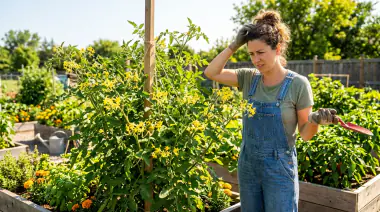
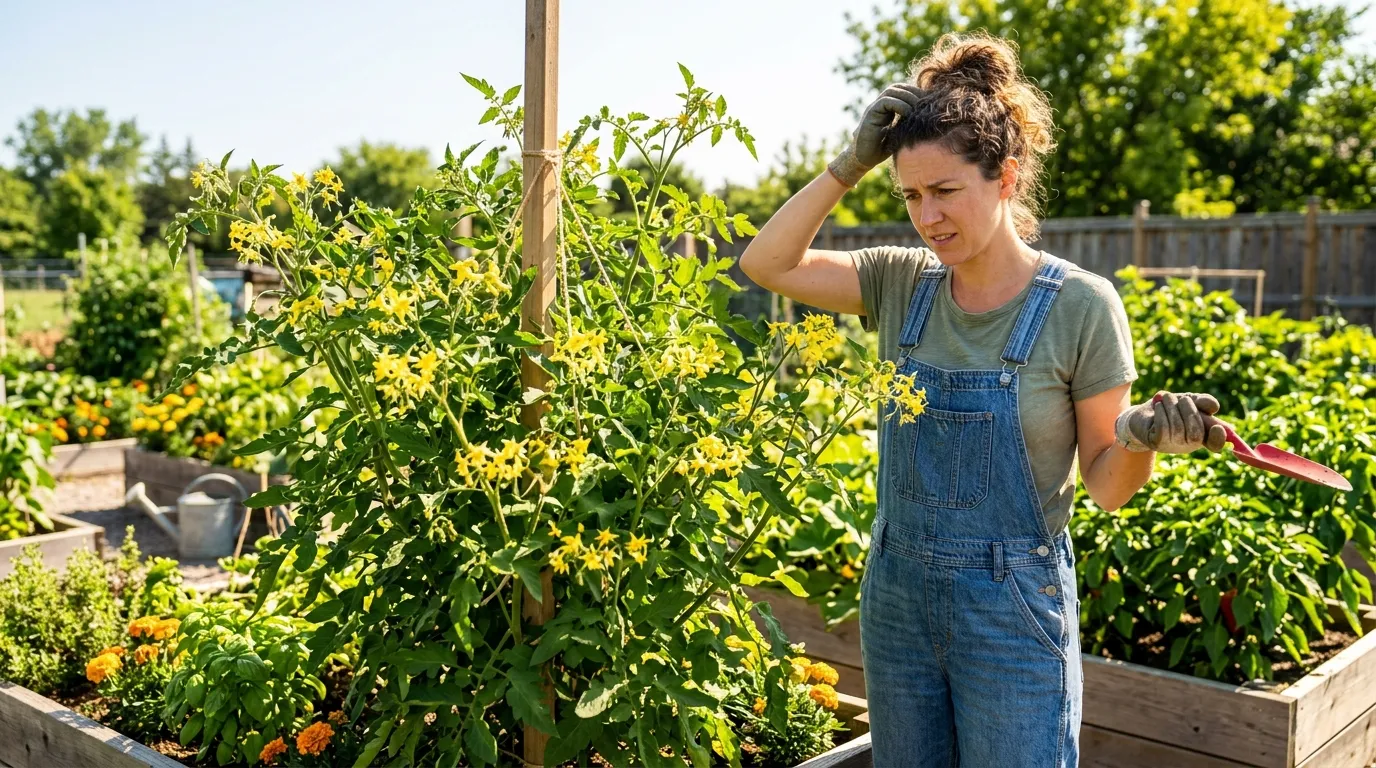
Is there a more heart-sinking sight than a tomato plant absolutely covered in pretty yellow flowers — and not a single tiny green fruit to show for it? You check every morning, pushing aside leaves, hoping to see that little swelling at the base of the blossom that says, yes, we made a tomato. Instead, the flowers just… yellow, shrivel, and fall. I have been there, and I know how personal it feels — like the plant is letting you down after all that hopeful tending.
Here is the reassuring truth I tell every worried beginner who emails me at Paliurus: in most cases your plant is healthy. It’s not dying. Its flowers simply didn’t get pollinated. And pollination in tomatoes is a wonderfully mechanical, fixable thing — a little shake, a little sun, a little timing — not a mystery.
I learned this the hard way during a brutal July heat wave with my ‘Brandywine’ heirlooms. The vines were enormous, jungly, gorgeous — and flower after flower dropped. No fruit. I thought I had fed wrong. In fact, it was too-hot nights plus still air on my sheltered patio. Once I understood that, I changed two tiny habits and within ten days I had marble-sized fruits hiding under every truss.
Let’s walk through exactly why blossoms drop without fruit, how to diagnose your specific cause in minutes, and the gentle fixes that coax those flowers into tomatoes — even in a tough summer. If you want the whole season view, my how to grow tomatoes guide pairs beautifully here.
Quick Answer: Tomato flowers fail to set fruit when daytime highs stay above 90°F or nights above 75°F (pollen gets sticky or sterile), when plants get too much nitrogen (big vines, few blooms), too little sun (fewer than 6 hours), or when pollination stalls in still, humid air. Give plants 6 to 8 hours of direct sun, feed with balanced fertilizer and switch to low-nitrogen once flowers open, water 1 to 1.5 inches per week evenly at the base, and shake each flower cluster gently at midday for 3 seconds to move pollen. Most plants resume fruiting within 10 to 14 days when temperatures moderate or vibration improves.
At a Glance
| Cause | What It Looks Like | Quick Fix That Works |
|---|---|---|
| Heat above 90°F / nights above 75°F | Flowers drop within 1-2 days, no swelling at base | 30% shade cloth over tops, mulch roots, water evenly, wait for cool nights |
| No pollination / still air | Flower stem yellows and abscises cleanly | Shake clusters at midday; electric toothbrush 3 seconds per truss |
| Too much nitrogen | Huge dark-green vines, lush leaves, very few flowers | Stop nitrogen, flush with water, switch to 5-10-10 |
| Too little sun | Leggy, pale, stretched stems, sparse blooms | Move containers to 6-8 hours direct sun; prune nearby shade |
| Inconsistent watering | Wilting + blossom drop + yellow leaves or blossom end rot | 1 to 1.5 inches per week in 2-3 deep sessions at base |
| Cold below 55°F nights | Flowers hold then fade, purplish stems | Row cover at night, wait for 55°F+ nights |
| Overcrowding / humidity | Dense jungle, flowers hidden, damp interior | Stake, prune suckers lightly, keep 2/3 foliage |
| Variety / timing | Big heirloom sets lightly in heat; young plant first truss light | Mix cherries + heat-set types; be patient for 2nd truss |
Why Flowers Drop Without Fruit — The Quiet Science Inside Each Blossom
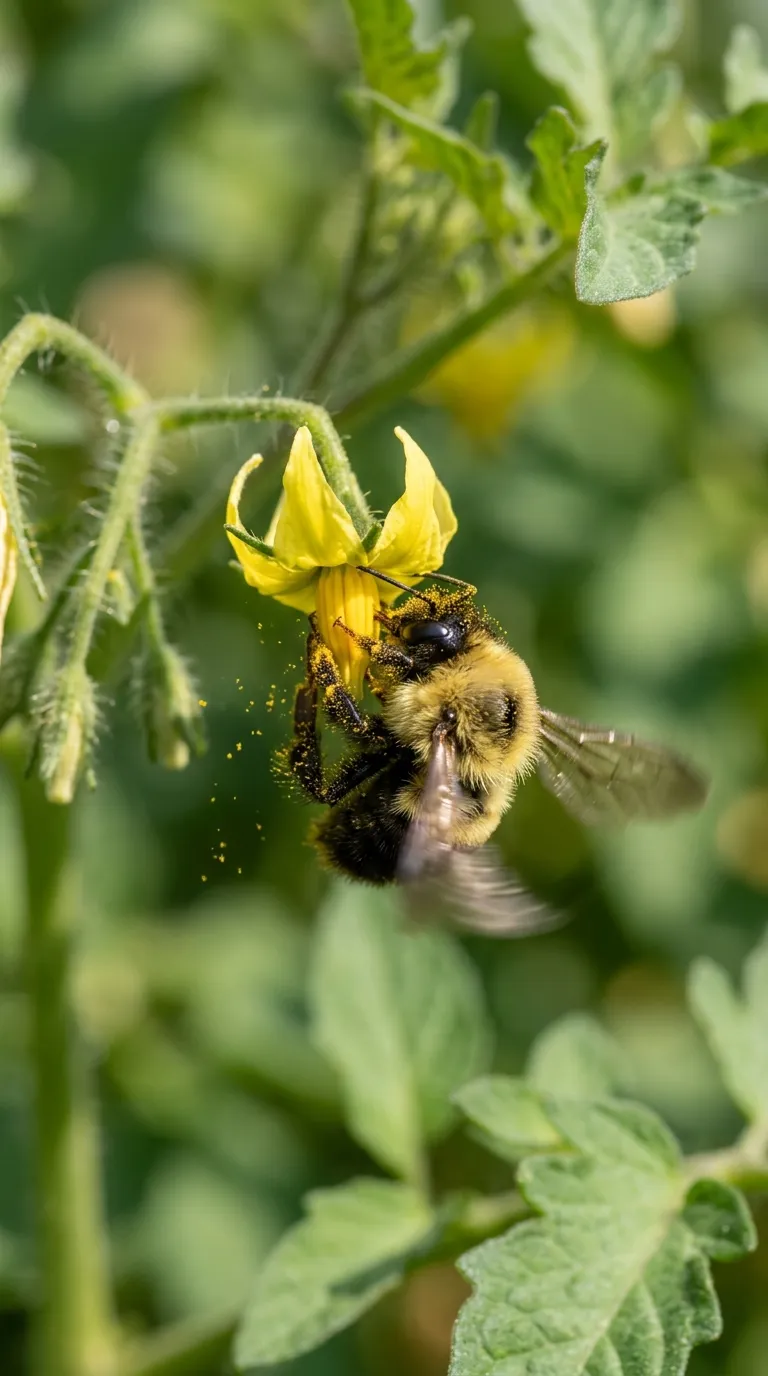
Every tomato flower is perfect — it holds both male and female parts inside the same blossom. In the center is the stigma (the female tip), surrounded by a little cone of anthers (the male parts) that release pollen inside the flower. For fruit to form, that pollen has to shake loose and land right onto the stigma. No trip to another flower required. No bee required, though bees certainly help by buzzing at the perfect vibration — what scientists call buzz pollination.
What tomatoes need most, then, is vibration. Wind does it. A bumblebee’s buzz does it at an ideal frequency. And your fingertap does it, too. When temperatures are just right — daytime 70-85°F and nights 55-75°F — pollen is fluffy, dry, and eager to shed. A gust or a gentle shake and it falls like dust. When it’s too hot (above 90°F day, above 75°F night), pollen becomes sticky, clumped, even sterile. When it’s too cold (below 55°F night), it stays damp and won’t release. In both cases, even perfect shaking fails, and the flower senses, we didn’t make seed, yellows at the pedicel, and lets go.
Seeing that helped me stop blaming myself. It wasn’t that I was a bad gardener. It was pollen biology, plus weather. And that is largely temporary.
11 Reasons Why Tomato Plants Are Not Producing Fruit — Find Yours
1. Heat Above 90°F / Nights Above 75°F (The Summer Stall) — The Number One Midsummer Reason
This is the top reason for mid-summer blossom drop from Kansas to Georgia. Day heat above 90°F makes pollen sticky; nights above 75°F make it almost sterile. Flowers open, look perfect, then drop within 24 to 48 hours without any swelling. The plant itself looks otherwise healthy — that’s the clue it’s environmental, not disease.
What to do: Add 30% shade cloth draped over the top of stakes — just to soften that scorching 2-5 p.m. sun. Don’t wrap the sides; you want breeze. Mulch 3 inches with straw to keep root zone below 80°F. Water deeply and consistently — 1 to 1.5 inches per week — so the plant isn’t heat-plus-thirst stressed. And then, patiently wait. Fruit set returns beautifully when nights cool back below 75°F, often by late August. Heirlooms and beefsteaks are most sensitive; cherries like ‘Sweet 100’ often power through.
2. Cold Below 55°F at Night (The Early Season Tease)
If you’re getting blossom drop in May or early June, cold is usually the actor. Tomatoes sulk when nights dip to the low 50s. Pollen stays damp, flowers hold a little longer, then fade. The plant may also look slightly purplish on stems (phosphorus not moving well in cold soil).
What to do: Wait to transplant until nights reliably stay above 55°F and soil is at least 60°F at two inches deep. If a late cold snap threatens already-blooming transplants, drape a floating row cover in the evening and remove it by mid-morning so pollinators and wind can still access flowers. I keep a cheap pack of row cover precisely for those fussy weeks.
3. Still Air / No Wind (The Sheltered Patio Problem)
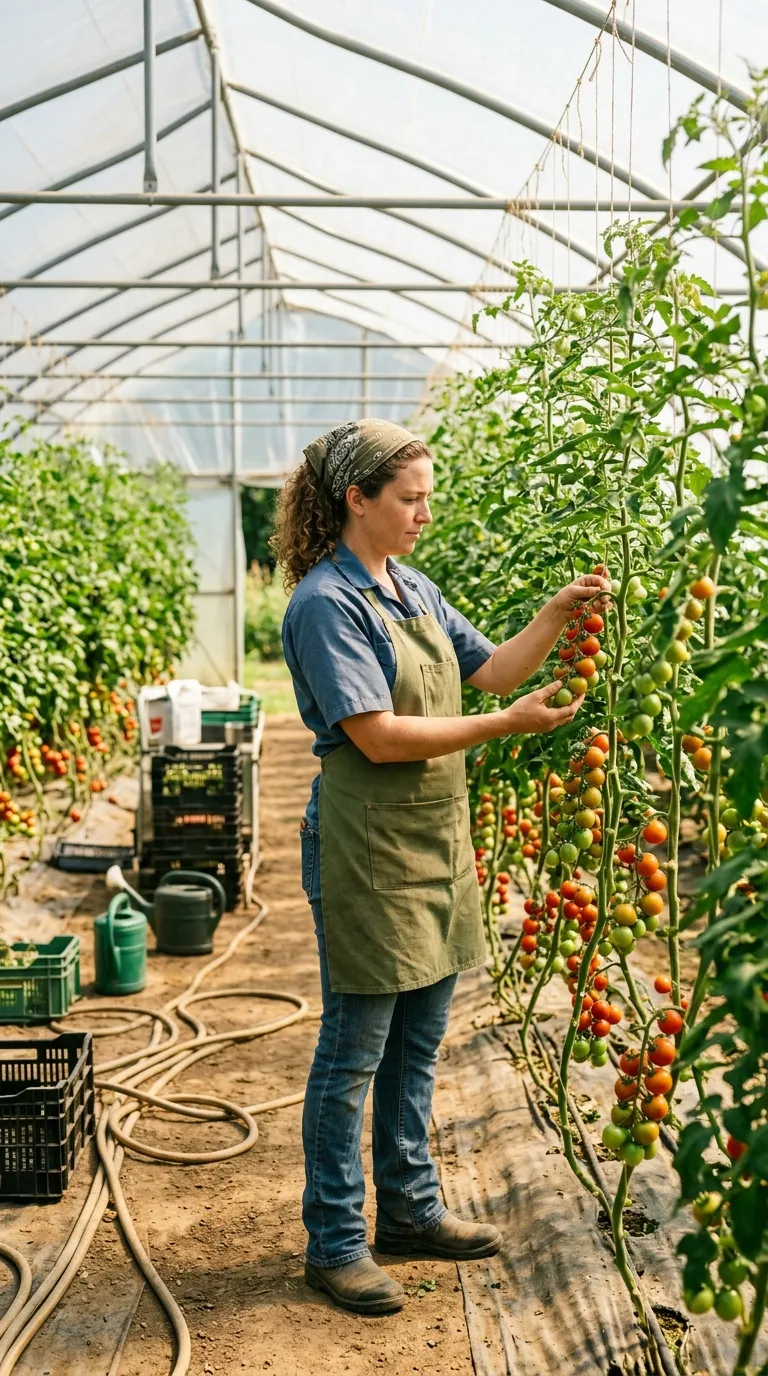
Do you grow on a calm balcony, against a privacy fence, or inside a greenhouse where the air is still as a library? Then pollen never gets that essential jiggle. Flowers may stay open longer, then drop cleanly at the abscission zone — that little elbow joint on the flower stem — with no fruit bead forming.
What to do — the 10-second ritual: Every day between 11 a.m. and 2 p.m., when the air is driest and pollen is fluffiest, gently hold the main stem and shake each flower cluster for about 3 seconds. Just a soft back-and-forth tremor. Or touch an electric toothbrush to the stem just behind open flowers and buzz for 2 to 3 seconds per truss. You’ll literally see a puff of pale pollen if you get the angle right in sunlight. Do this daily for a week; tag a few clusters with yarn so you can track them.
4. Too Much Nitrogen (The All-Leaves, No-Fruit Trap)
Oh, this one fools so many generous gardeners — I did it myself. You feed with high-nitrogen lawn fertilizer or pour on fish emulsion weekly, and your plant responds with enormous, deep-green, almost blue-green leaves, thick stems, gorgeous vigor… and barely any flowers. Or flowers that open weakly and drop. Nitrogen pushes leaf growth at the expense of reproduction.
What to do: Stop all high-nitrogen feeding immediately. If you fed heavily, flush the bed with a deep, slow watering to dilute salts. Switch to a bloom-friendly ratio once flowers appear: 5-10-10 or 3-4-6, side-dressed lightly at the drip line, 6 inches from the stem, and water in. Expect recovery in 2 to 3 weeks. See vegetable garden fertilizer for rates.
5. Too Little Sun (The Leggy Stretch)
Tomatoes are sun worshippers. With fewer than 6 hours of direct sun, they get leggy — stretching tall and pale, reaching for light like someone peering over a fence. They flower weakly, if at all, and those flowers have little energy to set. With 4 hours, I’ve seen plants with two lonely trusses all season.
What to do: Be honest about your light. Track it for a day: is the spot truly sunny 6 to 8 hours, or is it dappled by a maple or fence shadow? For containers, you can move them — even five feet can add two hours of sun. In-ground, prune back encroaching branches above, and space tomatoes 24 to 36 inches apart so they don’t shade each other by August.
6. Inconsistent Watering (The Swing Between Drought and Flood)
Think about how a tomato experiences thirst. If soil yo-yos between bone dry and soaking, the plant panics. It wilts, then gets flooded, then calcium transport fails, leading to blossom drop today and blossom end rot a few weeks later. You’ll see wilting midday, curling leaves, maybe yellow lower foliage, and cracked or leathery-bottomed tiny fruits if any set at all.
What to do — even, not more: Water 1 to 1.5 inches per week, delivered in 2 to 3 deep sessions, at the base, before 10 a.m. Soaker hose or drip line is ideal. Mulch 3 inches after soil warms to keep moisture even. Finger test 2 inches down before you water: dry? Soak. Still damp? Wait. See how often to water tomato plants.
7. Overcrowding & No Pruning (The Humid Jungle)
A dense, unpruned indeterminate tomato can become a humidity tent. Leaves overlap, inner foliage never dries, flowers hide in shade, and air stagnates. Pollen stays damp, disease spores linger, and overall fruit set drops even if the plant looks impressively bushy.
What to do gently: Stake or cage every indeterminate plant. Prune suckers below the first flower cluster early, and remove any leaf touching the soil. But keep at least two-thirds of the foliage overall; leaves are the sugar factories that feed your fruits. The goal isn’t a skeleton; it’s an open vase where light and breeze tickle each flower.
8. Lack of Pollinator Vibration — Even Outside
Outside, wind helps. But on very calm, humid weeks, even outdoor plants set poorly. I see this in sheltered urban gardens where fences block breeze.
What to do: That midday shake still helps. A small box fan on low for an hour at noon on a still patio moves air enough to help set. In greenhouses, growers vibrate with commercial buzzers; your toothbrush mimics that perfectly.
9. Over-Pruning or Pest Stress (Energy Diversion)
If you went hard pruning — stripping half the leaves at once — or if aphids or spider mites have colonized tips, the plant diverts energy to survival, not fruit. You’ll see sticky honeydew, crinkled new leaves, or fine webbing, and flowers abort as the plant says, let’s survive first.
What to do: Prune lightly and often, never removing more than a third at once. Scout weekly, focusing on leaf undersides and growing tips. A sharp water blast or insecticidal soap at first sign of aphids prevents the infestation that truly impacts set. Keep that two-thirds foliage minimum.
10. Variety Choice & Timing (The Heirloom Patience Factor)
Some tomatoes — especially big, pink heirlooms and beefsteaks — naturally set fewer fruits in prolonged heat, while cherries and early hybrids set more reliably. And every tomato needs time: even after perfect pollination, a cherry needs 40-plus days to ripen, a beefsteak 60 to 80. If you’re just 3 weeks after planting, sparse set is normal — the plant is still building its frame.
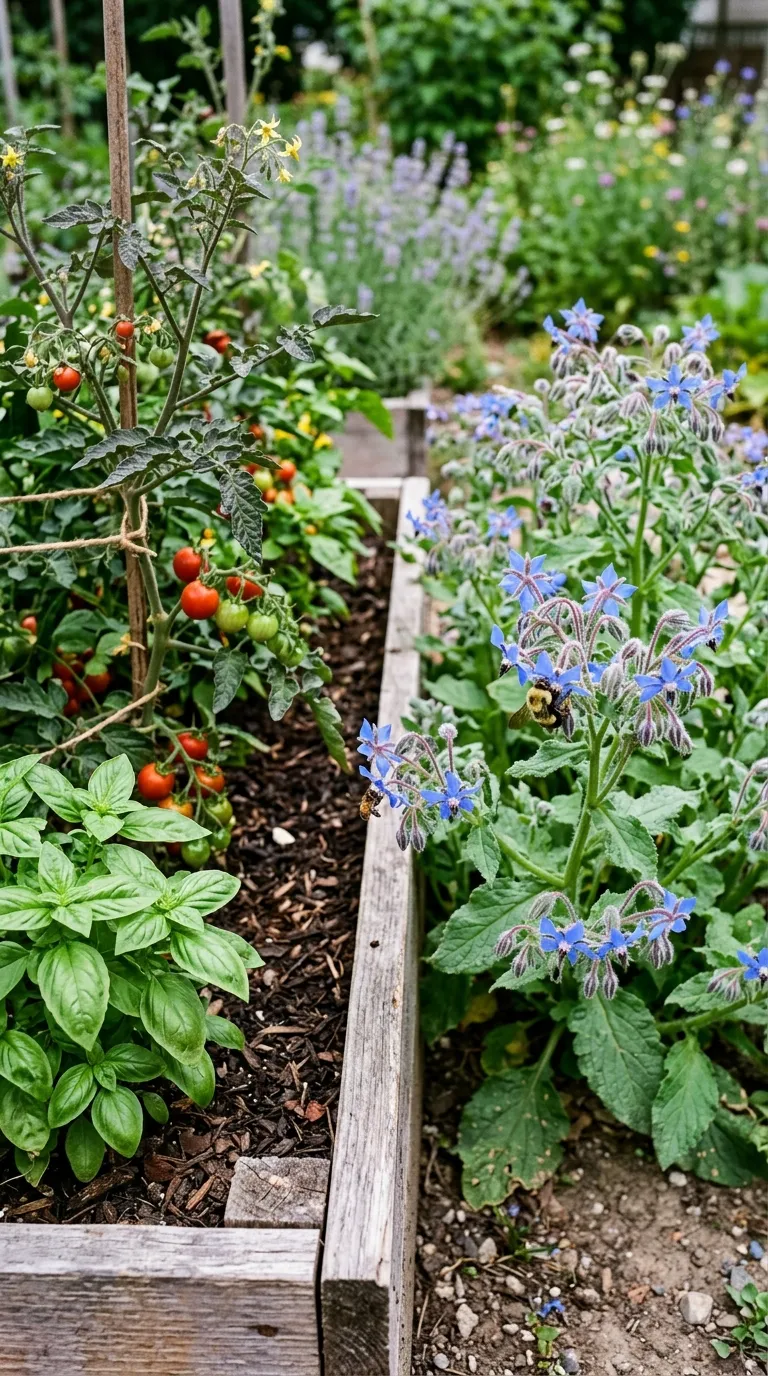
What to do: Help the variety you have by shaking flowers and planting helpers nearby. Basil and borage near tomatoes — see tomato companion plants — bring in bees that raise overall pollination activity. For next year, if summers regularly top 95°F, mix in heat-set types like ‘Florida 91’ or ‘Solar Fire’ alongside your heirloom heart’s desire. Diversity is insurance.
11. Not Harvesting & Late Flowers (The Signal to Keep Going — or Stop)
If you have some set but leave overripe tomatoes on the vine, it signals the plant to slow new set. Picking triggers more. Conversely, 4 weeks before first fall frost, pinch off any new flower clusters and tiny growing tips. Those late flowers will never have time to become ripe tomatoes, and by removing them you tell the plant, finish what you started — ripening green fruits already hanging, rather than starting doomed new ones. I do this around Labor Day when nights first whisper fall.
What to Do Today — A Simple 15-Minute Rescue Plan
If you walked outside right now and your flowers are dropping, do this this afternoon — not next week:
- Midday shake. Set a phone alarm for 11:30 a.m. and gently shake every open flower cluster for 3 seconds. Repeat daily for 10 days.
- Check sun and air. Are leaves wet for hours? Can you see breeze moving the foliage? If not, thin lightly, stake upright, and pull any leaf touching soil.
- Pause nitrogen. If you fed high-nitrogen in the last 2 weeks, stop. Water deeply once to flush, then switch to 5-10-10 only when fruits start to swell.
- Water evenly. Finger test 2 inches down, water at base, mulch if you haven’t. Keep it steady.
- Add a little shade if it’s scorching. A cheap 30% cloth over the tops for two weeks can drop air temp around flowers by 5 to 8°F.
- Tag and watch. Twist yarn around 3 trusses you shook. In 5 to 10 days, check for that tiny green swelling at the base. That’s the ovary growing — proof it worked.
Common Mistakes That Keep Flowers From Becoming Tomatoes
- Feeding high nitrogen after bloom. Switch to low-nitrogen, higher P and K at flowering.
- Misting or overhead watering to “cool” flowers. Wet pollen is dead pollen. Keep water at roots; keep flowers dry.
- Heavy pruning all at once. A brutal haircut shocks the plant. Prune lightly, on dry mornings.
- Not harvesting ripening fruit. Over-mature fruit on the vine slows new set — pick as soon as they blush.
- Assuming bees aren’t needed and shaking isn’t needed either. Outside wind helps; on a patio you are the wind.
Seasonal Calendar — Timing Is Everything
- Spring planting: Don’t rush blossoms. Pinching the very first early flowers on a small transplant (under 12 inches) actually helps it build roots and later bear more.
- Early summer: First truss is often lighter; second and third are where abundance builds. Shake daily; keep even water.
- Midsummer heat: Expect some drop when nights stay above 75°F. Shade, mulch, consistent water, patience.
- 4 weeks before first fall frost: Pinch new flowers and tips so energy goes to ripening what’s there. Tastes better than a flush of green vines into frost.
Troubleshooting — When to Wait vs. When to Worry
Wait and repeat the shake if: the plant looks otherwise lush and dark green, days are above 90°F or nights sticky warm, and you have sheltered air. This most often self-corrects within 10 to 14 days when a cooler spell arrives.
Intervene more if: foliage is pale, leggy, or deep-dark overfed; soil is soggy or cracked dry; or you see pests. Then correct feed, light, or water first, and keep shaking.
A good metaphor? Tomato fruit set is like baking. You can have all the right ingredients (leaves, sun, food), but if the oven is 25 degrees too hot, the soufflé falls. Lower the temp by five degrees — or just shake the pan at the right moment — and it rises.
Behind the Scenes — Why These Details Matter More Than They Sound
I used to think all this talk about pH and spacing was fussiness. It’s not. It’s physics and biology you can feel with your hands.
Every time I pushed my finger 2 inches into soil and actually waited a day when it felt cool and damp, I saved a watering and a yellow leaf. Every time I buried a stem deep and watched those tiny hairs become roots, I gave the plant a second engine. Do you know that small thrill when you tug gently on a deep-planted tomato a week later and it doesn’t move? That’s roots holding.
We gardeners love to buy things. But the biggest yield bumps I have measured came from not buying — not buying extra nitrogen after bloom, not buying a daily sprinkle habit, not buying a spray when a shake would do. The restraint is the technique.
A Note on Microclimates — Your Garden Is Not My Garden
Your fence, your oak tree, your wind corridor between houses — they all tweak sun and airflow by an hour or two. That’s enough to shift watering needs by a full day. I now keep a $8 max-min thermometer at tomato height for a week in June. The night temperature I thought I had and the one my plants actually felt differed by 4°F. That 4°F was the difference between set and drop.
So take any schedule here — mine included — and test it against your finger, your trowel, your tuna can. The schedule is a starting point. Your hands are the final authority. Have you checked your actual canopy temperature yet? Try it tomorrow. You may be surprised.
The Soil Food Web You Can’t See But Can Feed
Compost is not just nutrients. It’s a city. Bacteria, fungi, earthworms — they glue soil into crumbs that hold air and water in the same pore. When you add 2 to 3 inches of compost, you aren’t just feeding tomatoes. You are housing the workforce that will feed them for you, slowly, all summer.
I learned to add compost in fall, not just spring. Fall compost sits, settles, and lets frost do the mixing. Spring compost I work lightly into the top 6 inches only. Deep turning every year hurts the very fungi that help tomatoes find phosphorus. Less tillage, more surface blanket — that’s been my quiet revolution.
Common Mistakes Revisited — The Subtle Ones That Creep In Year Two
We covered the big mistakes. Here are the sneaky ones that show up after you think you’ve mastered the basics.
-
Mulching too early when soil is still cold. You trap 48°F soil under a blanket and roots sit shivering for an extra two weeks. Warm to 60°F first, then tuck in.
-
Watering on a clock, not after rain. That Tuesday-and-Friday timer doesn’t know about Monday’s inch. Always check the tuna can first.
-
Feeding high-nitrogen “tomato food” that is actually lawn food in disguise. Read the first number. If it’s 20 or higher and the bag shows grass, put it down.
-
Pruning in wet weather. Cuts stay open and invite bacteria when leaves stay damp. Prune on dry mornings, 3 to 5 days after watering, with alcohol-wiped shears.
-
Saving seed without noting which plant actually yielded. Next year you grow the pretty one, not the productive one. Tag the winner with yarn at harvest.
Which of these feels familiar? I have done every single one, some twice. The fix is not shame — it’s one new habit for seven days until it sticks.
Seasonal Timeline — Week by Week When It Actually Happens
-
Late April: Cover future tomato row with black plastic for 7 days to push soil from 50°F toward 60°F. Chive clumps wake up; borage self-sows reveal themselves. This is anticipation, not planting.
-
Early May: Sow carrots and lettuce in future tomato alleys while hardening off seedlings. They germinate while tomatoes toughen outdoors a few hours daily.
-
Mid-May (after last frost, soil 60°F): Transplant deep, composted, balanced feed, staked, watered in. Basil companions go 12 inches south of each tomato. Marigolds at corners. Water hole before plant, then after.
-
Late May to Early June: Keep top inch moist but not soggy. Purple stems? Usually cold, not phosphorus. Wait for warmth rather than adding more food.
-
Early to Mid-June: Plants hit 12 to 18 inches. First light side-dress if needed, first sucker pruning below first bloom, mulch now after soil is warm. Daily finger checks become every other day.
-
Late June to Mid-July: First flowers open. Switch to low-nitrogen. Shake flowers at midday. Bees arrive and stay if you let one basil flower. Watch lower leaves for first spots — remove early.
-
Mid-July to Mid-August: Fruit swelling, peak thirst and hunger. Even moisture plus second low-nitrogen feed 3 to 4 weeks after first fruits if warm. Scout for hornworms weekly. Harvest cherries every 2 days.
-
Mid-August: Second sowing of spinach or lettuce in dappled shade under trellised tomatoes. Garlic gaps from July harvest get new basil transplants. The bed gives again without extra space.
-
Late August to September: Taper water slightly to concentrate flavor as fruits blush. Pinch new flower clusters 4 weeks before first frost. Stop fertilizing. Let ripening take center stage.
-
At First Frost Warning: Harvest all, including greens, ripen indoors on counters. Pull vines for trash if blighted, compost if healthy. Wash stakes in 10% bleach, sun-dry. Spread fall compost.
I tape this to the fridge. It turns “am I late?” into “oh, next is that — I can do it this weekend.”
Troubleshooting Deep Dive — Real Garden Conversations
Q: “My leaves yellow from the bottom but I’m sure I didn’t overwater.” Have you checked nights? Cold soil below 55°F mimics nitrogen deficiency because roots stall. Warmth often greens the next leaves without any feed. Cover at night, wait ten days, then reassess.
Q: “I watered evenly but fruits still cracked after that storm.” Mulch is the buffer between you and weather. Without 3 inches of straw, even perfect watering between rains can’t stop a 2-inch overnight deluge from splitting tight skins. Mulch evens the spike.
Q: “My cherry sets fruit but beefsteak doesn’t in the same bed.” Heat sensitivity differs. Cherries set at 92°F when beefsteaks stall above 90°F nights above 75°F. That’s variety genetics, not your care. Grow both and harvest across temperatures.
Q: “Can I fix blossom end rot with calcium spray?” Usually water is the fix, not calcium. Most soils have enough calcium; irregular moisture stops its ride to fruit tips. Even water plus mulch solves the next fruits. Only add lime if a soil test shows pH low.
Q: “Should I mist flowers to help pollination?” Please don’t. Wet pollen is dead pollen. Dry vibration at midday is the help. Keep water at soil.
If you answer your own garden with these prompts, you will hear what it’s actually asking for rather than what the internet shouted loudest yesterday.
What I Keep in My Apron — The Small Tools That Make Big Differences
- A $8 soil thermometer that tells me when 60°F is real, not calendar-guessed.
- A $6 packet of yarn to tag flower trusses the day I shake them.
- A cheap electric toothbrush in a zip bag for buzz pollination.
- A tuna can nailed to a stake as a rain gauge, shocking in its accuracy.
- A pocket notebook — one line per week: date, weather, what I did, what leaves looked like. By September, I have next year’s plan.
Could you assemble these this week? They cost less than one nursery tomato and save a season of guessing.
Quick Field Checklist — Tape This to Your Watering Can
- Sunday: finger test 2 inches, prune one spotted leaf if needed, note in book
- Midweek: shake tomato flowers at midday, check pepper undersides for aphids
- After rain: check tuna can, skip watering if inch collected, pull mulch back if soggy
- At first blush: pick promptly, leave a few to fully ripen for flavor test
- Before frost: pinch new flowers 4 weeks out, stop feeding, harvest all greens
This five-line loop replaces worry with rhythm. It takes six minutes and covers water, pruning, and pollination in one walk.
Small Tools, Big Payoff
A soil thermometer, yarn for tagging trusses, a $8 heat mat for pepper seeds, a tuna can gauge, and a pocket notebook. These cost less than two nursery plants and answer questions you would otherwise Google at midnight.
One More Thought — Patience Is a Fertilizer
Plants resume when nights cool. Your job is to keep them alive and even until then. Even moisture, a daily shake, a little shade. That trio buys time without cost. Have you tried setting a phone alarm labeled tomato tickle? It turns a chore into a ritual.
Frequently Asked Questions
Q: Why is my tomato plant flowering but not producing fruit?
A: In almost every case, it’s failed pollination, not a sick plant. When days stay above 90°F or nights above 75°F, tomato pollen gets sticky and less viable, so even a breezy day can’t move it. In still, sheltered spots, there’s simply not enough vibration for that pollen to fall onto the stigma inside the same blossom. Give the plant full 6 to 8 hours of sun, keep water maddeningly even, and gently shake each flower truss daily between 11 a.m. and 2 p.m. when pollen is dry. Add a light shade cloth if you’re broiling, and pause any high-nitrogen feeding. Give it 10 to 14 days — once a slightly cooler night arrives or your daily shake does its job, you’ll see flower bases stay green and swell into pea-sized fruits.
Q: How do you get tomato plants to produce more fruit?
A: Give 6 to 8 hours sun, water 1 to 1.5 inches weekly at the base, switch to low-nitrogen fertilizer after flowering, stake for airflow, and vibrate flowers daily. Harvest ripe fruit promptly to signal the plant to keep setting new tomatoes. Consistency is the multiplier here — even moisture plus that midday shake does more than any expensive blossom spray. I also mix varieties: one cherry that sets reliably in heat, one heat-set slicer, and my heirloom favorite. Diversity smooths the season’s swings and keeps picking baskets full from July through September.
Q: Does too much nitrogen stop tomatoes from fruiting?
A: Yes, and it’s one of the most common reasons lush plants stay fruitless — I’ve absolutely done it myself with an over-generous scoop. Too much nitrogen tells the plant, grow leaves! It puts out deep green, almost bluish foliage, thick stems, wild vines — and holds back on flowers, or drops them, because it’s in vegetative overdrive. The remedy is simple and a little counterintuitive: stop feeding nitrogen, give the bed one deep watering to leach excess salts, then wait 2 to 3 weeks and only side-dress with a lower-nitrogen formula like 5-10-10 or 3-4-6 when fruits actually start to swell. At planting, a balanced 10-10-10 or compost is perfect; once those first yellow stars open, go low on N.
Q: How long after flowering do tomatoes form?
A: After successful pollination you’ll see a pea-sized swelling in about 5 to 10 days. The little green bulge at the base doesn’t fall off with the petals — that’s the ovary growing. It then spends weeks growing to full size while still green and hard. Cherries ripen fastest, often 40 to 45 days from bloom to blush; big slicers and beefsteaks usually need 55 to 80 days. If a flower drops cleanly within 1 to 2 days without any swelling left behind, pollination didn’t happen and that bloom is done. Tie yarn around a few fresh trusses on the day you shake them to track success.
Related Articles
- How to Grow Tomatoes
- How Often to Water Tomato Plants
- Best Fertilizer for Tomatoes
- Tomato Leaves Turning Yellow
- How to Prune Tomato Plants
- Best Soil for Tomatoes
Sources & References
- Cornell Vegetables — https://www.vegetables.cornell.edu/crops/tomatoes/
- University of Minnesota Extension — https://extension.umn.edu/yard-and-garden/vegetables/growing-tomatoes
- NC State Extension — https://content.ces.ncsu.edu/growing-tomatoes
- Iowa State University Extension — https://hortnews.extension.iastate.edu/tomato-pollination
- University of California IPM — https://ipm.ucanr.edu/PMG/GARDEN/VEGES/tomato.html