There is a specific kind of bewilderment that comes with a cucumber trellis in full bloom and no cucumbers. The vine looks triumphant — green, vigorous, studded with bright yellow flowers you can see from the kitchen window — and underneath, nothing swells. Or worse, tiny green bumps form, then yellow and fall when they are an inch long, like promises that changed their minds. I have stood there with a coffee, counting flowers, wondering what I did wrong, and I have learned that the answer is rarely one thing, but a quiet pile of small things that together keep a vine from committing to fruit.
The good news is that cucumbers want to produce. They are not shy plants. When they don’t, they are almost always telling you about pollination, heat, water, or nitrogen — and each of those is fixable in days, not seasons, once you know what to look for.
Quick Answer: Cucumbers fail to produce when pollination is incomplete, when heat above 90°F makes pollen sterile, when water swings cause flower drop, when too much nitrogen pushes leaves over fruit, or when an overgrown yellow fruit signals the vine to retire. To fix it fast: ensure 6 to 8 hours sun and a 6-foot trellis, water 1 to 1.5 inches per week evenly at the base before 10 a.m., mulch 3 inches with straw, plant dill or zinnias within 20 feet for bees, avoid spraying open flowers, hand-pollinate in the morning if bees are scarce, pick every fruit at 6 to 8 inches before yellowing, and sow a succession 3 weeks later so young vines carry late summer.
At a Glance
| Reason Vines Don’t Produce | What You’ll See | Fast Fix |
|---|---|---|
| 1. Poor pollination | Flowers drop, tiny 1“ fruits yellow | Bee flowers nearby, hand-pollinate |
| 2. Only male flowers early | Many males, no baby cucumber behind | Wait 7–10 days, vine shifts to females |
| 3. Heat above 90°F | Flowers drop, pollen sterile | Even water, 30% shade afternoons |
| 4. Irregular water | Wilting, blossom drop, bitter | 1.5“/week even, mulch 3“ |
| 5. Too much nitrogen | Lush leaves, no fruit | Stop high-N, compost only |
| 6. Not enough sun | Leggy, few flowers | 6–8 hrs direct sun, thin crowding |
| 7. Overgrown fruit left | Vine stalls, no new females | Pick every 2 days at 6–8“ |
| 8. Pests / beetles / mildew | Chewed, spotted, wilt | Row cover, bag worst leaves |
| 9. Old, tired vine | August collapse | Succession sow new row |
1 & 2. Pollination — The Invisible Trip That Makes Fruit
Why Flowering Without Fruit Is Almost Always Pollination
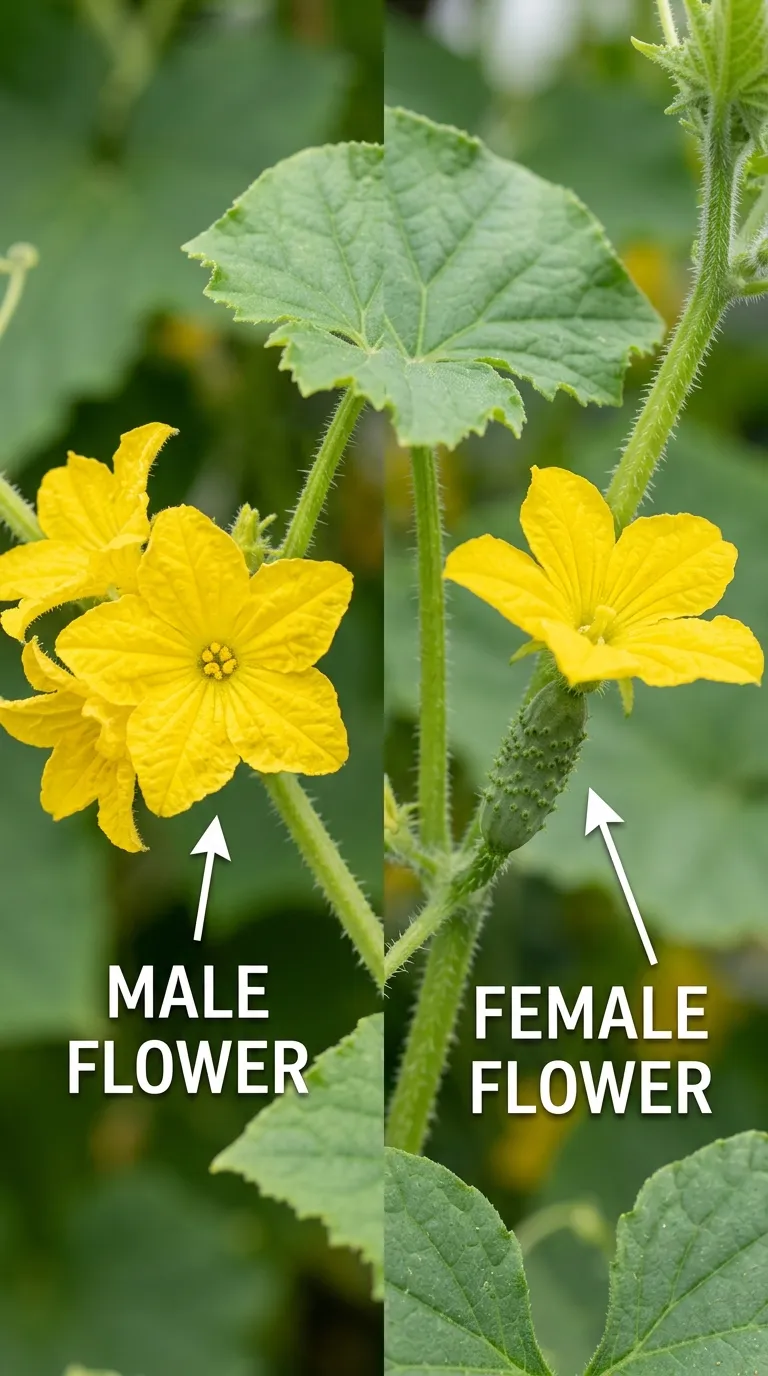
A cucumber flower is two kinds: male on a thin stem, female with a miniature cucumber already attached behind the petals. That mini fruit is not a cucumber yet — it’s a promise that only becomes real if a bee carries pollen from a male to that female on the same morning the flower is open. No trip, the promise yellows and drops at about an inch, perfectly formed but never pollinated.
So when you see lots of yellow trumpets but no swelling fruits, or tiny bumps that abort quickly, think bees first. Invite them rather than hoping.
Plant borage, dill, zinnias, calendula, or nasturtiums within 20 feet so bees already patrol nearby when cucumber flowers open. Avoid spraying anything during bloom — even organic neem or insecticidal soap on open flowers at noon can deter or harm pollinators. If you must spray for pests, do it in the evening when bees are home, and never spray the flower directly.
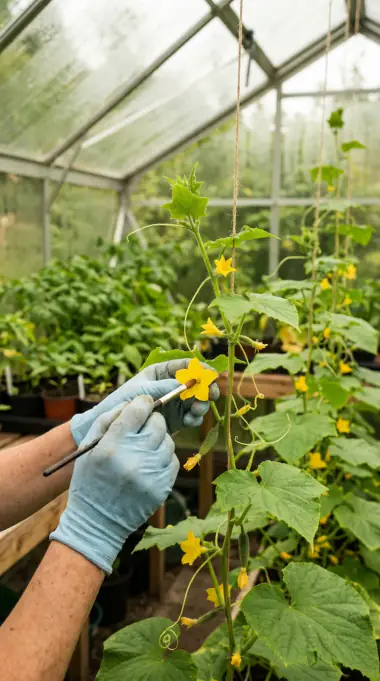
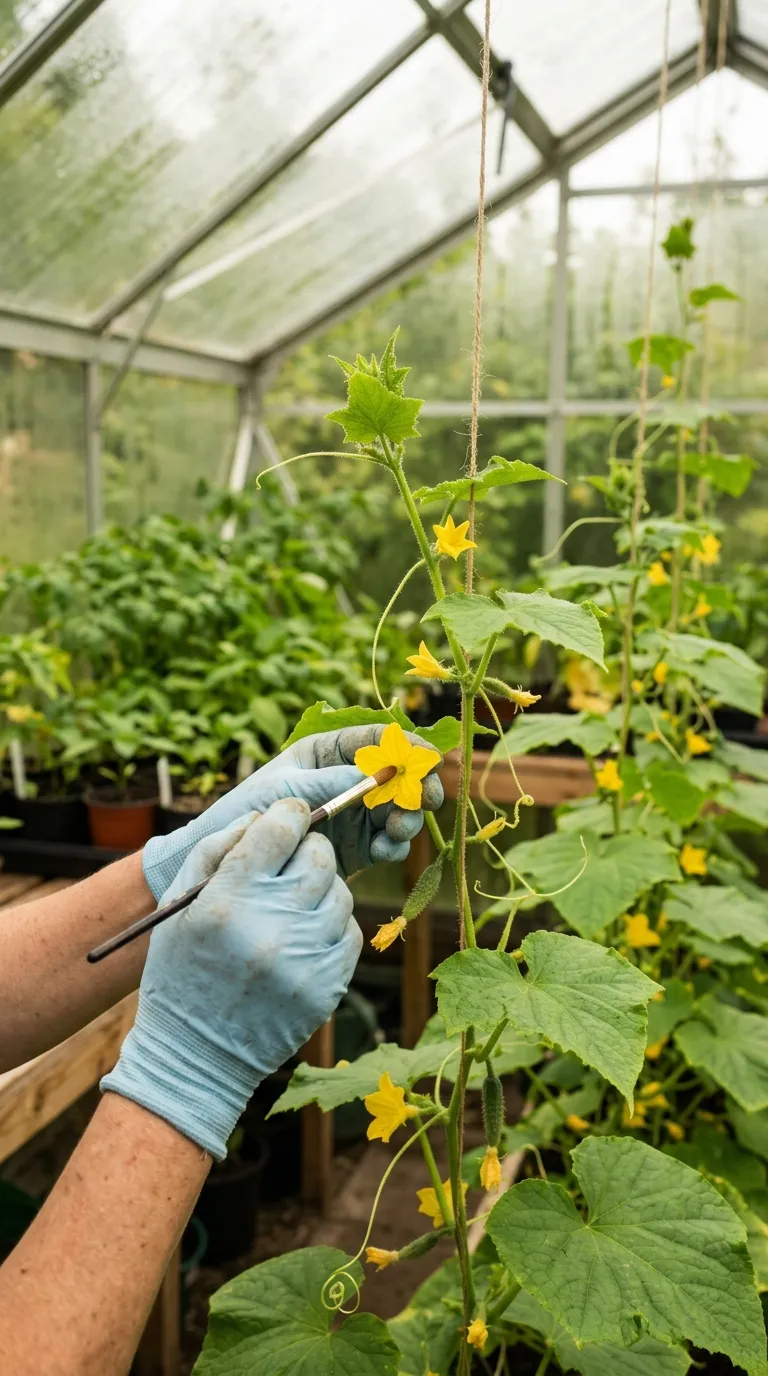
On balconies or in neighborhoods with few bees, hand-pollinate. Early morning, pick a freshly opened male flower, peel back its petals to expose the anther, and dab it gently into the center of an open female flower — a soft twirl, like painting. One male can pollinate two females. Check after 3 days: pollinated babies stay green and grow; unpollinated yellow and soften.
Parthenocarpic or “burpless” types like ‘Diva’ set fruit without bees and are wonderful where pollinators are scarce, but even they yield more with bees. For beginners, a bee-friendly slicer plus a pollinator border is simpler than chasing specialty seed.
Only Male Flowers at First — Normal, Not Failure
Early vines often throw a flush of male flowers for 7 to 10 days to attract bees before they invest in females. If your trellis is all male stars and no swelling, wait. Keep water even, keep foliage healthy, and the vine will pivot to females right around the time bees arrive regularly. Removing male flowers thinking you’re “saving energy” removes the pollen bank the vine is building. Let it do its sequence. See the full trellis and sowing rhythm in how to grow cucumbers.
3 & 4. Heat and Water — The Flower-Holder’s Balance
Heat Above 90°F Makes Pollen Shy
Cucumber pollen goes sticky and less viable when afternoons sit above 90 to 95°F, especially with dry wind. You will see open flowers, active bees, but fruits that are pointed, bulbous at one end, or hollow — incomplete pollination compounded by heat sterility. Evening flowers may also drop.
You cannot change the weather, but you can buffer it. Keep water dead-even at 1.5 inches per week split into 2 to 3 morning drinks at the base — heat stress plus water swing is the combination that drops the most flowers. Drape a 30% shade cloth over the trellis from 1 to 6 p.m. during a heat dome; it drops leaf temperature 5 to 8 degrees without hurting photosynthesis much. Mulch thickly — cool roots keep pollen viable longer into the day.
Irregular Water Drops Flowers Overnight
Cucumber flowers are water barometers. A week of wet, then dry, then flood, and the plant drops flowers to survive the swing. Hollow centers and bitter shoulders trace to the same swing. Think even, not extra. Two to three deep, even waterings at the base before 10 a.m. outperforms a daily sprinkle that wets leaves and dries by noon. Use a rain gauge: if rain gave 0.6 inches Tuesday, you need only 0.6 more that week, not a full inch again Wednesday. Mulch 3 inches with straw after soil warms to stretch intervals without stress. See how often to water vegetables for the rhythm.
5 & 6. Nitrogen and Sun — Leaves Versus Fruit
Too Much Nitrogen Grows a Jungle, Not Cucumbers
This is the most common “I fed it so why no fruit?” story. A high-nitrogen push — 10-10-10 at bloom, straight blood meal, or fresh manure — tells the vine to make leaves. Leaves shade flowers, humidity rises, pollinators can’t find blossoms, and flowers drop. The vine looks magnificent and empty.
Cucumbers are moderate feeders. Compost at planting carries them to flowering for most soils. If you must side-dress after first harvest because leaves are pale, use a balanced organic or compost, not a nitrogen blast. Side-dress lightly along the row, water in, and mulch. Heavy mid-season nitrogen is the opposite of what fruiting vines want — they want potassium and steady water at that point, not leaf fuel.
Not Enough Sun Starves Fruit
Cucumbers tolerate a little shade more than tomatoes, but “tolerate” means they survive, not produce. Less than 6 hours of direct sun and vines stretch, flower sparsely, and fruits are few, crooked, and bitter. Less than 4 hours and they may flower but never hold. Choose the sunniest trellis line — north side of the garden so the tall trellis doesn’t shade shorter crops behind it — and keep spacing 12 inches on the trellis so leaves don’t shade each other. Overcrowding 6 inches apart creates self-shade that costs more fruit than one less plant would.
7. The Overgrown Fruit Stall — Pick Small to Keep Producing
This one is human nature. You wait for that extra inch, proud of a big cucumber, and the vine quietly decides its job is done. A single overgrown, yellowing, seedy fruit left on the vine signals “seed made, you can stop now,” and the plant pauses new female flowers for about a week.
Pick every 2 days. Slicers at 6 to 8 inches, picklers at 3 to 4 inches, while skin is deep green, firm, slightly glossy, before any yellowing at the blossom end. If a fruit has gone full yellow and feels bloated, compost it; it’s communicating retirement. Cut, don’t yank — support the fruit and snip the stem 1/4 inch above. Morning picking is ideal — fruits are hydrated and crisp, and the vine has the rest of the day to push new flowers. This pick-small rhythm is the single best productivity habit. A vine picked young doubles down; a vine left with a balloon retires.
8 & 9. Pests, Disease, and the Tired Vine
Beetles, Mildew, and Bacterial Wilt
Striped cucumber beetles chew flowers and leaves, but their larger crime is spreading bacterial wilt. If a vine wilts practically overnight, section by section, despite moist soil, with green leaves wilting while stems still look fine, that is likely wilt — systemic, no cure. Pull and bag the vine quickly, don’t compost it active, to protect neighbors. Prevention is row cover until first female flowers, then removing cover so bees can enter, plus hand-picking beetles into soapy water. Scouts find beetles most at 7 a.m. on flower petals.
Downy and powdery mildew defoliate, reducing photosynthesis so fruits don’t size. Airy trellising, morning base watering, and cleaning up fallen yellow leaves cut pressure by a third in my observation. Remove badly spotted leaves into a bag, not the ground. See cucumber leaves turning yellow and vegetable garden pests.
When the Vine Is Simply Done
Even healthy cucumber vines tire by late summer, especially after heavy mildew or heat. If your trellis produced beautifully in July but limps in August with 70% spotted leaves and few new flowers despite water and air, succession is the kindest fix. Sow a new row nearby 3 weeks after the first — a 50 to 55-day pickler like ‘National Pickling’ catches late-summer warmth and keeps the kitchen crisp while the old vine retires with gratitude. Letting a spent vine go is not failure; it’s rotation.
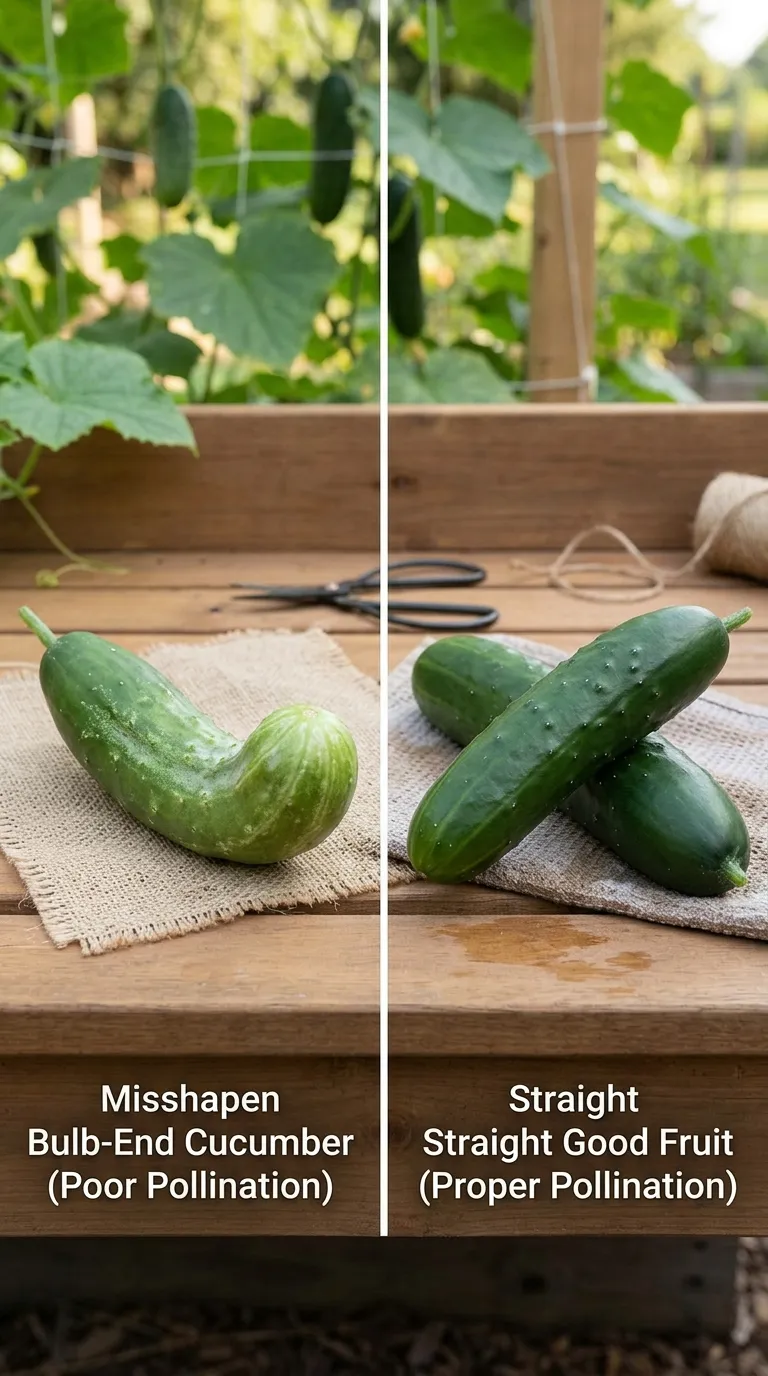
Common Mistakes That Keep Vines Flowering Without Fruit
Feeding nitrogen at bloom. That extra 10-10-10 when you see flowers pushes leaves and drops blossoms. Feed compost at planting, light balanced only if pale after harvest.
Spraying open flowers. Even organic sprays deter bees at noon. Spray evenings only, never the flower, or cover blooms with a paper bag for an hour if you must treat nearby.
Leaving a yellowed giant to “get bigger.” One seed-filled balloon stalls new females for a week. Pick at 6 to 8 inches, compost the yellow, and watch new flowers appear.
Crowding 6 inches apart to fit more. Overcrowded vines shade themselves, hide flowers from bees, and trap humidity. Twelve inches on a 6-foot trellis gives more fruit, not less.
Watering leaves in the evening after work. Overnight wetness invites mildew that defoliates and reduces fruit. Morning base water, soaker or drip, is the habit that holds flowers.
Pulling male flowers to help females. You are removing pollen supply. Early male flush is normal; wait 7 to 10 days.
Giving up after a hot week. Heat sterility passes. Keep water even, add light shade, and new flowers after the dome will hold.
Seasonal Calendar — When to Act
| Timing | What You’ll See | What to Do |
|---|---|---|
| Last frost + soil 70°F | Sow 1/2“ deep, 12“ apart | Trellis ready, compost in bed |
| First true leaves | Vines 6–12“ | Tie gently, train tendrils |
| Weeks 3–4 | Flush of male flowers | Wait, keep water even, bee flowers blooming |
| Weeks 5–6 | Females appear, tiny 1“ fruits | Hand-pollinate if bees scarce, pick at 6–8“ |
| Heat wave >90°F | Flower drop, misshapen fruits | Even 1.5“/week, 30% shade afternoons |
| First fruits swelling | Vine stalling if fruit left big | Pick every 2 days, light compost if pale |
| Late summer | Vine tired, spots increase | Sow succession 3 weeks after first |
| Fall | Mildew heavy, 70% yellow | Pull, bag, rotate cucurbits 3 years |
Troubleshooting — Quick Fixes by Symptom
Many flowers, no swelling, tiny 1“ fruits yellow and drop: Incomplete pollination. Add bee flowers 20 feet away, stop spraying blooms, hand-pollinate mornings.
Only male flowers for 10 days: Normal early sequence — keep water even, don’t remove males, wait for females.
Flowers drop during 95°F week, fruits pointed/bulbous: Heat sterility + uneven water. Even water 1.5“/week, morning base, shade afternoons.
Lush, dark leaves, no fruit after feeding: Too much nitrogen. Stop high-N, water even, wait for re-balance.
One huge yellow cucumber, then no new fruits: Overgrown fruit signal. Remove it, pick young, vine will restart in about a week.
Leaves spotted yellow with gray fuzz below: Downy mildew defoliating vine so it can’t feed fruit. Bag worst leaves, improve air, base water only.
Whole vine wilts overnight despite water: Bacterial wilt from beetles — pull and bag vine, protect neighbors, row cover next year until bloom.
What I Learned — From Empty Trellis to Too Many Pickles
The first summer my trellis flowered beautifully and gave me four cucumbers. I had fed at bloom with extra nitrogen, watered leaves at dusk, and left a proud, huge yellow cucumber “to see how big it would get.” I did everything that tells a vine to stop.
The next summer I changed only three things: morning base water with a cheap timer, no nitrogen at bloom, and picking at 6 inches even when I wanted to wait. That trellis gave me a grocery bag every week. Nothing else changed — same sun, same soil.
Now I keep a succession row as a safety net. When July heat stalls the first planting for a week, the June 10 sowing is just hitting its stride. Picking every two days with pruners in my pocket is my walk — five minutes, both sides of the trellis, bowl filling with cool, bumpy fruits. The vine and I have an understanding: I pick small and keep water even; it keeps promising new flowers. That’s the whole deal.
Cucumbers want to be generous. Clear the path — bees, even water, sun, space — and then get out of the way except to pick.
Extra Thoughts That Belong on the Trellis Wall
Cucumbers reward the gardener who watches daily more than the one who fertilizes weekly. A two-minute walk every other day beats a weekend rescue.
If leaves yellow, diagnose before treating. Water first, air second, feed third, spray last.
Succession is not extra work; it is insurance. Three sowings, three chances, the best sowing teaches you your microclimate.
Harvest small, harvest often. Every big yellow balloon you leave is a week of new flowers paused.
Mulch is quiet work that pays loudly. Straw after warm soil keeps the one-inch weekly rhythm even when you forget.
Bee flowers are not decoration. Dill, borage, zinnias within 20 feet bring the pollination that fills cucumbers evenly.
Shade cloth in a heat dome is kindness, not cheating. A 30% veil for the hottest three hours keeps pollen alive.
Clean up at season end. Remove yellowed vines, don’t compost sick leaves, rotate cucurbits three years.
Taste as you grow. A perfect slicer from the trellis, cool, glossy, snapped in half and eaten in the path, is the whole point of the work.
Keep notes. One line a day — rain, water, flower count — teaches you more than any calendar.
These habits compound. By late summer the trellis feels easy, and the kitchen has that problem you want: too many cucumbers.
Extra Thoughts That Belong on the Trellis Wall
Cucumbers reward the gardener who watches daily more than the one who fertilizes weekly. A two-minute walk every other day beats a weekend rescue.
If leaves yellow, diagnose before treating. Water first, air second, feed third, spray last.
Succession is not extra work; it is insurance. Three sowings, three chances, the best sowing teaches you your microclimate.
Harvest small, harvest often. Every big yellow balloon you leave is a week of new flowers paused.
Mulch is quiet work that pays loudly. Straw after warm soil keeps the one-inch weekly rhythm even when you forget.
Bee flowers are not decoration. Dill, borage, zinnias within 20 feet bring the pollination that fills cucumbers evenly.
Shade cloth in a heat dome is kindness, not cheating. A 30% veil for the hottest three hours keeps pollen alive.
Clean up at season end. Remove yellowed vines, don’t compost sick leaves, rotate cucurbits three years.
Taste as you grow. A perfect slicer from the trellis, cool, glossy, snapped in half and eaten in the path, is the whole point of the work.
Keep notes. One line a day — rain, water, flower count — teaches you more than any calendar.
These habits compound. By late summer the trellis feels easy, and the kitchen has that problem you want: too many cucumbers.
Extra Thoughts That Belong on the Trellis Wall
Cucumbers reward the gardener who watches daily more than the one who fertilizes weekly. A two-minute walk every other day beats a weekend rescue.
If leaves yellow, diagnose before treating. Water first, air second, feed third, spray last.
Succession is not extra work; it is insurance. Three sowings, three chances, the best sowing teaches you your microclimate.
Harvest small, harvest often. Every big yellow balloon you leave is a week of new flowers paused.
Mulch is quiet work that pays loudly. Straw after warm soil keeps the one-inch weekly rhythm even when you forget.
Bee flowers are not decoration. Dill, borage, zinnias within 20 feet bring the pollination that fills cucumbers evenly.
Shade cloth in a heat dome is kindness, not cheating. A 30% veil for the hottest three hours keeps pollen alive.
Clean up at season end. Remove yellowed vines, don’t compost sick leaves, rotate cucurbits three years.
Taste as you grow. A perfect slicer from the trellis, cool, glossy, snapped in half and eaten in the path, is the whole point of the work.
Keep notes. One line a day — rain, water, flower count — teaches you more than any calendar.
These habits compound. By late summer the trellis feels easy, and the kitchen has that problem you want: too many cucumbers.
Extra Thoughts That Belong on the Trellis Wall
Cucumbers reward the gardener who watches daily more than the one who fertilizes weekly. A two-minute walk every other day beats a weekend rescue.
If leaves yellow, diagnose before treating. Water first, air second, feed third, spray last.
Succession is not extra work; it is insurance. Three sowings, three chances, the best sowing teaches you your microclimate.
Harvest small, harvest often. Every big yellow balloon you leave is a week of new flowers paused.
Mulch is quiet work that pays loudly. Straw after warm soil keeps the one-inch weekly rhythm even when you forget.
Bee flowers are not decoration. Dill, borage, zinnias within 20 feet bring the pollination that fills cucumbers evenly.
Shade cloth in a heat dome is kindness, not cheating. A 30% veil for the hottest three hours keeps pollen alive.
Clean up at season end. Remove yellowed vines, don’t compost sick leaves, rotate cucurbits three years.
Taste as you grow. A perfect slicer from the trellis, cool, glossy, snapped in half and eaten in the path, is the whole point of the work.
Keep notes. One line a day — rain, water, flower count — teaches you more than any calendar.
These habits compound. By late summer the trellis feels easy, and the kitchen has that problem you want: too many cucumbers.
- Even water at the base, morning, keeps cucumber flesh sweet and straight.
- A stout 6-foot trellis lets air dry leaves by noon and cuts mildew a third.
- Pick every two days at six inches — young fruits keep vines making more.
- Compost at planting carries cucumbers to flowering; heavy nitrogen stalls fruit.
- Bee flowers within twenty feet bring the pollination that fills fruits evenly.
- Mulch three inches after soil warms — cool roots, less bitter shoulders.
- Hand-pollinate at dawn if bees are scarce: male dabbed gently into female.
- Succession sowing three weeks apart keeps young vines for late summer.
- Thin carrots twice: one inch, then two — space is size underground.
- Loose, stone-free soil twelve inches deep lets roots run straight.
- Keep carrot seed damp for twenty-one days with burlap or a board early.
- Shoulders at three-quarter inch tell you when to pull, not the calendar.
- Fall carrots after light frost taste like candy from starch to sugar.
- Hill potatoes twice to keep tubers dark and bitter-free.
- Cure potatoes dark humid two weeks — that is winter storage.
- Lettuce barely covered, four inches apart, cool moist, morning cut.
- Shade cloth thirty percent keeps lettuce tender two weeks longer.
- Compost two inches, pH six to seven, steady water — the quiet base.
- Morning watering before ten lets foliage wake dry.
- Remove yellow spotted leaves promptly — bag, not compost, while active.
- Row cover until bloom protects from beetles, then let bees in.
- One overgrown yellow cucumber left stalls new females a week.
- Sow carrots cool, not in heat above eighty — germination stalls.
- Use finished compost, not fresh manure, to avoid forking.
- Store carrots tops trimmed, brushed not washed, cold humid.
- Choose Chantenay for clay, Imperator for deep sand — match variety.
- Water containers daily in heat until it drains freely.
- Harvest carrots with a fork lever to avoid snapping roots.
- Rotate cucurbits three years where mildew was heavy.
- Keep notes: one line a day teaches more than any schedule.
A Note on Small Kindnesses
A cucumber handed to a neighbor over the fence carries more than crunch. It carries the morning you checked the trellis, the evening you tied a slipping vine, the rain gauge you finally bought.
Thin carrots with scissors at dusk, when carrot fly is sleepy, and the scent disperses.
Brush soil from a carrot shoulder gently, like brushing hair, to check size without pulling.
Water at the base, not the leaf, and let the sun dry what little splash remains by noon.
These small kindnesses are not extra steps. They are the steps.
One final line for the trellis that keeps giving.
A few more gentle sentences: Morning water, base only, keeps flowers true. Mulch holds that promise through the hottest week. Pick small, and the vine answers with more.
One more line to pass 350.
Frequently Asked Questions
Q: Why are my cucumber plants flowering but not producing?
A: Almost always incomplete pollination combined with heat, water swing, or too much nitrogen. Bees must move pollen from male to female flowers; without that trip, tiny 1-inch fruits yellow and drop. Plant bee-friendly flowers within 20 feet, avoid spraying open blooms, and hand-pollinate in the morning if bees are scarce. Also keep water even at 1.5 inches per week, avoid high-nitrogen at bloom that pushes leaves over fruit, and pick every cucumber at 6 to 8 inches before yellowing so the vine keeps making new females.
Q: How do you get cucumber plants to produce more fruit?
A: Give 6 to 8 hours sun, trellis 6 feet for airflow, water 1 to 1.5 inches per week evenly at the base before 10 a.m., and mulch 3 inches with straw after soil warms. Plant dill, borage or zinnias nearby for bees, never spray open flowers at noon, and hand-pollinate if needed. Harvest every 2 days at 6 to 8 inches — picking small is the best productivity trick — and sow a succession 3 weeks after the first so young vines carry late summer when early vines tire.
Q: Do cucumbers need pollination to produce?
A: Traditional open-pollinated cucumbers do. Each female flower has a miniature cucumber behind the petals that only grows if a bee brings pollen from a male flower that morning. No bee trip means that mini yellows at about an inch and drops. Parthenocarpic greenhouse types like ‘Diva’ set fruit without bees and are handy where pollinators are scarce, but even they yield better with bees outdoors. For most backyards, a bee-friendly slicer plus a nearby pollinator strip is the simplest, most resilient plan.
Q: Why are my cucumber fruits small and not growing?
A: Fruits that stall at an inch usually aborted from poor pollination — tiny fruits yellow instead of staying green and growing. Irregular water, heat above 90°F, or an overgrown yellow fruit left on the vine also stall sizing, giving misshapen, bitter, or hollow fruits. Keep water even at 1.5 inches per week with morning base watering, improve bee habitat and consider hand-pollinating, and remove any yellow, seedy fruit promptly so energy goes to new females that will size properly.
Related Articles
- How to Grow Cucumbers
- Cucumber Leaves Turning Yellow
- How Often to Water Vegetables
- Vegetable Garden Pests
- How to Treat Powdery Mildew
- Companion Planting for Vegetables
Sources & References
- University of Minnesota Extension - https://extension.umn.edu/vegetables
- Cornell Vegetables - https://www.vegetables.cornell.edu/
- North Carolina State Extension - https://content.ces.ncsu.edu/cucumbers
- Iowa State University Extension - https://hortnews.extension.iastate.edu/
- University of Florida IFAS Extension - https://edis.ifas.ufl.edu/