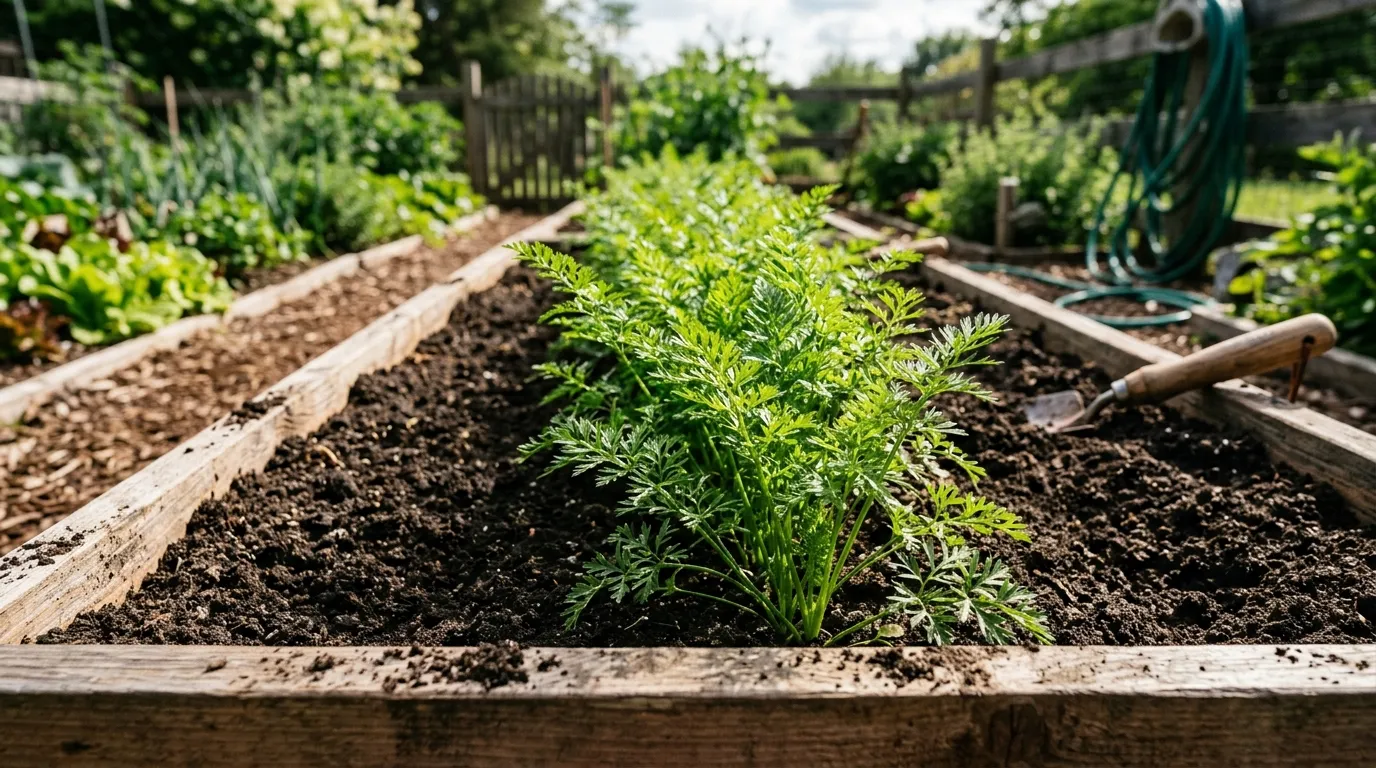
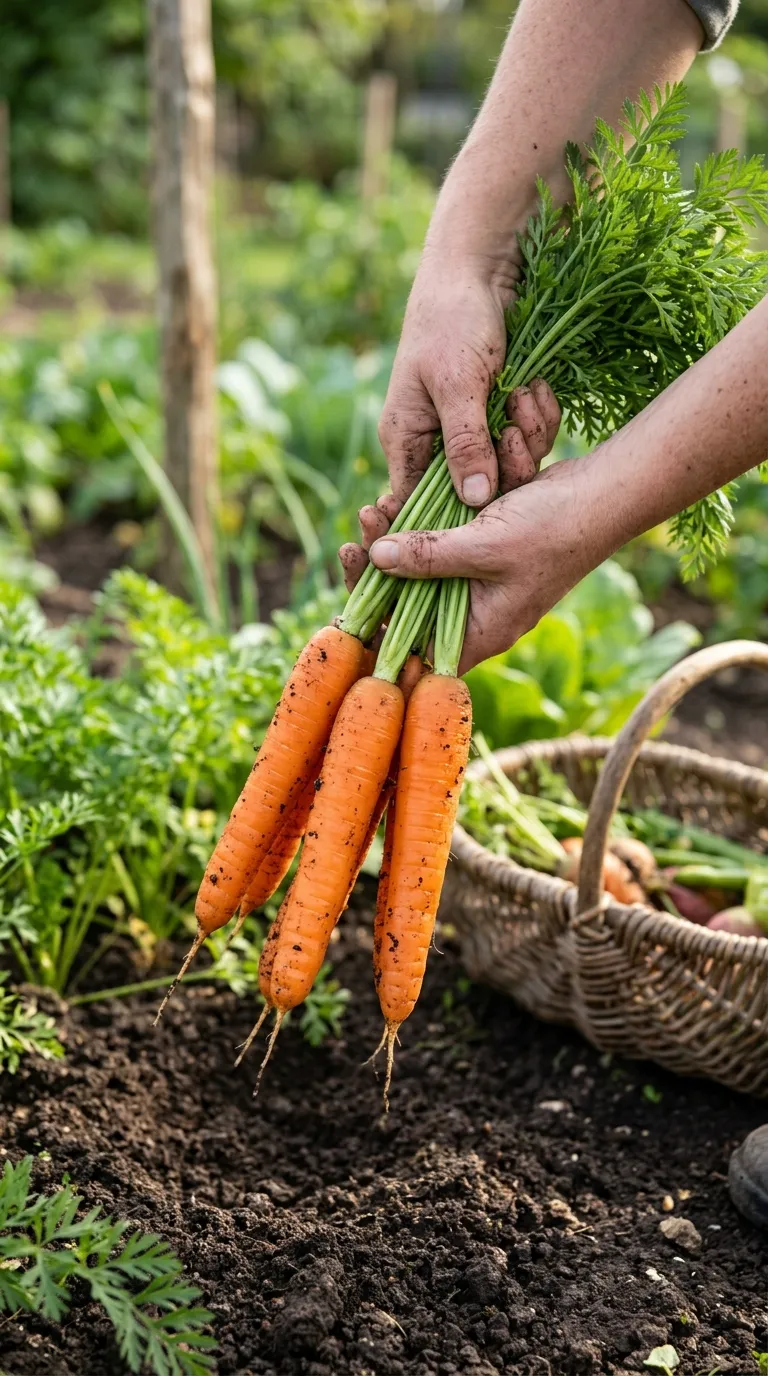
There is a particular kind of magic to pulling a carrot you’ve grown yourself. You loosen the soil with a fork, brush the fronds aside, and tug — and up comes this crisp, straight, sweet-smelling root that snaps when you break it, its orange so much more vivid than anything bagged at the store, soil still cool from being underground. The first time I grew carrots well, after seasons of sad, stubby forks that looked like bewildered hands, my kids ate them standing right in the path, unwashed except for a wipe on a shirt, and declared store carrots “not the same thing.” They weren’t wrong.
Carrots have a reputation for being fickle. Slow to germinate, prone to forking, cracking, or staying stubbornly pencil-sized, they ask for two things most gardens don’t offer without intention: loose, deep, stone-free soil and your ruthless willingness to thin. Give them those, plus cool weather patience and even water, and they reward you with sweetness that actually improves after a touch of chill. They don’t ask for coddling — they ask for preparation.
These 10 tips are my bench — after rocky beds, crusty soil, and the painful first thinning where I learned that kindness to every seedling is cruelty to the harvest. We’ll walk through soil the taproot dreams of, sowing without transplanting, the why behind keeping seeds damp for three endless weeks, thinning without guilt, watering that prevents cracks, and knowing that perfect moment to harvest when shoulders tell you “now.”
Quick Answer: Sow carrot seeds directly outdoors 2 to 4 weeks before your last frost and again throughout cool weather, 1/4 inch deep in loose, stone-free, sandy-loam soil loosened 12 inches deep with pH 6.0–6.8. Keep soil consistently moist — not puddled — for the full 10 to 21 days until germination; cover lightly with burlap or a board for 7 days to hold moisture if needed. Thin seedlings first to 1 inch when 1 inch tall, then ruthlessly to 2 inches apart when 3 inches tall by snipping with scissors, with rows 12 inches apart. Water 1 inch per week evenly and mulch lightly after thinning; avoid fresh manure which causes forking. Harvest 60 to 80 days after sowing when shoulders reach 3/4 to 1 inch for full size (1/2 inch for baby) — carrots sweeten after cool nights — by loosening soil with a fork and pulling gently.
At a Glance
| Fact | Details |
|---|---|
| Sun | 6 to 8 hours (4 hours tolerated for baby carrots) |
| Soil | Loose, deep, stone-free, sandy loam, pH 6.0–6.8 |
| Sowing depth | 1/4 inch |
| Spacing | Thin to 2 inches apart; rows 12 inches apart |
| Germination | 10 to 21 days, needs consistent moisture |
| Water | 1 inch per week, even |
| Harvest | 60 to 80 days |
| Tips covered | 10 tips from soil to storage |
If you remember nothing else, remember this: deep and loose, shallow-sown, kept damp, thinned hard. Every other tip is a footnote to those four.
Tip 1 & 2: Soil Is the Root’s World — Make It Soft and Deep
Tip 1: Loosen 12 Inches and Remove Every Pea-Sized Stone
Imagine being a carrot seed the size of a fleck of dust, asked to push a single pale taproot straight down 6 to 9 inches through whatever is below you. A rock as small as a grape forces that tip to fork left or right. A clod of cold clay makes it stop and swell sideways, producing a stumpy, branched thing that tastes fine but looks defeated. Fresh manure or chunky compost tilled in right before sowing throws a burst of nitrogen and irregular lumps that make roots hairy, forked, and oddly twisted. A carrot is honest: it shows you exactly what your soil feels like underground.
So prepare the bed as if you were the root. Loosen soil 12 inches deep — double-dig with a fork, or build a raised bed where you control the mix. Sift out stones larger than a pea, break clods until the soil runs through your fingers like coarse sand. Enrich with 2 to 3 inches of finished, finely textured compost incorporated two to three weeks before sowing, not the day of. Avoid fresh manure entirely for carrots; it invites forking. If your native soil is heavy clay, a raised bed with a sandy loam blend (roughly 60% topsoil, 30% compost, 10% coarse sand or perlite) will give you straighter carrots than fighting clay all season. Aim for pH 6.0–6.8, tested and amended per lab. For more on building that bed right, see best soil for vegetable gardens and how to prepare soil.
Tip 2: Choose the Right Variety for Your Soil Depth
Variety choice is your soil’s companion. Long Imperator types like ‘Tendersweet’ need that full 12-inch depth and want sandy ground to hit length. Shorter Nantes, Chantenay, or ‘Danvers’ are far more forgiving of shallower or heavier beds and still give you that classic straight cylinder. For containers, round ‘Thumbelina’ or ‘Paris Market’ are built for 8-inch depth. Matching variety to your real soil, not your wishful soil, is wisdom, not compromise. Texture also governs sweetness. Carrots convert starches to sugars as they mature, and compacted or waterlogged soil that stresses the plant mutes that conversion. Loose, evenly moist soil lets the root expand without cracking and lets sugars accumulate. Think of soil as breathing room. No breathing, no sweet length.
Tip 3 & 4: Sowing — Direct, Shallow, and Patient
Tip 3: Sow Directly Where They Will Grow
Carrots never transplant well. That taproot, once bent in a cell tray, stays bent forever — hence those U-turned roots you see at markets. So we sow directly where they will grow, and we accept carrot time, which is slower than our impatience.
Wait for cool, not cold. Carrots germinate best when soil is 50 to 75°F, which often means 2 to 4 weeks before last frost in spring, and again in late summer for a fall crop that will sweeten beautifully after light frosts. In hot summer soil above 80°F, germination stalls; shade the row with a board or sow in late afternoon and pre-water.
Tip 4: 1/4 Inch Deep and Undisturbed for 21 Days
The method: rake the bed until the surface is fine — no lumps larger than a pea on top. Water the bed lightly first so seeds don’t wash. Make shallow furrows 1/4 inch deep with the edge of a hoe or your finger; I stretch a string to keep rows 12 inches apart and furrows straight. Scatter seeds thinly — carrot seed is tiny, so mix with a pinch of dry sand if your hands want to dump too much — then cover lightly with fine soil or sifted compost to exactly 1/4 inch. Water gently with a mist nozzle so seeds don’t float. Covering the row with a board or burlap for 7 days is the old-timer trick that really works: it holds moisture, prevents crusting from sun and wind, and raises germination dramatically. Check daily — the moment you see green, remove the cover so seedlings get light.
Keep soil consistently moist for the full 10 to 21 days until emergence. This is the contract most new growers accidentally break. One hot, dry afternoon where the top quarter-inch dries to dust can kill a whole line of germinating seeds sitting right at the surface. Light, daily misting morning and evening in dry weather, plus that board or burlap early, bridges the gap without waterlogging deeper soil. Once seedlings are an inch tall, shift to deeper, less frequent water. See your zone timing in when to plant vegetables.
Tip 5 & 6: Thinning Is Mandatory — The Hard, Necessary Kindness
Tip 5: Thin to 1 Inch at 1 Inch Tall
I won’t sugarcoat this: thinning carrots hurts the first time. Those little ferny seedlings look so hopeful, an inch tall, crowded like seedlings in a nursery photo. You will think, “I can’t pull that many. Maybe they’ll sort themselves out.” They won’t. Crowded carrots compete instantly for light and root space, growing thin, twisted, and staying pencil-sized even at 80 days. Ruthless thinning is the difference between a harvest that shocks you with straight orange lengths and a harvest that disappoints.
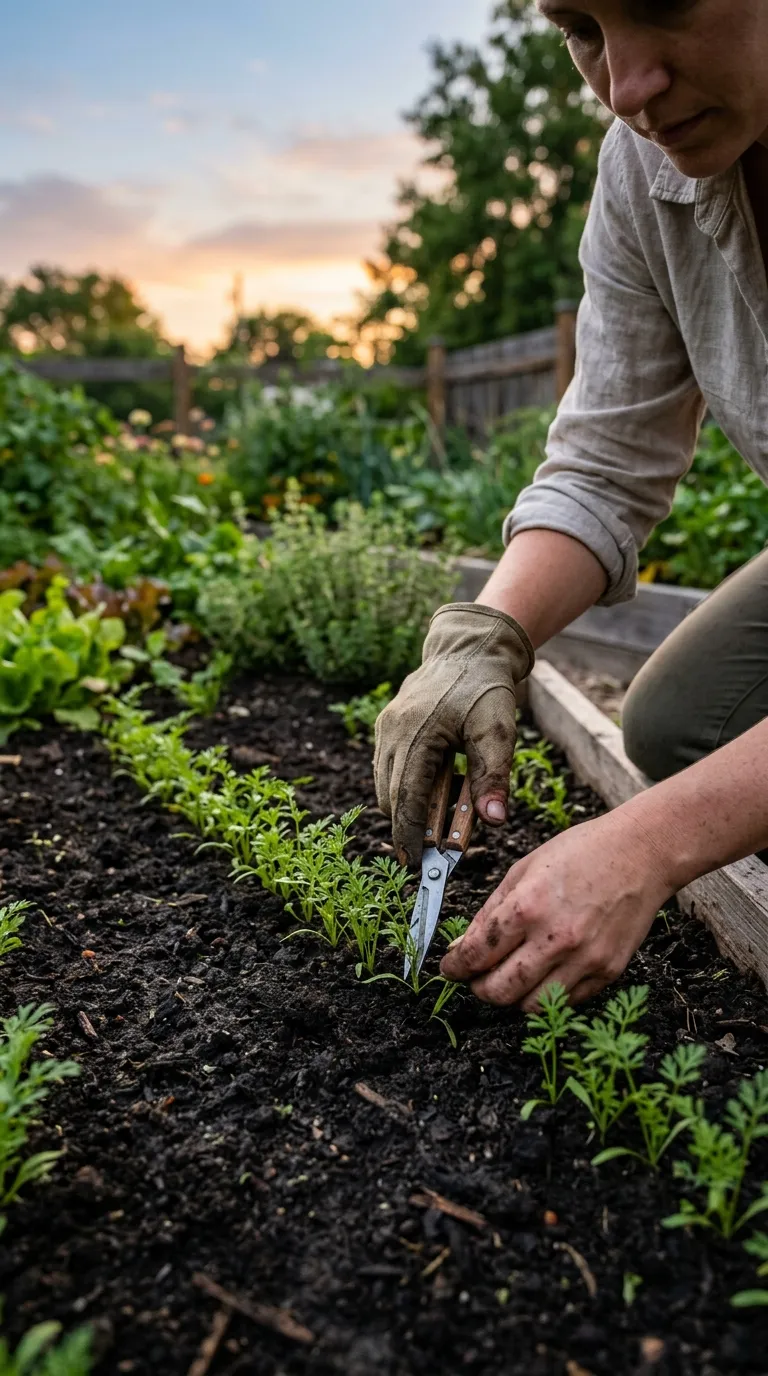
Stage one: when seedlings are 1 inch tall, thin to 1 inch apart. Snip extras at soil level with small scissors rather than yanking, which disturbs the neighbors’ delicate roots and can invite carrot rust fly scent. Do this in the evening when scent disperses and flies are less active, and brush soil back lightly.
Tip 6: Thin Again to 2 Inches at 3 Inches Tall
Stage two: when tops are 3 inches tall and feathery, thin again to a final 2 inches apart for standard carrots (1 to 1.5 inches for baby fingerling harvest). Yes, again. Two inches feels absurdly generous when you look at those tiny leaves, but that root below needs shoulder room. For round container types, you can stay at 2 inches as well. Toss thinned seedlings — they make a delicate garnish — or compost them. If the row was over-sown heavily, thin in two passes a few days apart rather than ripping out half at once. Mulch lightly after the second thinning — a whisper of straw, not a heavy blanket — to keep soil cool and moist but not to bury expanding crowns. And see the full why in why carrots stay small if you have been haunted by small harvests; almost always thinning plus soil depth is the answer.
Tip 7 & 8: Water Evenly and Feed Lightly — Restraint Grows Sweetness
Tip 7: Even Water Prevents Cracks and Forks
Water is the sweetness lever. Keep soil moist until germination, then shift to about 1 inch per week, evenly, not in feast-famine swings. Uneven water after a dry spell is what cracks carrots overnight — the root swells too fast and splits lengthwise. Sandy soils may need two half-inch drinks weekly; clay soils one deep inch is better than three sips. Aim to keep the root zone damp to 6 inches, not just the surface.
Mulch lightly after thinning — a whisper of straw, not a heavy blanket — to keep soil cool and moist but not to bury expanding crowns. And see the full why in why carrots stay small if you have been haunted by small harvests; almost always thinning plus soil depth is the answer.
Tip 8: Feed Sparingly, Avoid Fresh Manure
Feeding carrots is about restraint. They want phosphorus and potassium for root growth, not nitrogen-heavy pushes that make big leafy tops and small, hairy roots. That compost at bed prep — 2 inches, finished, incorporated ahead of time — is often enough for the whole crop in decent soil. If you must side-dress, use a low-nitrogen vegetable fertilizer or fish bone blend at half strength, lightly worked in after thinning, and water in. Never apply fresh manure before or during the carrot crop; fresh organic matter plus irregular moisture equals forking. For schedules, see how often to water vegetables and gentle feeding in fertilizer guide.
Two details that matter more than they appear: hill slightly if shoulders push above soil and turn green. Green shoulders are sunburned and bitter — just nudge soil over exposed crowns. And weed gently but early; carrot seedlings grow slowly while weeds sprint. Hand-weed when weeds are thread-sized, kneeling and pulling so you don’t disturb carrot roots. Once tops close canopy, weeds lose.
Container carrots follow the same care with one tweak: 12-inch deep pots minimum (8-inch for Thumbelina types) with light potting mix plus 20% perlite for drainage, thinned to 2 inches, watered so soil never fully dries but never soggy. Containers dry faster, so morning and evening finger-checks beat schedules. And choose short varieties; a 10-inch Imperator will not be happy contorting in a shallow pot.
Tip 9 & 10: Harvest by Shoulders and Store Cold — Sweetness Loves Chill
Tip 9: Shoulders Don’t Lie
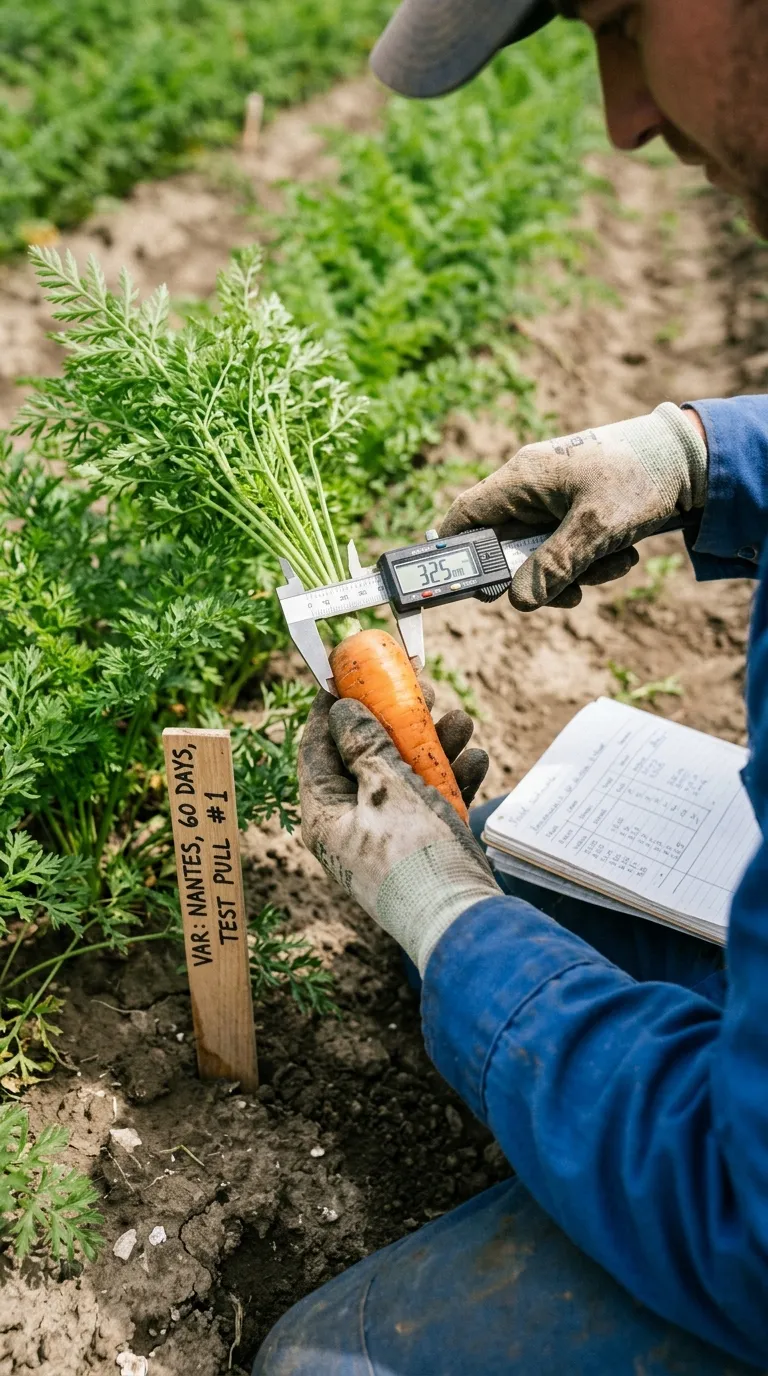
Here’s the most satisfying piece of carrot advice I can give you: carrots tell you when they’re ready by their shoulders. Brush soil back gently at the crown; the diameter you see is the root below. Baby carrots at 1/2 inch, full-size slicers at 3/4 to 1 inch depending on variety. If you sowed Nantes, expect a 6 to 7-inch cylinder with a blunt tip; Chantenay will be broader and conical; Imperator longer and tapered. Days on the packet — 60 to 80 — are guidance, not law. Cool weather slows them, warm speeds them, but shoulders are truth.
Harvest by loosening first. Push a garden fork in a few inches away and lever slightly to fracture compacted soil, then grasp the foliage low and pull steadily. On loose sandy beds they slide out; on heavier loam, that fork-lever prevents snapped tops and broken roots. Harvest in late afternoon after sugars have accumulated through the day, or — even better — after a run of cool nights. Carrots are one of the few vegetables that sweeten after a light frost; starches convert to sugars as the plant prepares for cold. I intentionally leave a fall block under straw mulch until after the first 28°F night, then pull crisp, candy-sweet roots for storage.
Tip 10: Cut Tops, Keep Cold and Humid
For baby carrots, pull every other plant at 1/2 inch to simultaneously thin and eat. For storage, harvest full-size, cut tops to 1/2 inch immediately (tops draw moisture), brush off loose soil but do not wash, and store in a perforated bag or bucket of barely damp sand in the fridge or root cellar at 32–40°F. Kept cold and humid, carrots hold for months. See post-harvest handling in harvesting and storing vegetables and root-storage synergy in when to harvest potatoes. And if you miss the window and pull an oversized woody carrot? Don’t compost it in disappointment. Roast it low and slow with honey and thyme — big fall carrots caramelize wonderfully when given time.
Common Problems — The Fork, The Crack, The Green Shoulder
Forked carrots: Almost always rocky or compacted soil, fresh manure, or damage to the taproot at transplant (which is why we direct sow). Fix for next time is stone-screening, double-digging to 12 inches, and using only well-finished compost prepared weeks ahead.
Cracked carrots: A smooth longitudinal split after a sudden watering following drought. Roots got thirsty, outer skin hardened, then fast water swelled interior faster than skin could stretch. Prevent with even 1 inch per week and mulching that buffers swings.
Green shoulders: Crowns pushed above soil and exposed to light turn green and bitter on top. Simply hill soil over exposed shoulders when you notice them, especially after rain erodes tops.
No germination or blotchy stands: The quarter-inch sowing depth dries faster than you think. Keep moist continuously for 21 days, use board or burlap, and sow at the right 1/4 inch — not 1/2 inch, which is too deep for such small seed.
Small, spindly carrots at harvest: Crowding is usually the culprit. See why carrots stay small. But also check: Did you thin to 2 inches? Is soil loose 12 inches? Are you getting at least 6 hours of sun?
Rust fly: Thin in evening, cover with row fabric until tops are 4 inches to deter rust fly, rotate beds yearly.
Seasonal Calendar — 10 Tips Across the Season
| Season | Tip Focus | Action |
|---|---|---|
| Early spring | Tips 1–2: Soil & variety | Fork 12“, remove stones, add compost, choose Chantenay for clay |
| 2–4 weeks before last frost | Tips 3–4: Sow | Sow 1/4“ when soil 50°F+, keep damp 21 days |
| Seedlings 1“ tall | Tip 5: First thin | Snip to 1“ |
| Seedlings 3“ tall | Tip 6: Final thin | Snip to 2“, evening, water after |
| Late spring | Tips 7–8: Water & feed | 1“/week even, no fresh manure |
| 60–80 days after sow | Tips 9–10: Harvest | Shoulder check 3/4–1“, fork-loosen, store cold humid |
| Late summer | Succession | Sow fall block 10–12 weeks before frost |
| Fall | Sweetness | Mulch heavier, harvest after first light frost |
| Fall / containers | Options | 12“ pots, Nantes types, same thinning |
| Next year | Rotation | Rotate roots yearly, fresh compost in fall |
Troubleshooting — Read Your Harvest
Thin and straight but short? Harvested too early or sown too late. Let next row mature 2 weeks longer.
Forked and bent? Stones, clay pan, or fresh manure. Go deeper and cleaner.
Pale with huge tops? Too much nitrogen + shade. Compost enough, move to sun.
Cracked down the middle? Inconsistent water. Mulch and water evenly.
Green top, orange bottom? Shoulders exposed — hill soil over crowns.
What I Learned After 5 Seasons — Notes From the Bed Edge
The first year I pulled a handful of little orange fists that each split into three fingers. I blamed the seed. The soil was actually full of pea gravel from construction backfill I’d never removed. One afternoon with a hardware-cloth screen over a wheelbarrow, shaking beds to remove stones, changed everything the next spring.
The second year I watered faithfully until germination — then forgot, thinking “they’re up, they’re fine.” A late May heat wave crusted the surface and half the row vanished. Now I set a phone reminder: “mist carrot row” for 21 days after sowing.
The third lesson was thinning courage. I thinned to 1 inch and called it good, unable to snip more. Harvest was a carpet of pencil-thin carrots my kids called “fairy carrots.” The following season I thinned to 2 inches at 3 inches tall with kitchen scissors and held the bowl of compost guilt. The nudge of seeing those first shoulders at an inch diameter that July cured me.
Year four taught me about timing and temperature. The fall block sown August 1 that I left through a 26°F night, mulched with 4 inches of straw under a row cover, was transcendent — flavor like apple-sweet. Now I always plan a fall sowing just for that cold-sweetened harvest.
And year five gave me the green-shoulder fix. A heavy rain washed an inch of soil off the crowns and I didn’t notice for a week. Tops turned bitter and I had to trim deeper. Now I walk the row after every heavy rain and tuck soil back over any orange showing. Thirty seconds, noticeable sweetness.
Extra Thoughts That Belong on the Trellis Wall
Cucumbers reward the gardener who watches daily more than the one who fertilizes weekly. A two-minute walk every other day beats a weekend rescue.
If leaves yellow, diagnose before treating. Water first, air second, feed third, spray last.
Succession is not extra work; it is insurance. Three sowings, three chances, the best sowing teaches you your microclimate.
Harvest small, harvest often. Every big yellow balloon you leave is a week of new flowers paused.
Mulch is quiet work that pays loudly. Straw after warm soil keeps the one-inch weekly rhythm even when you forget.
Bee flowers are not decoration. Dill, borage, zinnias within 20 feet bring the pollination that fills cucumbers evenly.
Shade cloth in a heat dome is kindness, not cheating. A 30% veil for the hottest three hours keeps pollen alive.
Clean up at season end. Remove yellowed vines, don’t compost sick leaves, rotate cucurbits three years.
Taste as you grow. A perfect slicer from the trellis, cool, glossy, snapped in half and eaten in the path, is the whole point of the work.
Keep notes. One line a day — rain, water, flower count — teaches you more than any calendar.
These habits compound. By late summer the trellis feels easy, and the kitchen has that problem you want: too many cucumbers.
Extra Thoughts That Belong on the Trellis Wall
Cucumbers reward the gardener who watches daily more than the one who fertilizes weekly. A two-minute walk every other day beats a weekend rescue.
If leaves yellow, diagnose before treating. Water first, air second, feed third, spray last.
Succession is not extra work; it is insurance. Three sowings, three chances, the best sowing teaches you your microclimate.
Harvest small, harvest often. Every big yellow balloon you leave is a week of new flowers paused.
Mulch is quiet work that pays loudly. Straw after warm soil keeps the one-inch weekly rhythm even when you forget.
Bee flowers are not decoration. Dill, borage, zinnias within 20 feet bring the pollination that fills cucumbers evenly.
Shade cloth in a heat dome is kindness, not cheating. A 30% veil for the hottest three hours keeps pollen alive.
Clean up at season end. Remove yellowed vines, don’t compost sick leaves, rotate cucurbits three years.
Taste as you grow. A perfect slicer from the trellis, cool, glossy, snapped in half and eaten in the path, is the whole point of the work.
Keep notes. One line a day — rain, water, flower count — teaches you more than any calendar.
These habits compound. By late summer the trellis feels easy, and the kitchen has that problem you want: too many cucumbers.
Extra Thoughts That Belong on the Trellis Wall
Cucumbers reward the gardener who watches daily more than the one who fertilizes weekly. A two-minute walk every other day beats a weekend rescue.
If leaves yellow, diagnose before treating. Water first, air second, feed third, spray last.
Succession is not extra work; it is insurance. Three sowings, three chances, the best sowing teaches you your microclimate.
Harvest small, harvest often. Every big yellow balloon you leave is a week of new flowers paused.
Mulch is quiet work that pays loudly. Straw after warm soil keeps the one-inch weekly rhythm even when you forget.
Bee flowers are not decoration. Dill, borage, zinnias within 20 feet bring the pollination that fills cucumbers evenly.
Shade cloth in a heat dome is kindness, not cheating. A 30% veil for the hottest three hours keeps pollen alive.
Clean up at season end. Remove yellowed vines, don’t compost sick leaves, rotate cucurbits three years.
Taste as you grow. A perfect slicer from the trellis, cool, glossy, snapped in half and eaten in the path, is the whole point of the work.
Keep notes. One line a day — rain, water, flower count — teaches you more than any calendar.
These habits compound. By late summer the trellis feels easy, and the kitchen has that problem you want: too many cucumbers.
Extra Thoughts That Belong on the Trellis Wall
Cucumbers reward the gardener who watches daily more than the one who fertilizes weekly. A two-minute walk every other day beats a weekend rescue.
If leaves yellow, diagnose before treating. Water first, air second, feed third, spray last.
Succession is not extra work; it is insurance. Three sowings, three chances, the best sowing teaches you your microclimate.
Harvest small, harvest often. Every big yellow balloon you leave is a week of new flowers paused.
Mulch is quiet work that pays loudly. Straw after warm soil keeps the one-inch weekly rhythm even when you forget.
Bee flowers are not decoration. Dill, borage, zinnias within 20 feet bring the pollination that fills cucumbers evenly.
Shade cloth in a heat dome is kindness, not cheating. A 30% veil for the hottest three hours keeps pollen alive.
Clean up at season end. Remove yellowed vines, don’t compost sick leaves, rotate cucurbits three years.
Taste as you grow. A perfect slicer from the trellis, cool, glossy, snapped in half and eaten in the path, is the whole point of the work.
Keep notes. One line a day — rain, water, flower count — teaches you more than any calendar.
These habits compound. By late summer the trellis feels easy, and the kitchen has that problem you want: too many cucumbers.
- Even water at the base, morning, keeps cucumber flesh sweet and straight.
- A stout 6-foot trellis lets air dry leaves by noon and cuts mildew a third.
- Pick every two days at six inches — young fruits keep vines making more.
- Compost at planting carries cucumbers to flowering; heavy nitrogen stalls fruit.
- Bee flowers within twenty feet bring the pollination that fills fruits evenly.
- Mulch three inches after soil warms — cool roots, less bitter shoulders.
- Hand-pollinate at dawn if bees are scarce: male dabbed gently into female.
- Succession sowing three weeks apart keeps young vines for late summer.
- Thin carrots twice: one inch, then two — space is size underground.
- Loose, stone-free soil twelve inches deep lets roots run straight.
- Keep carrot seed damp for twenty-one days with burlap or a board early.
- Shoulders at three-quarter inch tell you when to pull, not the calendar.
- Fall carrots after light frost taste like candy from starch to sugar.
- Hill potatoes twice to keep tubers dark and bitter-free.
- Cure potatoes dark humid two weeks — that is winter storage.
- Lettuce barely covered, four inches apart, cool moist, morning cut.
- Shade cloth thirty percent keeps lettuce tender two weeks longer.
- Compost two inches, pH six to seven, steady water — the quiet base.
- Morning watering before ten lets foliage wake dry.
- Remove yellow spotted leaves promptly — bag, not compost, while active.
- Row cover until bloom protects from beetles, then let bees in.
- One overgrown yellow cucumber left stalls new females a week.
- Sow carrots cool, not in heat above eighty — germination stalls.
- Use finished compost, not fresh manure, to avoid forking.
- Store carrots tops trimmed, brushed not washed, cold humid.
- Choose Chantenay for clay, Imperator for deep sand — match variety.
- Water containers daily in heat until it drains freely.
- Harvest carrots with a fork lever to avoid snapping roots.
- Rotate cucurbits three years where mildew was heavy.
- Keep notes: one line a day teaches more than any schedule.
A Note on Small Kindnesses
A cucumber handed to a neighbor over the fence carries more than crunch. It carries the morning you checked the trellis, the evening you tied a slipping vine, the rain gauge you finally bought.
Thin carrots with scissors at dusk, when carrot fly is sleepy, and the scent disperses.
Brush soil from a carrot shoulder gently, like brushing hair, to check size without pulling.
Water at the base, not the leaf, and let the sun dry what little splash remains by noon.
These small kindnesses are not extra steps. They are the steps.
One final line for straight, sweet roots.
Frequently Asked Questions
Q: How long do carrots take to grow?
A: Carrots germinate in 10 to 21 days and mature 60 to 80 days from sowing, depending on variety and weather. Nantes types are often ready at 60 to 65 days, Imperator at 70 to 80. Those 21 germination days are the tender part — keep soil consistently moist the whole time, covering with a board or burlap for the first week to hold humidity. Cool weather slows maturity slightly, but improves sweetness and texture, especially for fall-sweetened storage carrots.
Q: Why do carrots fork and split?
A: Forked or split carrots usually come from rocky or compacted soil, fresh manure, transplanting damage, or uneven watering. Use loose, stone-free soil loosened 12 inches deep with well-finished compost incorporated weeks before sowing — not fresh manure — and water evenly at about 1 inch per week. A crack after a heavy soak following a dry spell is a classic water swing, while forking is almost always a stone or clod that forced the tip to split.
Q: Can you grow carrots in containers?
A: Yes, beautifully, if you go deep enough. Grow carrots in 12-inch deep pots with light potting mix and about 20% perlite for drainage; 8-inch pots work only for short, round varieties like Thumbelina or Paris Market. Keep soil consistently moist, thin to 2 inches spacing, and give 6 hours of sun. Containers often give the straightest carrots because you control stones completely, but they dry faster so check morning and evening.
Q: Why are my carrots so small?
A: Small carrots almost always mean overcrowding, heavy or shallow soil, too little sun, or harvesting too early. Thin seedlings ruthlessly to 2 inches apart when 3 inches tall — snip with scissors to avoid disturbing neighbors — loosen soil 12 inches deep and stone-free, ensure at least 6 hours of sun, and wait until shoulders reach 3/4 to 1 inch. Check the detailed fix in why carrots stay small; spacing plus depth is usually the whole answer.
Related Articles
- Why Are My Carrots So Small
- How Often to Water Vegetables
- Vegetable Garden Fertilizer
- How to Prepare Soil for Planting
- Vegetable Garden Layout
- Best Vegetables for Raised Beds
Sources & References
- University of Minnesota Extension - https://extension.umn.edu/vegetables/carrots
- Cornell Vegetables - https://www.vegetables.cornell.edu/
- North Carolina State Extension - https://content.ces.ncsu.edu/carrots
- Iowa State University Extension - https://hortnews.extension.iastate.edu/
- University of California Agriculture and Natural Resources - https://ucanr.edu/