You wait 70 days. You water, you weed, you try not to peek. Then you finally grip those feathery tops, pull with the little thrill you remember from childhood — and up comes a cluster of pale, finger-thin wisps that look more like orange toothpicks than carrots. I know that quiet disappointment. My first carrot bed gave me a handful of fragrant, sweet, utterly tiny roots that I pretended to be delighted with while I chopped them into soup, trying not to count how many it took to fill a cup.
Small carrots are almost never a mystery, and they are rarely your fault in the way you think. They are not about having a bad thumb or bad luck. They are about what happened underground in the dark, where you could not see it: too many seedlings fighting for the same inch, soil that fought back with stones and clay, sun that never quite arrived, or a harvest that came just two weeks too early. The good news is that all of that is fixable, and the next sowing — just a few feet away, in the same season — can be completely different.
If you are holding a bunch of small carrots right now, taste one first. They are often the sweetest of the lot. Then let us figure out why they stayed small so the next pull gives you that satisfying, earthy snap of a full-size root.
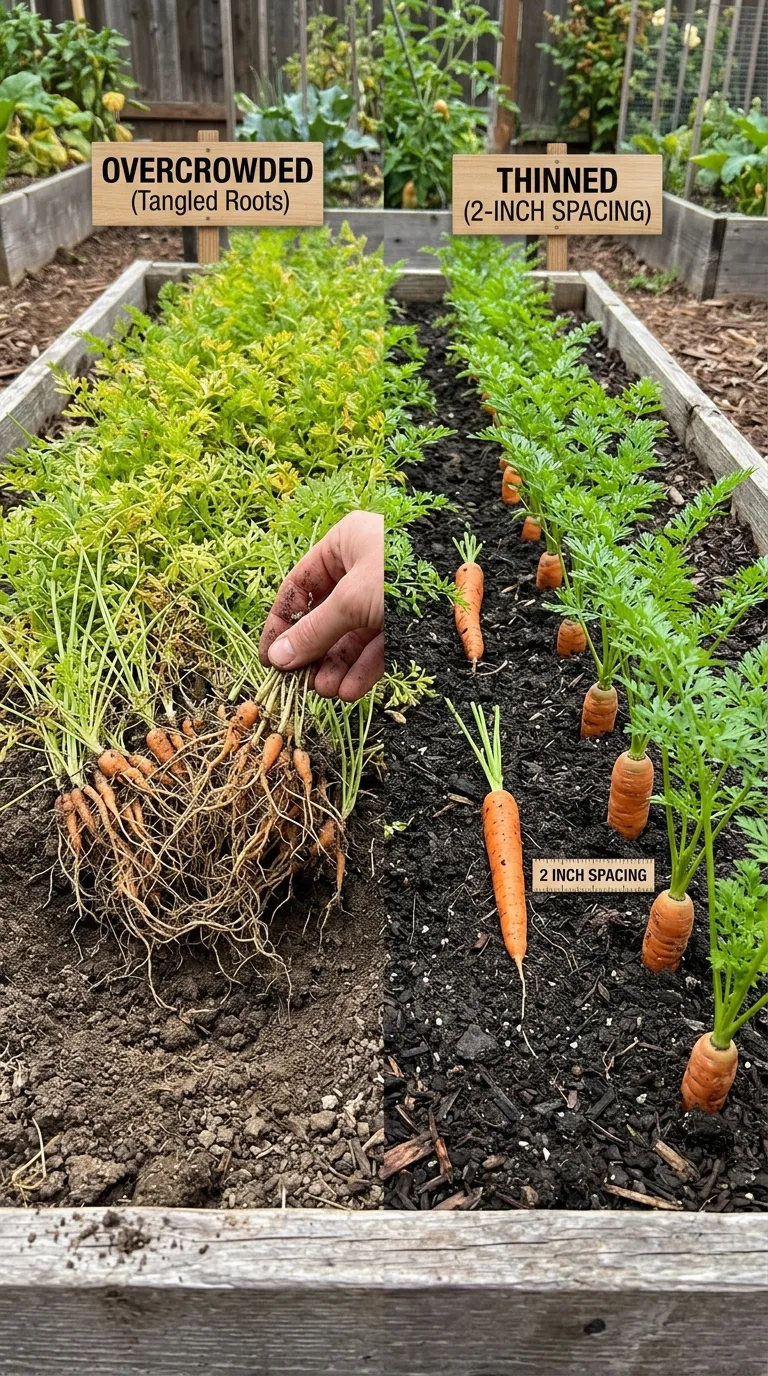
Quick Answer: Carrots stay small when seedlings are left crowded, when soil is rocky, compacted, or shallow, when they get less than 6 hours of direct sun, or when they are harvested too early. That pencil-thin look is almost always crowding + heavy soil. For thick, straight carrots: thin seedlings to a final spacing of 2 inches apart (snip with scissors at 1 inch tall and again at 3 inches), grow in loose, stone-free, deeply worked soil 12 inches deep with plenty of aged compost, give 6 to 8 hours of full sun with rows 12 inches apart, water evenly with about 1 inch per week, and harvest only when shoulders reach 3/4 to 1 inch in diameter — usually 60 to 80 days after sowing depending on variety. Carrots sown thickly and never thinned will always stay small, no matter how long you leave them.
At a Glance
| Cause | What You’ll See | Why It Keeps Small | The Fix |
|---|---|---|---|
| 1. Crowding | Pencil-thin, tangled | No room to swell | Thin to 2“ |
| 2. Rocky / clay soil | Forked, short, bent | Hits stones, stops | Loosen 12“, remove stones |
| 3. Too little sun | Pale, leggy tops | Not enough photosynthesis | 6–8 hrs sun |
| 4. Early harvest | Short but perfect | Needed 2–3 more weeks | Shoulder 3/4–1“ |
| 5. Inconsistent water | Cracked, stunted | Growth starts/stops | 1“/week even |
| 6. Wrong variety | Always small | Long type in shallow clay | Chantenay for clay |
| 7. Sown in heat | Poor germination, woody | >85°F inhibits | Sow cool seasons |
| 8. Fresh manure / crust | Hairy, forked, blotchy | Nitrogen pockets, crust | Aged compost, 1/4“ depth |
My First Tiny Harvest (And What It Taught Me)
The bed was beautiful on top. I had sown an entire packet of ‘Nantes’ in a neat, hopeful row, covered it with a whisper of soil, and watered it like a ritual every evening. When the green haze of seedlings appeared, I felt proud. So proud, in fact, that I could not bear to pull any of them. They looked so lively, so earnest. Who was I to decide which ones got to live?
Six weeks later that pride turned into a dense, ferny carpet. The foliage looked lush from the sidewalk. Underground, it was a traffic jam. When I finally thinned — far too late and far too timidly — the seedlings came up in clumps, their tiny white roots already intertwined like shy fingers. At harvest, I pulled what felt like a bouquet of orange chives.
That is the moment most gardeners learn the central paradox of carrots: to get more, you have to grow fewer. Carrots are not generous like zucchini. They do not compensate. Each root needs its own quiet column of soft soil and its own share of sunlight, or it simply stays small. And unlike tomatoes, you cannot fix it later with extra fertilizer. By the time you see the problem at harvest, the cause was weeks ago.
If that is your story this season too, you are in very good company. Let us walk through exactly what keeps them small.
The 8 Common Causes — From Crowding to Crust
1. Crowding — The Number One Reason
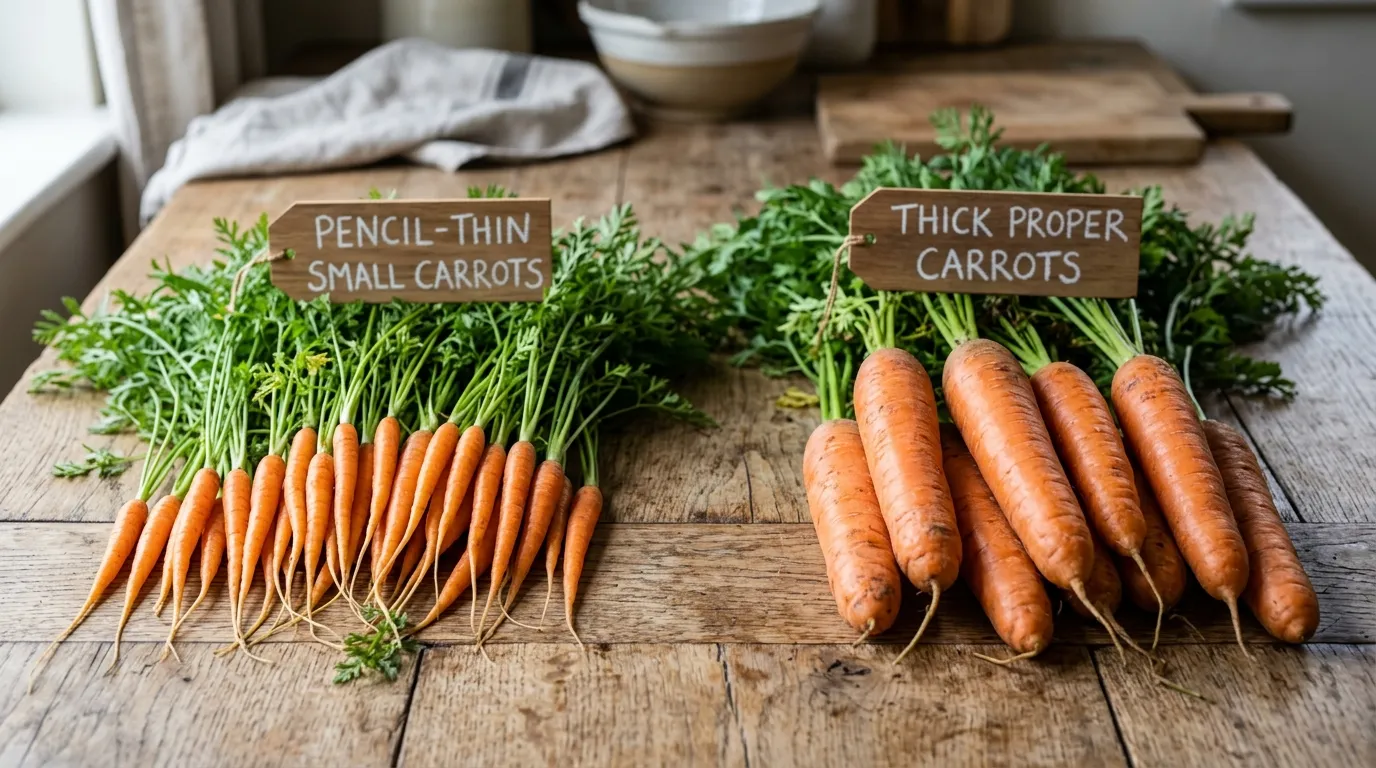
This is the hardest and most important. At 1 inch tall, thin to 1 inch apart. At 3 inches tall, thin again to a final 2 inches apart. Snip, don’t pull. Crowded carrots stay in survival mode, throwing up thin leaves, waiting for room that never comes. One crowded foot produces 50 tiny roots. That same foot thinned to 2 inches produces 6 full-size ones with 5 times the weight. Gardeners who thin twice, on time, almost never get small carrots again.
2. Rocky or Clay Soil — The Underground Wall
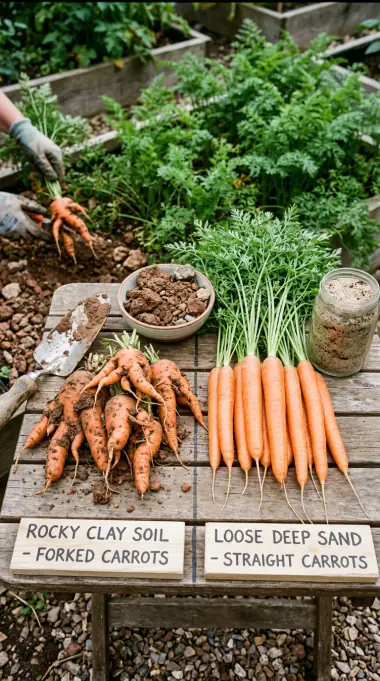
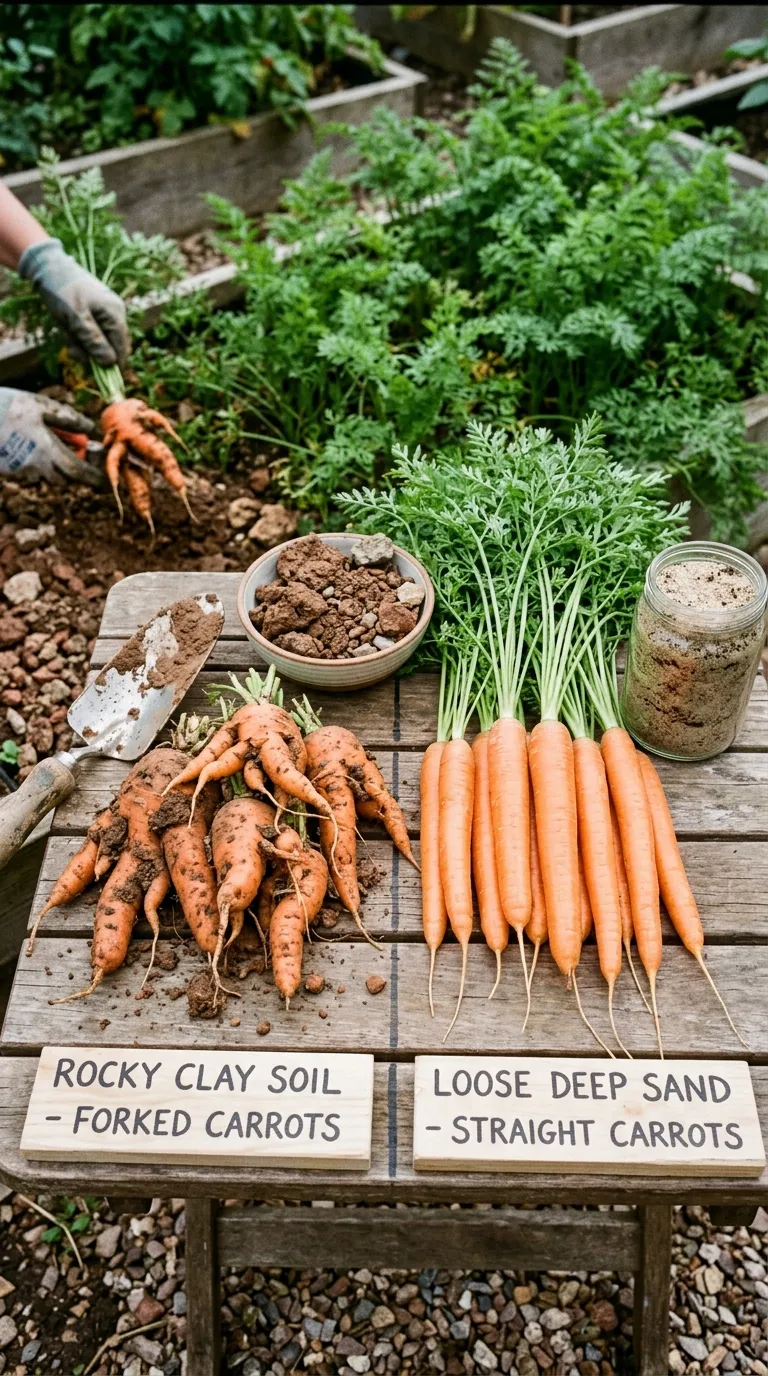
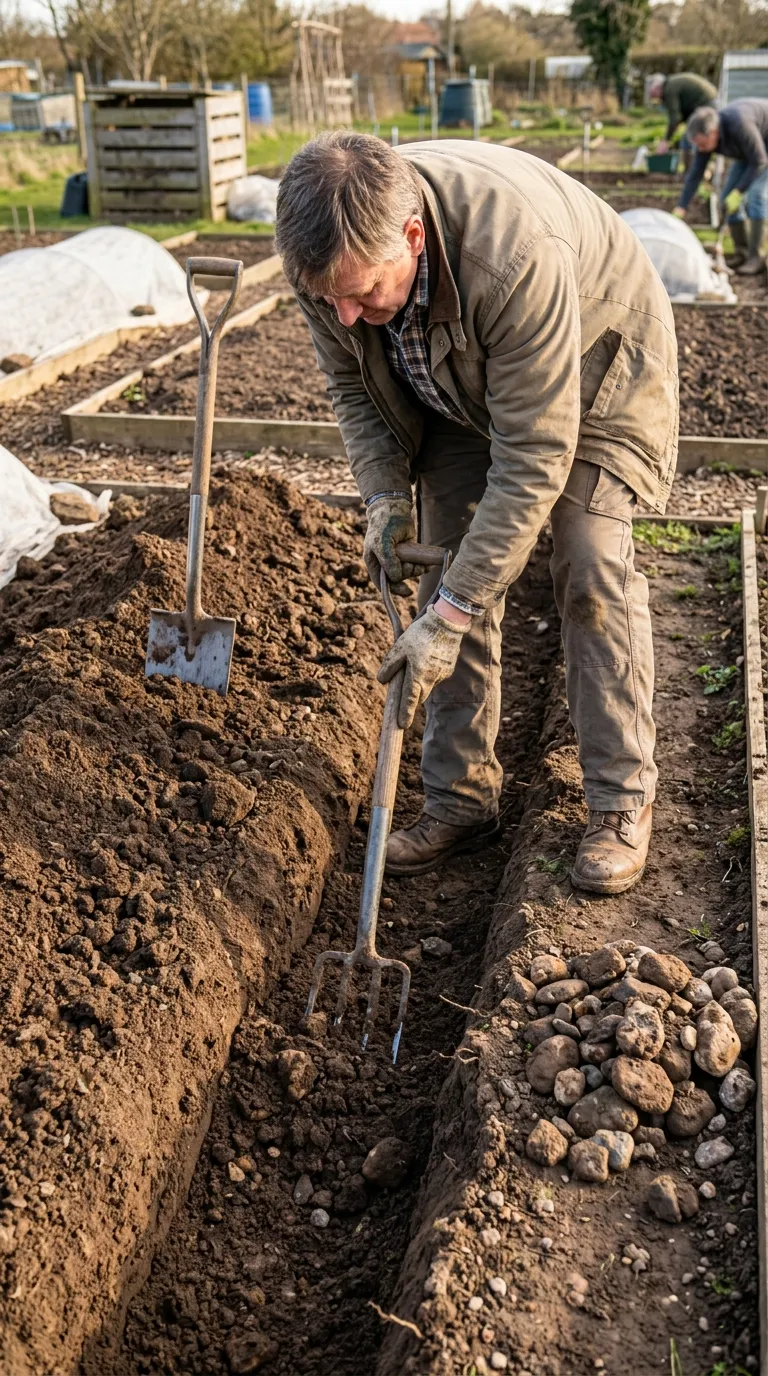
A carrot root does not drill like a tree root. It expands by gentle pressure. Hit a pebble the size of a marble, a layer of clay at 4 inches, or soil compacted by winter rain, and it forks, bends, or simply stops growing longer. Heavy soil is the second most common reason for both small and crooked carrots. Loosen 12 inches, remove stones larger than a pea, work in 2 to 3 inches of well-rotted compost weeks before sowing. If your native soil is heavy clay, a raised bed 12 inches tall filled with sandy loam is the easiest path to straight, thick carrots.
3. Too Little Sun — The Light That’s Not Quite Enough
I learned this next to a fence that seemed sunny enough. The tops looked green and happy, but the roots underneath never thickened. Three hours of bright morning light plus dappled afternoon is not full sun to a carrot. It is a slow, pale existence. Choose your sunniest bed — where tomatoes would be happy — sow carrots there, and space rows 12 inches apart so leaves catch light without shading each other. Shade plus crowding is the most common double-hit for tiny carrots.
4. Harvested Too Early — Two Weeks Matters
Most varieties need 60 to 80 days to reach full size. Instead of counting days, learn the shoulder check. Brush soil gently away from the top of one root. Is the shoulder at least 3/4 to 1 inch across? Does it look broad and well-colored, not pointed? If yes, pull that test carrot. If slender, smooth the soil back and give the row another 10 to 14 days. Carrots size up in the last 2 weeks more than the first 6.
5. Inconsistent Water — The Crack and Stall
Carrots crack and stall when water swings from drought to deluge. Think steady. Give about 1 inch per week, ideally in one or two deep waterings rather than daily sprinkles. Mulch lightly between rows with straw once seedlings are 4 inches tall — it holds moisture without crusting over the row itself. Keep the seed row moist until germination (14 to 21 days and cannot dry out), then shift to deeper, less frequent water.
6. Wrong Variety for Your Soil Depth
Not all carrots want the same soil depth. Heavy or shallow soil (6 to 8 inches loose): Chantenay, Nantes, Amsterdam, Parisian — short, blunt, fast. Deep sandy loam (10 to 12 inches loose): Danvers, Imperator, St. Valery — long, tapered. Containers: Little Finger, Thumbelina — bred for 6-inch depth. A 12-inch Imperator will never finish in a 6-inch window box.
7. Sown in Heat — Woody and Stunted
Carrots germinate best when soil is 55 to 75°F and sweeten when they mature in cool air (60 to 70°F). Soil hotter than 85°F gives spotty, slow germination and small, woody roots. Two sowings beat one: sow first 2 to 4 weeks before last frost, as soon as soil can be worked. Sow again in late summer — about 10 weeks before first fall frost — for the sweetest storage roots. In very hot climates, pause mid-summer.
8. Fresh Manure and Crusted Soil
Fresh manure creates ultra-rich pockets that make roots fork into alien shapes and stay small. Use compost that is dark, crumbly, and sweet-smelling — at least 6 months rotted. Crusted soil caps the surface like concrete after heavy rain and seedlings cannot push through. Don’t bury seeds deep — 1/4 inch is enough. Cover with vermiculite or fine compost, not heavy soil. Keep damp with a fine mist.
Water, Sun, and Timing — The Steady Trio
Choose your sunniest bed, water about 1 inch per week evenly, and sow at the right temperature. Carrots sweeten dramatically after a light frost. A row sown in late summer and left into October often tastes sweeter than the spring row, even if the roots are the same size. Harvest before the ground freezes hard, but do not rush. See how to grow carrots for step-by-step sowing and when to plant vegetables for frost dates.
If the weather turns hot and dry during swelling (when shoulders are visible), do not let the bed go dusty for a week and then flood it. That cycle causes splits and a bitter core. Even moisture grows smooth, sweet cylinders. For watering rhythm by crop and season, see how often to water vegetables.
How to Fix Next Sowing — A Checklist
Before you sow:
- Soil forked and stone-free 12 inches deep, 2 inches compost mixed in, no fresh manure
- Sunniest bed chosen, rows marked 12 inches apart
- Variety matched to your depth (Chantenay for clay, Imperator only for deep sand)
- Seeds mixed with sand, sown 1/4 inch deep, row covered with fine compost
After germination:
- Thin at 1 inch tall to 1 inch, at 3 inches tall to 2 inches — snip, evening, water after
- Mulch between rows with straw, keep 1 inch water per week evenly
- Shoulder check at 60 days — harvest when 3/4 to 1 inch, not before
Do that once, and you will see thick roots — crisp, bright, and fragrant when you snap one in half.
Common Mistakes That Keep Carrots Small
Sowing straight from the packet like salt. Mix seeds with fine sand or spent coffee grounds so you can see where they fall, or use a seed tape. Less sown = less thinning grief.
Pulling thinnings instead of snipping. Yanking loosens neighbors and invites rust fly. Sharp scissors at soil level is quiet, precise.
Fresh manure or unfinished compost. Dark, crumbly, sweet-smelling — at least 6 months rotted. Add it in autumn or 3 weeks before sowing, never at sowing.
Crusted soil. 1/4 inch is enough depth. Cover with vermiculite or fine compost, keep damp with fine mist.
Harvesting after just one peek. The biggest carrot at 45 days is the outlier. Check median shoulders. If most are still slender, wait. Carrots size up in the last 2 weeks more than the first 6.
Growing long varieties in shallow pots. Match variety to depth.
Seasonal Calendar at a Glance
| Season | What to Do | Why It Matters |
|---|---|---|
| Late Winter | Choose variety for soil depth; build raised bed if clay | Prevents forked, stunted roots |
| 2–4 Weeks Before Last Frost | First sowing, soil 50°F+, keep damp 14–21 days | Cool germination = even stand |
| Seedlings 1“ & 3“ Tall | Thin twice to 2“ final, evening + water after | Biggest size gain |
| Late Spring to Early Summer | Even water, light mulch, 6–8 hrs sun | Steady growth, no cracking |
| 60–80 Days After Sowing | Shoulder check 3/4–1“, harvest as needed | Lets roots reach full diameter |
| Late Summer (10 wks before frost) | Second sowing for fall | Sweetest flavor, best storage |
| Fall | Harvest after light frost | Cold sweetens |
Troubleshooting — What Your Small Carrots Are Telling You
Small, straight, perfectly formed but short? Harvested too early or sown too late. Let next row mature 2 weeks longer.
Small, forked, and bent? Stones, clay pan, or fresh manure. Go deeper and cleaner.
Small, pale, with huge ferny tops? Too much nitrogen + shade. Compost at sowing is enough. Move to sunnier bed.
Small, cracked down the middle? Inconsistent water. Mulch and water evenly.
Small and woody with strong taste? Heat + late harvest. Sow earlier or later to mature in cool weather, and harvest promptly when shoulders size up.
Don’t Waste the Small Ones
Even pencil-thin carrots are sweet, and their very smallness is tender. Wash them well — no need to peel — and use them whole. They roast beautifully in 12 minutes, make the most fragrant quick pickles, and are perfect for that glossy butter-glazed side dish where full-size carrots would need peeling and chopping. I keep a jar of tiny carrots pickled with dill and a little honey specifically for winter salads. They are a cook’s treasure, even if they were not what you planned to pull.
More Human Notes From the Garden
A garden is not a factory. Carrots sweeten after a light frost because starch turns to sugar as the plant prepares for winter sleep. That cool-night candy happens without you doing anything except leaving the row a touch longer under straw.
Potatoes need darkness like carrots need softness. Hill them twice, 4 to 6 inches, and keep tubers 4 inches under. Green shoulders are sunburned and bitter — hill soil over them when rain washes tops.
Lettuce wants to be cut young. Thirty-day baby leaves picked at 7 a.m. are tender and mild; sixty-day oversized leaves after a hot week are bitter and tough.
Succession is not extra work; it is forgiveness. Sow a pinch every two weeks and the season forgives a bad sowing or a heat wave.
Mulch is the quiet helper. Straw after warm soil for cucumbers and peppers, light straw between carrots after thinning, straw over potatoes after hilling — same idea, different depth.
Water at the base, morning, before 10 a.m. Leaves that wake dry stay healthier four weeks longer than leaves that slept wet.
Taste as you go. A tiny orange carrot eaten standing in the path tells you more than a calendar about whether the row is ready.
Keep one line of notes: date, rain, water, what you harvested. That notebook teaches you more than any schedule.
Harvest with care. Cut cucumbers, don’t yank. Loosen carrots with a fork, then pull. Brush potatoes, don’t wash before storing. Snip lettuce, leave the center to regrow.
Share the surplus. A bowl of mixed lettuce, a handful of tiny carrots pickled with dill, a basket of new potatoes boiled with butter — these are the garden’s conversations with the kitchen.
These habits compound across seasons until the garden feels less like work and more like a rhythm you step into each morning.
More Human Notes From the Garden
A garden is not a factory. Carrots sweeten after a light frost because starch turns to sugar as the plant prepares for winter sleep. That cool-night candy happens without you doing anything except leaving the row a touch longer under straw.
Potatoes need darkness like carrots need softness. Hill them twice, 4 to 6 inches, and keep tubers 4 inches under. Green shoulders are sunburned and bitter — hill soil over them when rain washes tops.
Lettuce wants to be cut young. Thirty-day baby leaves picked at 7 a.m. are tender and mild; sixty-day oversized leaves after a hot week are bitter and tough.
Succession is not extra work; it is forgiveness. Sow a pinch every two weeks and the season forgives a bad sowing or a heat wave.
Mulch is the quiet helper. Straw after warm soil for cucumbers and peppers, light straw between carrots after thinning, straw over potatoes after hilling — same idea, different depth.
Water at the base, morning, before 10 a.m. Leaves that wake dry stay healthier four weeks longer than leaves that slept wet.
Taste as you go. A tiny orange carrot eaten standing in the path tells you more than a calendar about whether the row is ready.
Keep one line of notes: date, rain, water, what you harvested. That notebook teaches you more than any schedule.
Harvest with care. Cut cucumbers, don’t yank. Loosen carrots with a fork, then pull. Brush potatoes, don’t wash before storing. Snip lettuce, leave the center to regrow.
Share the surplus. A bowl of mixed lettuce, a handful of tiny carrots pickled with dill, a basket of new potatoes boiled with butter — these are the garden’s conversations with the kitchen.
These habits compound across seasons until the garden feels less like work and more like a rhythm you step into each morning.
More Human Notes From the Garden
A garden is not a factory. Carrots sweeten after a light frost because starch turns to sugar as the plant prepares for winter sleep. That cool-night candy happens without you doing anything except leaving the row a touch longer under straw.
Potatoes need darkness like carrots need softness. Hill them twice, 4 to 6 inches, and keep tubers 4 inches under. Green shoulders are sunburned and bitter — hill soil over them when rain washes tops.
Lettuce wants to be cut young. Thirty-day baby leaves picked at 7 a.m. are tender and mild; sixty-day oversized leaves after a hot week are bitter and tough.
Succession is not extra work; it is forgiveness. Sow a pinch every two weeks and the season forgives a bad sowing or a heat wave.
Mulch is the quiet helper. Straw after warm soil for cucumbers and peppers, light straw between carrots after thinning, straw over potatoes after hilling — same idea, different depth.
Water at the base, morning, before 10 a.m. Leaves that wake dry stay healthier four weeks longer than leaves that slept wet.
Taste as you go. A tiny orange carrot eaten standing in the path tells you more than a calendar about whether the row is ready.
Keep one line of notes: date, rain, water, what you harvested. That notebook teaches you more than any schedule.
Harvest with care. Cut cucumbers, don’t yank. Loosen carrots with a fork, then pull. Brush potatoes, don’t wash before storing. Snip lettuce, leave the center to regrow.
Share the surplus. A bowl of mixed lettuce, a handful of tiny carrots pickled with dill, a basket of new potatoes boiled with butter — these are the garden’s conversations with the kitchen.
These habits compound across seasons until the garden feels less like work and more like a rhythm you step into each morning.
More Human Notes From the Garden
A garden is not a factory. Carrots sweeten after a light frost because starch turns to sugar as the plant prepares for winter sleep. That cool-night candy happens without you doing anything except leaving the row a touch longer under straw.
Potatoes need darkness like carrots need softness. Hill them twice, 4 to 6 inches, and keep tubers 4 inches under. Green shoulders are sunburned and bitter — hill soil over them when rain washes tops.
Lettuce wants to be cut young. Thirty-day baby leaves picked at 7 a.m. are tender and mild; sixty-day oversized leaves after a hot week are bitter and tough.
Succession is not extra work; it is forgiveness. Sow a pinch every two weeks and the season forgives a bad sowing or a heat wave.
Mulch is the quiet helper. Straw after warm soil for cucumbers and peppers, light straw between carrots after thinning, straw over potatoes after hilling — same idea, different depth.
Water at the base, morning, before 10 a.m. Leaves that wake dry stay healthier four weeks longer than leaves that slept wet.
Taste as you go. A tiny orange carrot eaten standing in the path tells you more than a calendar about whether the row is ready.
Keep one line of notes: date, rain, water, what you harvested. That notebook teaches you more than any schedule.
Harvest with care. Cut cucumbers, don’t yank. Loosen carrots with a fork, then pull. Brush potatoes, don’t wash before storing. Snip lettuce, leave the center to regrow.
Share the surplus. A bowl of mixed lettuce, a handful of tiny carrots pickled with dill, a basket of new potatoes boiled with butter — these are the garden’s conversations with the kitchen.
These habits compound across seasons until the garden feels less like work and more like a rhythm you step into each morning.
Small Variations That Matter
Dappled afternoon shade for lettuce keeps it sweet two weeks longer than blazing sun.
Chantenay carrots in clay outgrow Imperator in clay every time — match variety to soil, not dream.
Yukon Gold new potatoes at 75 days eat better than late Russets dug early for storage.
Potato scab loves high pH — keep 5.0 to 6.0 and rotate three years.
Carrot rust fly finds scent — thin at dusk, cover with row fabric after, and the row stays cleaner.
Potato beetles patrol at 7 a.m. — hand-pick then with a jar of soapy water.
Lettuce tipburn is water swing, not lack of feed — even 1 inch weekly prevents brown edges.
Sow lettuce barely covered — light helps it wake.
Hill potatoes twice — darkness is flavor.
Thin carrots twice — space is size.
What I Keep on the Shed Wall
A handwritten card that says: warm soil, direct sow, 12 inches, thin twice to 2, even water, pick before yellow. For potatoes: 4 to 6 deep, hill twice, 1 to 1.5 even, dead vine wait 14 days, cure dark. For lettuce: barely cover, 4 inches, cool moist, morning cut, shade above 75. That card is the whole season distilled into a sentence you can read with muddy hands.
Tape your own card this weekend. The plants will teach the rest.
What I Keep on the Shed Wall
A handwritten card that says: warm soil, direct sow, 12 inches, thin twice to 2, even water, pick before yellow. For potatoes: 4 to 6 deep, hill twice, 1 to 1.5 even, dead vine wait 14 days, cure dark. For lettuce: barely cover, 4 inches, cool moist, morning cut, shade above 75. That card is the whole season distilled into a sentence you can read with muddy hands.
Tape your own card this weekend. The plants will teach the rest.
I keep a hardware cloth sieve over a wheelbarrow now — one afternoon of shaking soil saves a season of forked carrots. A board over the row for the first five days holds moisture better than three extra waterings. Mixing tiny carrot seed with a pinch of dry sand lets you see where you have sown and prevents the panicked dump. Snip thinnings with kitchen scissors; the scent is less than pulling and rust fly notices less. Fall carrots under straw after a 28°F night taste like candy — that is the sowing I never skip now. If shoulders push green, hill soil over them — bitterness hides where sun touches. Two inches of finished compost weeks before sowing feeds gently; fresh manure forks roots. A finger test at two inches beats any calendar for the one-inch weekly rhythm. Label each row with date and variety; memory blurs faster than carrots grow. Containers with Nantes and 20% perlite give the straightest roots where clay dominates. Sow cool, thin hard, keep damp for three weeks — that is the straight line. Baby carrots at half-inch are not failure; roast them whole with honey and they are treasure. Check after heavy rain — a washed crown needs soil tucked back immediately. Chantenay in clay, Imperator in deep sand — match the root to the bed you have. Phone reminder: mist carrot row for 21 days. It feels fussy until you see even stands. Weed when weeds are thread-sized; waiting lets them steal the carrot row. Harvest late afternoon when sugars have risen, or after a cool night for sweetest snap. Store tops trimmed to half-inch, soil brushed not washed, in barely damp sand at 35°F. One less plant, more space, yields more weight than a crowded foot of wisps.
Frequently Asked Questions
Q: Why are my carrots so small and thin?
A: Almost always crowding, heavy clay, or harvesting too early — often all three at once. Carrots sown thickly and left that way stay pencil-thin no matter how long you leave them, and a taproot that hits rocks or a clay pan simply stops growing. Thin ruthlessly to a final 2 inches apart (snip at 1 inch tall and again at 3 inches), loosen soil 12 inches deep and pull stones larger than a pea, give the bed 6 to 8 hours of direct sun, and wait until shoulders reach a full 3/4 inch diameter before you call the harvest done. That single sequence turns wispy roots into thick ones the very next sowing.
Q: Can you fix small carrots after they are grown?
A: A carrot that has already sized up will not get bigger on the counter — once the root has stopped expanding, it stays that size. But if the row is still in the ground, the soil is loose and not frozen, and tops are still green, you can absolutely leave the smaller ones for another 2 to 3 weeks and many will thicken noticeably. Water evenly, keep them mulched, and check shoulders every few days. For the next sowing, the real fix is earlier: thin on time, ensure deep soft soil, and give full sun from the start.
Q: Do carrots need full sun to get bigger?
A: Yes — carrots are sun-builders. They need 6 hours of direct sun, ideally 6 to 8, to photosynthesize enough sugars to fill the root. With only 3 to 4 hours they grow slowly, stay pale and slender, and the tops often look leggier than normal. Shade combined with crowding is the most common cause of tiny carrots in otherwise good soil. If you only have part shade, choose a fast, short variety like Chantenay or Amsterdam and expect smaller, salad-size roots rather than storage thickness.
Q: Will carrots get bigger if you leave them in the ground longer?
A: Yes, for a window — carrots do most of their thickening in the final 2 to 3 weeks before maturity, so leaving a crowded-but-healthy row for another 10 to 14 days can add meaningful girth if soil is still moist and friable. Check shoulder diameter every few days. Once tops yellow significantly, soil is compacted, or temperatures drop near freezing, growth stalls and you should harvest. Carrots that are stunted from dense crowding or a clay pan won’t catch up no matter how long you wait; they need space and soft depth next time.
Related Articles
- How to Grow Carrots
- How Often to Water Vegetables
- Vegetable Garden Fertilizer
- How to Prepare Soil for Planting
- Vegetable Garden Layout
- Best Vegetables for Raised Beds
Sources & References
- University of Minnesota Extension - https://extension.umn.edu/vegetables
- Cornell Vegetables - https://www.vegetables.cornell.edu/
- North Carolina State Extension - https://content.ces.ncsu.edu/carrots
- Iowa State University Extension - https://hortnews.extension.iastate.edu/
- University of California Agriculture and Natural Resources - https://ucanr.edu/