Cucumber vines don’t whisper. They broadcast.
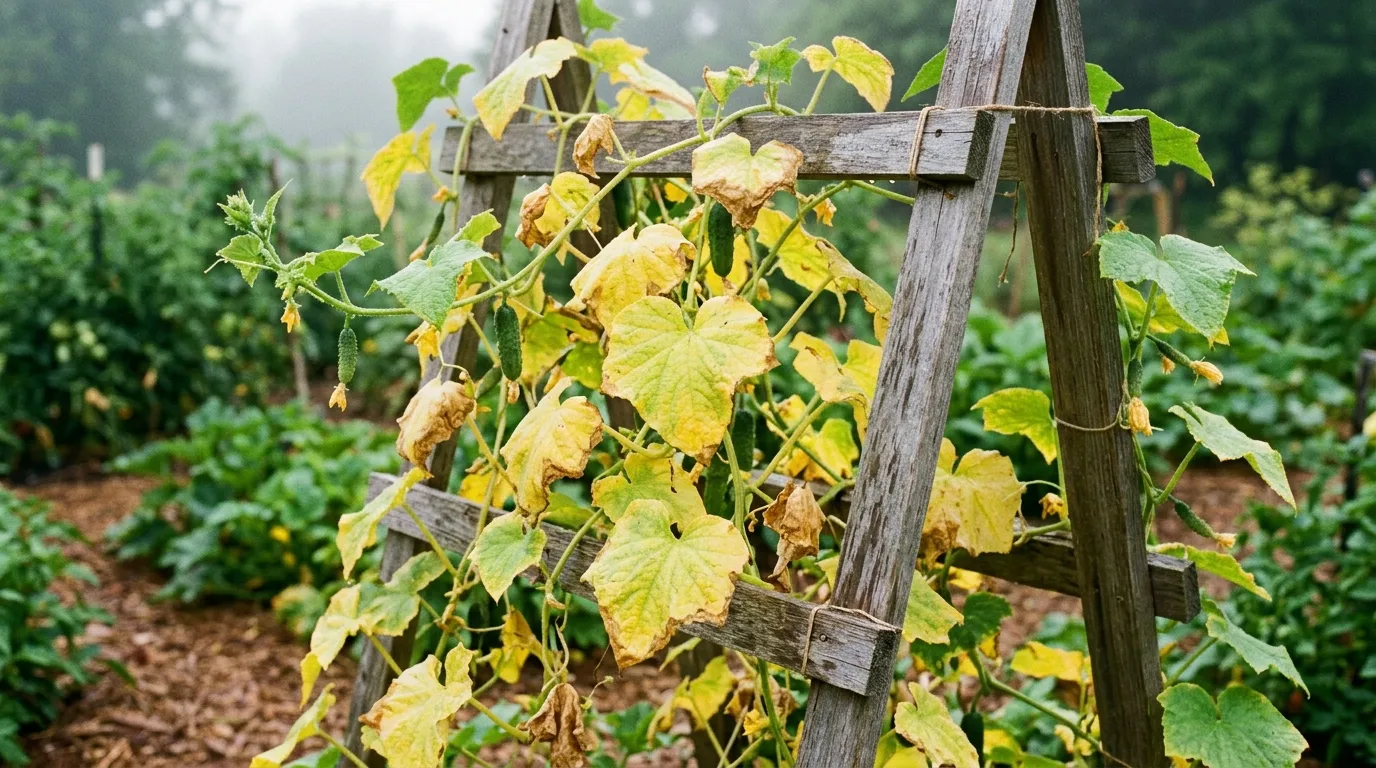
One morning they’re a wall of dinner-plate leaves on the trellis, you can hear the bees under them before you see them. A week later — especially that hot, humid turn in mid-July when storms roll through every afternoon — you look up and the canopy is suddenly spotted with yellow, edges crisping, a few leaves curling inward like they’ve given up. I know that lurch. You think, “I just got them to the top of the trellis. Why are they quitting on me already?”
The good news is cucumbers yellow in very legible patterns. Learn to read where on the plant, what shape, and what’s underneath, and you can often stop a collapse in its tracks. Wait and guess — water more here, spray something there — and the vine that collapsed in seven days will. Diagnose by pattern today and you usually buy yourself three more weeks of crisp harvest.
Quick Answer: The pattern is the diagnosis. Yellow spots bounded by leaf veins, with gray-purple fuzzy growth underneath and leaves that cup inward, is downy mildew — cucumber’s summer nemesis. Remove the worst leaves immediately into a bag (not compost), stop overhead watering, improve trellis airflow, and consider neem or copper as a protective spray. Uniform pale yellow on lower, older leaves usually means nitrogen shortage or overwatering — let the top 2 inches dry, then feed with compost or a balanced organic feed, and water 1 to 1.5 inches per week evenly at the base. Myriads of tiny yellow speckles with fine webbing on the underside is spider mites — blast undersides daily with a strong jet of water, then insecticidal soap. New leaves that are yellow between green veins point to pH/iron. Always confirm before treating; the same yellow can mean starvation in one case and drowning in another.
At a Glance
| Pattern | Likely Cause | Check | First Action |
|---|---|---|---|
| Yellow angular spots, gray fuzz below | Downy mildew | Underside at dawn | Bag leaves, base water, neem/copper |
| Uniform pale lower leaves, soft | Overwatering / nitrogen | Soil 2“ wet? | Dry out, drainage, light feed |
| Tiny speckles + webbing | Spider mites | Shake over white paper | Water jet, insecticidal soap |
| Yellow between green veins (upper) | Iron / pH high | pH test | Chelated iron, correct pH |
| Edges yellow then brown | Potassium / heat scorch | Fruit pointed? | Compost + even water |
| Whole vine wilts fast | Bacterial wilt (beetle) | Beetles present? | Pull and bag vine |
| Lower leaves yellow, stunted | Lack of sun / crowding | Hours of sun? | Thin, trellis, 6–8 hrs sun |
Print this. Bring it to the trellis with you. The stories behind each row are what will keep your vines green through August.
Why Cucumbers Yellow Faster Than Almost Any Vegetable
Cucumber leaves are big, thin, and hungry. A healthy leaf can be the size of your hand, 80% water, building sugars all day to pump into fast-growing fruits. That physiology makes them sensitive to anything that interrupts water, nutrients, or photosynthesis — even briefly.
Three realities make cucumbers especially prone:
First, they are mildew magnets when nights are cool and days are humid. Spores ride wind from far away, land on a wet leaf at night, and within 4 to 7 days produce yellow angular lesions. I’ve watched a trellis go from one yellow leaf to twenty in a weekend after a stormy spell, while tomatoes inches away still looked fine.
Second, they are shallow-rooted heavy drinkers. Uneven water swings chlorophyll production like a light switch. A drought-stressed week followed by a flood confuses the vine and washes nitrogen down past roots; lower leaves yellow uniformly even though you fertilized.
Third, they are vines built to climb. On a trellis they breathe. On the ground, or crowded 6 inches apart on a trellis meant for 12, humidity lingers. Wet leaves for 8 hours overnight is mildew’s favorite sentence. Spacing 12 inches apart on a 6-foot trellis and watering in the morning before 10 a.m. are not fussy details — they are how the plant avoids sleeping wet.
For the sunny, stable baseline they want, see the full grow guide how to grow cucumbers and the broader leaf-health primer how to fix yellow leaves. Then come back and diagnose.
Reading the Yellowing Like a Field Scout — 4 Questions
Before you touch a watering can or sprayer, take one slow lap and answer four questions. This is how extension scouts do it, and it prevents the common kindness-mistake of feeding a drowning plant.
1. Where did it start — bottom, top, or spotted all over? Bottom-up, uniform pale yellow = nitrogen or overwatering. Top-down, yellow between green veins = micronutrient/pH. Scattered yellow spots or patches, often with distinct angular edges bounded by veins = downy mildew or other disease. Tips and edges yellowing with tiny speckles = spider mites.
2. What does the underside look like? Gray to purplish downy fuzz on the underside of yellow spots, especially if you check early morning when dew is still there, is almost diagnostic for downy mildew. No fuzz but stippled dots and fine webbing between leaf and stem is spider mites. Sticky, shiny honeydew and clustered soft insects is aphids.
3. Is the soil wet, moist, or dry 2 inches down? Push your finger deep by the root zone, not the path. Sopping wet + yellow lower leaves = too much water, probably leached nitrogen. Bone-dry + limp yellow = underwatering stress. Cool-moist + yellow spots with fuzz = disease, not water.
4. What was the weather last 7 to 10 days? Humid nights in the 60s, foggy mornings, frequent rain = mildew window. Hot, dusty, dry and windy = mite window. A cold snap isn’t really cucumber’s issue the way it is for peppers, but a stretch of overcast, cool days can still slow nutrient uptake.
That two-minute inventory tells you whether you’re dealing with a cultural fix (water, feed, air), a disease fix (sanitation and protection), or a pest fix (physical removal plus soap/oil). Most yellowing on cucumbers is cultural + disease intertwined — water leads to mildew which looks like nutrient loss. So start cultural.
The 7 Common Causes, Up Close, and What They Feel Like
1. Downy Mildew — The July Storm Aftermath
This is the one to fear and therefore to learn fastest. Downy mildew is not powdery mildew (white on top). Downy mildew shows as yellow, angular spots delimited by leaf veins on top, and a delicate gray-to-purple velvety fuzz on the underside, visible early in the morning before it dries. Leaves cup inward, yellow spreads, then brown, then the vine defoliates from the bottom up with alarming speed. Spores arrive on wind; overhead water and poor airflow let them germinate.
What it feels like: you did nothing wrong. You mulched, you trellised, and still yellow exploded after a week of afternoon thunderstorms. That’s because downy mildew doesn’t need you to do anything wrong — it just needs leaf wetness.
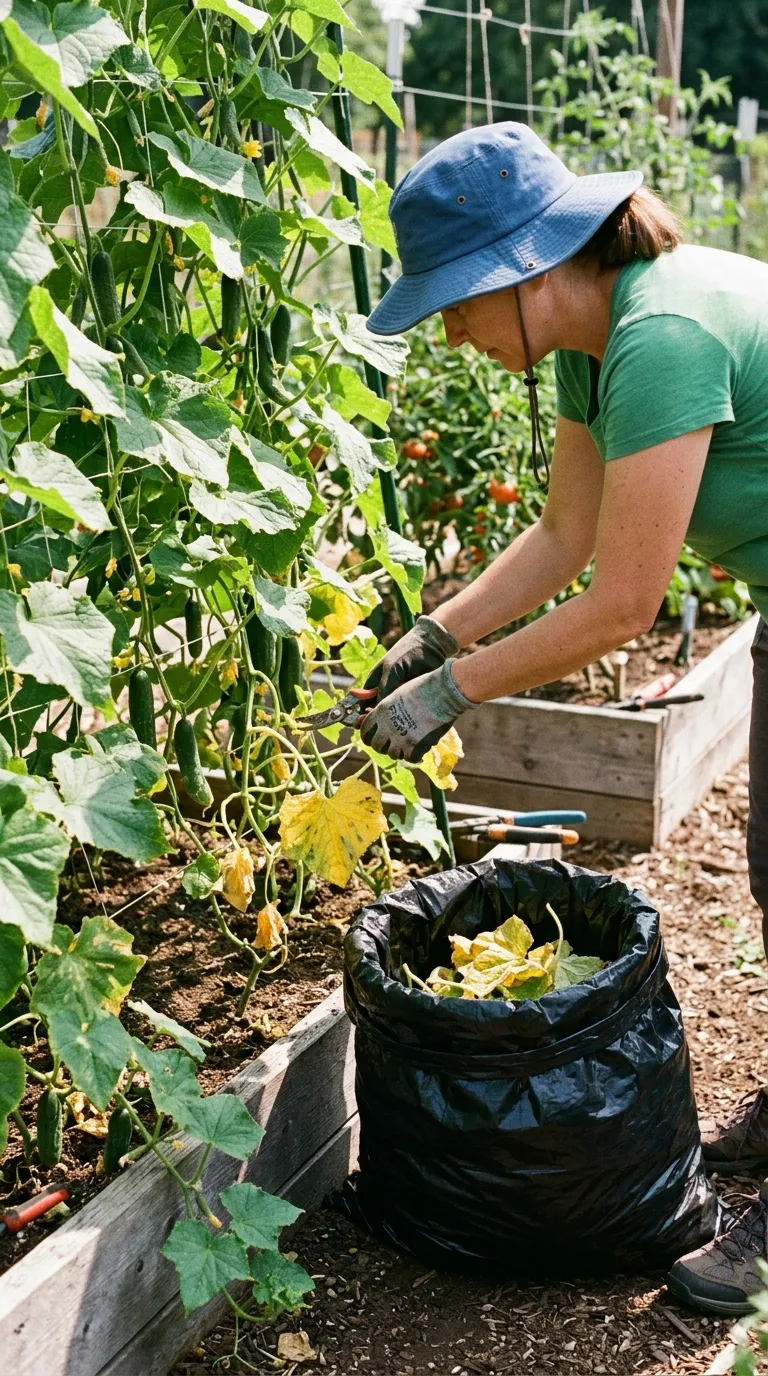
Early action is everything. Pick off the worst leaves immediately — into a bag, not the ground — to reduce spore load. Don’t compost them while active. Stop wetting leaves; switch to base watering only. Open the base of the trellis by removing the lowest 6 to 12 inches of heavily affected foliage to create a chimney of air. Protective options include weekly neem oil or copper fungicide, applied in the evening per label — they don’t cure heavily infected leaves but they can protect new growth. Choose resistant varieties next spring: ‘Diva’, ‘Marketmore 76’, ‘Bristol’ and others bred for downy mildew tolerance buy you weeks. See vegetable diseases and the powdery mildew comparison in how to treat powdery mildew.
2. Powdery Mildew — The White Cousin
Powdery mildew looks different: white, flour-like patches on leaf tops, not angular yellow spots with fuzz below. It prefers dry leaves with humid air, often late summer when nights cool but days are still warm. Leaves yellow around those white patches, then brown. Less aggressive than downy but still defoliates if ignored. Same hygiene helps: morning base watering, trellis airflow, remove worst leaves. Potassium bicarbonate and neem can slow it. The two mildews often get confused; check tops vs undersides in morning dew to tell them apart.
3. Overwatering — Love That Drowns
Cucumbers want moisture like a sponge that has been wrung out — damp throughout, never dripping. Overwatering yellows lower leaves uniformly, makes them soft and slightly translucent, and often comes with wilting that doesn’t improve after watering — because roots are suffocating. You’ll see it most in clay soil, in beds watered daily with short sips, or in containers without drainage.
The confusing part is it looks like nitrogen deficiency. Here’s the test: check soil moisture. If it’s wet 2 inches down and lower leaves are pale, it’s water excess — and leached nitrogen as a secondary effect — not primarily a feeding problem. Fix drainage, space waterings to 2 to 3 deep drinks per week totaling 1 to 1.5 inches, and let the surface dry slightly between. Raised beds or hilled rows help in heavy soil. Empty saucers under pots. I often advise beginners to get a cheap rain gauge; guessing 1 inch is humbling the first time you actually measure.
4. Nitrogen Deficiency — The Plant Eating Its Own Pantry
When nitrogen runs short, the plant robs its oldest leaves to build new ones. That’s why nitrogen yellowing is uniform paling starting at the bottom, moving up, with new growth smaller and lighter green. Fruits may be skinny or pale. This is common on sandy beds that leach quickly, beds heavy with undecomposed wood chips, or mid-season after a heavy fruit set when you didn’t side-dress.
Distinguish from overwatering by moisture: if soil is moist but not soggy and lower leaves are evenly yellow, feed. An inch of finished compost worked lightly into the top 2 inches along the row, watered in, is my gentle favorite. Or use a balanced organic vegetable feed at half to full label rate. Do it once, then wait 10 days before judging — you want leaves to green slightly and new growth to deepen. Don’t chase instant color with double doses; burned roots yellow more dramatically than hungry ones.
5. Spider Mites — The Almost Invisible Stipplers
In hot, dusty late July, I will find them first on the lowest leaves: hundreds of pinpoint yellow speckles, as if someone tapped the leaf with a pale-yellow pin, with a dusty, bronzing look overall. Turn the leaf over and you may see fine, wispy webbing at the vein axils and specks moving if you breathe gently — those are mites. They pierce cells and suck, creating stipple that coalesces to solid yellow. Left alone, leaves bleach and die.
They love drought stress and dust. The organic fix is wonderfully physical: blast undersides with a strong jet of water every morning for three days to disrupt them mechanically. Raise humidity slightly with mulch and adequate water — hydrated plants tolerate mites better. Then treat with insecticidal soap or horticultural oil, coating undersides thoroughly in the evening. Repeat 5 to 7 days later to catch hatching eggs. Keep the trellis base clean of dust and fallen leaves. A trick: shake a suspect leaf over a white sheet of paper and tap. If dusty specks start walking, you have mites.
6. Aphids and Cucumber Beetles — The Visible and the Viral
Aphids are easier to spot than mites: clusters of soft green or black dots on undersides and tender tips, leaves curling, many small yellow spots, and that telltale sticky gloss. Ants going up and down stems are a giveaway — they farm aphids. Knock aphids off with a water jet, then follow with insecticidal soap or neem, repeating weekly. Encourage ladybugs and lacewings by planting nearby yarrow and dill and by avoiding broad insecticides.
Cucumber beetles — both striped and spotted — do direct damage but their larger crime is spreading bacterial wilt. If a vine wilts practically overnight and doesn’t recover with water, with green leaves wilting section by section, that is likely wilt; there is no cure once systemic, so pull and bag the vine quickly to protect neighbors. Early row cover until first female flowers, then hand-picking beetles into soapy water, reduces risk. Don’t leave wilted vines hoping they’ll bounce back; they become beetle reservoirs.
7. pH, Iron, and Other Nutrient Edges
Less common on cucumbers than mildew or mites, but real: upper, new leaves emerging yellow between green veins while older leaves stay greener suggests iron chlorosis from high pH above 7.0, or sometimes manganese. Test soil pH; cucumbers share that 6.0 to 6.8 sweet spot. Sulfur to lower alkaline soils works slowly; foliar chelated iron gives quick cosmetic relief while the soil correction catches up. Potassium deficiency, seen as yellow edges that turn brown on older leaves with fruits that are pointed at the stem end, can show in heavily fruiting vines on sandy soil — a balanced vegetable fertilizer or compost side-dress supports it. If yellowing is only on leaf edges after a hot wind or after you sprayed something strong in midday sun, consider scorch rather than disease.
How to Fix — A Calm, Ordered Protocol That Actually Works
Do things in this order. Disorder wastes time and spray.
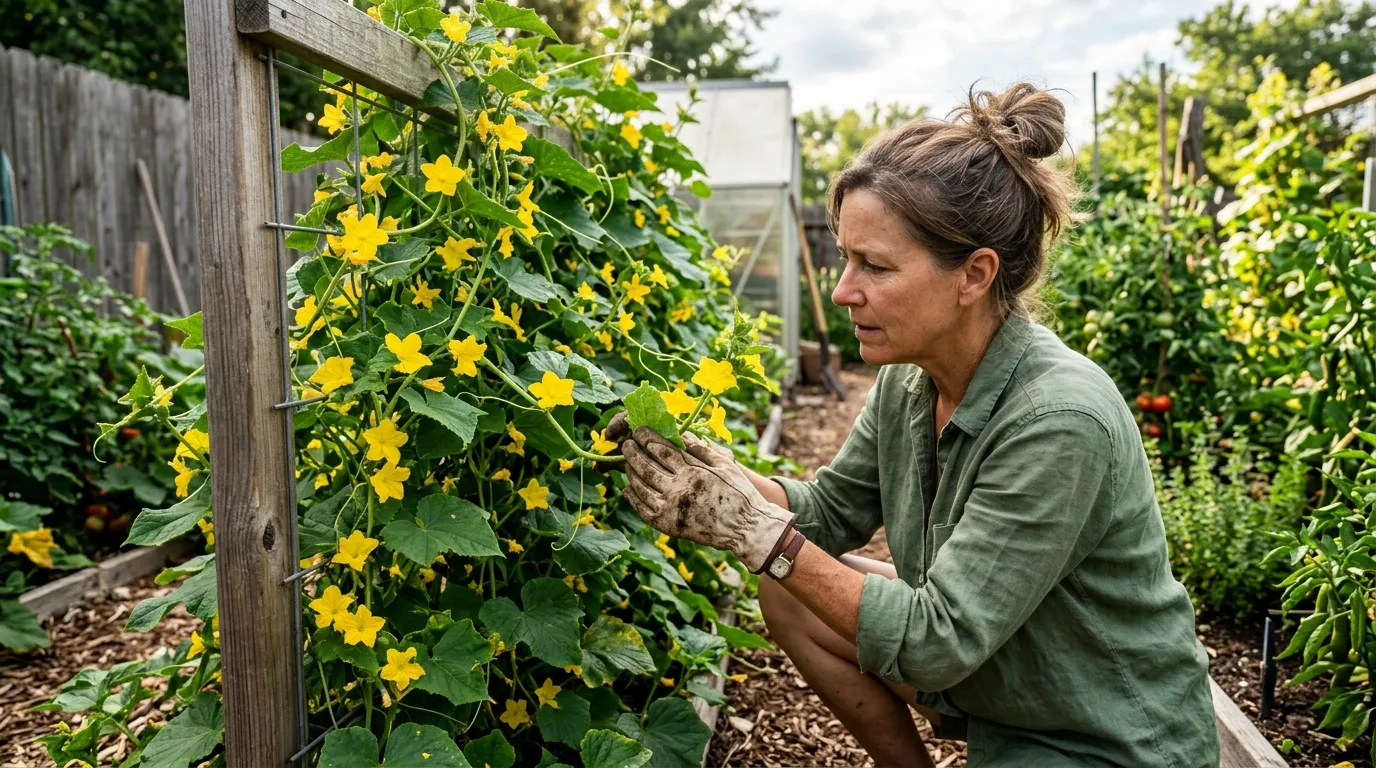
1. Remove and bag the worst. Snip fully yellow leaves, especially any with fuzzy undersides or massive stippling. Put them in a bag and trash or burn — not in open compost while spores or mites are active. Disinfect pruners with rubbing alcohol between vines if you suspect disease. Removing 20 to 30% of the most damaged foliage lets you see whether new growth is improving and instantly improves airflow. New leaves that emerge deep green are your success metric; old yellow leaves will never re-green.
2. Change the water, not the product. Water 1 to 1.5 inches per week total, evenly, at the base before 10 a.m. Use a rain gauge or a marked can. Mulch 3 inches with straw after soil is warm, keeping mulch off stems. Stop overhead sprinklers entirely. Letting leaves wake dry is the single best mildew suppressant. Details in how often to water vegetables.
3. Feed only if lower leaves are uniformly pale. If moisture is okay and yellowing is bottom-up uniform, side-dress compost or a balanced organic feed once. Water it in. Resist feeding spotted mildew leaves — fertilizer won’t fix fungus and excess nitrogen makes succulent growth more susceptible.
4. Spray only after steps 1 to 3, and target correctly. For mildew, apply neem or copper on a dry evening, coating the undersides where spores live, repeating per label interval (often 7 to 14 days). These are protectants for new leaves, not erasers for old yellow tissue. For mites and aphids, insecticidal soap or horticultural oil after a water blast is the gentle workhorse — again, evening, thorough underside coverage, repeat once. Look to powdery mildew guide for application style even though downy mildew is a different organism; the hygiene logic overlaps.
5. Trellis and airflow. If you are not trellised, get vines off the ground today on any temporary support — even a tomato cage or garden twine to a fence. If trellised, clear the bottom 12 inches of foliage and weeds for a breeze channel. Space too tightly? Thin one plant entirely to save the row. I know it hurts to pull a plant, but airflow for eight beats disease for nine every time.
6. Monitor trajectory, not perfection. Take a photo today. Check in 7 to 10 days. Is new growth greener? Are fewer leaves developing fresh yellow spots? That slow uptick is recovery. Vines won’t rewrite their old yellow leaves; they’ll grow past them. If yellowing accelerates despite corrections, suspect a heavy disease load or bacterial wilt and be willing to succession-sow a new row nearby for fall while nursing the older row for whatever harvest it can still give.
Seasonal Timeline — When Each Cause Peaks
| When | Common Cause | What to Do Before It Shows |
|---|---|---|
| Late spring, seedlings | Overwatering on cold soil | Warm soil before sowing, light mulch only after warm |
| Early summer, first bloom | Nitrogen dip after heavy growth | Side-dress compost if lower leaves pale |
| Mid-July humid storms | Downy mildew | Morning base water, trellis, weekly scout undersides |
| Late July hot & dusty | Spider mites | Mulch, even water, blast dust off undersides |
| All summer | Aphids / beetles | Row cover until bloom, hand-pick, water jet |
| Late summer | Powdery mildew / pH drift | Airflow, test pH, remove debris |
Common Mistakes That Make Yellow Worse
Spraying before checking water. Feeding a soggy plant or spraying mildew on wet leaves you keep wetting nightly solves nothing. Fix water and air first.
Composting diseased leaves while active. Home compost rarely gets hot enough to kill downy mildew spores. Bag and trash heavily infected leaves; compost only healthy trimmings.
Over-fertilizing spotted leaves. Nitrogen makes soft, succulent growth more susceptible to mildew. Feed only uniform pale lower leaves.
Watering in the evening to be helpful after work. The most human mistake. Leaves wet all night are mildew’s banquet. Switch to morning, use a timer and soaker so you don’t have to choose between your schedule and the vine’s health.
Waiting to act. Three yellow spotted leaves on Monday become thirty by Sunday in humid July. Remove early, even if it feels drastic.
Troubleshooting — Quick Diagnosis by Photo-Free Check
Yellow spots bounded by veins with gray fuzz below at dawn? Downy mildew. Bag leaves, keep dry, protect new growth.
White powder on top, yellow halo? Powdery mildew. Similar hygiene, plus potassium bicarbonate.
Stippled pale dots + webbing? Mites. Water jet + soap.
Uniform pale bottom leaves, soil wet? Overwatering / leached N. Dry out, improve drainage.
Uniform pale bottom, soil moist not soggy? True nitrogen need. Compost side-dress.
New leaves yellow between green veins? Iron/pH. Test pH, adjust, chelated iron foliar for quick help.
Whole section wilts overnight despite water? Bacterial wilt. Pull vine, protect neighbors, plan rotation.
What I Learned After 5 Seasons of Yellow Vines
The first summer I blamed the seed company. Then the weather. Then myself. Really, I was watering in the evenings because that’s when I had time after work — the exact overnight wetness mildew loves. Switching watering to mornings before 8 a.m., buying a $9 faucet timer for the soaker hose, and mulching with straw cut my July yellowing by two-thirds. Ten minutes of habit vs hours of worry.
Another lesson: one brave cull saves a trellis. I hated pulling yellow leaves because I thought the plant needed them. Once I started bagging the worst 30% the moment spots appeared — not waiting until the leaf was totally yellow — vines rebounded faster. The plant doesn’t need dying tissue; it needs to protect its new leaves, and removing the spore factory helps it do that.
My third lesson was succession as self-compassion. No matter how well I watered, something always dinged the first planting by early August. So I now sow cucumbers May 10 and again June 10 near me, sometimes a small third sowing July 1 of a 50-day pickler. The younger vines catch that late-summer energy and keep the kitchen in cucumbers without heroic spraying. Letting a tired early vine go to the compost after it has given well is not failure; it’s rotation.
Finally, variety matters more than magic sprays. When I switched to downy-mildew-tolerant types like ‘Marketmore 76’ and ‘Diva’, the yellowing that used to race up the trellis slowed to a crawl. Resistance isn’t immunity, but time bought is fruit harvested.
More Tips I Wish I’d Known Sooner
Cucumbers are not just a crop but a conversation with July. The first time you hear that soft snap as a fruit releases from the vine, cool in your palm, you understand why trellising matters — gravity does half the work of straightening, and your job is just to keep water steady.
Choose a sunny bed where the trellis will not shade tomatoes behind it. North side of the garden is kindest if rows run east-west. Give the bed a 2-inch compost blanket in fall and let worms do winter work; spring soil then feels like chocolate cake.
Water with a rain gauge, not a guess. That 1-inch weekly total includes rain. If a storm gave half an inch, you need only half an inch more. Mulch holds the difference between watering every two days and every four.
Succession sowing is self-compassion. Young vines in August outproduce tired July vines without heroic sprays. Let a spent vine go to compost; it is not failure but rotation.
Keep leaves dry at night. Morning water, base only, is the single best mildew prevention you can give. Evening wetness is the invitation mildew waits for.
Feed lightly. Compost at planting plus a palmful at first harvest carries most beds all summer. Heavy nitrogen pushes leaves, not pickles.
Harvest small, often. Every two days, snip, don’t yank. A yellowed balloon left on the vine tells the plant to retire.
Save seed only from open-pollinated, isolated fruits fully yellow past eating stage, fermented two days, rinsed, dried. For most gardeners, fresh seed with disease resistance is simpler.
These small habits compound. By August, the trellis hums with bees, the kitchen has too many cucumbers — the best problem — and you are already planning next year’s second sowing date before you have finished pickling this year’s.
More Tips I Wish I’d Known Sooner
Cucumbers are not just a crop but a conversation with July. The first time you hear that soft snap as a fruit releases from the vine, cool in your palm, you understand why trellising matters — gravity does half the work of straightening, and your job is just to keep water steady.
Choose a sunny bed where the trellis will not shade tomatoes behind it. North side of the garden is kindest if rows run east-west. Give the bed a 2-inch compost blanket in fall and let worms do winter work; spring soil then feels like chocolate cake.
Water with a rain gauge, not a guess. That 1-inch weekly total includes rain. If a storm gave half an inch, you need only half an inch more. Mulch holds the difference between watering every two days and every four.
Succession sowing is self-compassion. Young vines in August outproduce tired July vines without heroic sprays. Let a spent vine go to compost; it is not failure but rotation.
Keep leaves dry at night. Morning water, base only, is the single best mildew prevention you can give. Evening wetness is the invitation mildew waits for.
Feed lightly. Compost at planting plus a palmful at first harvest carries most beds all summer. Heavy nitrogen pushes leaves, not pickles.
Harvest small, often. Every two days, snip, don’t yank. A yellowed balloon left on the vine tells the plant to retire.
Save seed only from open-pollinated, isolated fruits fully yellow past eating stage, fermented two days, rinsed, dried. For most gardeners, fresh seed with disease resistance is simpler.
These small habits compound. By August, the trellis hums with bees, the kitchen has too many cucumbers — the best problem — and you are already planning next year’s second sowing date before you have finished pickling this year’s.
More Tips I Wish I’d Known Sooner
Cucumbers are not just a crop but a conversation with July. The first time you hear that soft snap as a fruit releases from the vine, cool in your palm, you understand why trellising matters — gravity does half the work of straightening, and your job is just to keep water steady.
Choose a sunny bed where the trellis will not shade tomatoes behind it. North side of the garden is kindest if rows run east-west. Give the bed a 2-inch compost blanket in fall and let worms do winter work; spring soil then feels like chocolate cake.
Water with a rain gauge, not a guess. That 1-inch weekly total includes rain. If a storm gave half an inch, you need only half an inch more. Mulch holds the difference between watering every two days and every four.
Succession sowing is self-compassion. Young vines in August outproduce tired July vines without heroic sprays. Let a spent vine go to compost; it is not failure but rotation.
Keep leaves dry at night. Morning water, base only, is the single best mildew prevention you can give. Evening wetness is the invitation mildew waits for.
Feed lightly. Compost at planting plus a palmful at first harvest carries most beds all summer. Heavy nitrogen pushes leaves, not pickles.
Harvest small, often. Every two days, snip, don’t yank. A yellowed balloon left on the vine tells the plant to retire.
Save seed only from open-pollinated, isolated fruits fully yellow past eating stage, fermented two days, rinsed, dried. For most gardeners, fresh seed with disease resistance is simpler.
These small habits compound. By August, the trellis hums with bees, the kitchen has too many cucumbers — the best problem — and you are already planning next year’s second sowing date before you have finished pickling this year’s.
More Tips I Wish I’d Known Sooner
Cucumbers are not just a crop but a conversation with July. The first time you hear that soft snap as a fruit releases from the vine, cool in your palm, you understand why trellising matters — gravity does half the work of straightening, and your job is just to keep water steady.
Choose a sunny bed where the trellis will not shade tomatoes behind it. North side of the garden is kindest if rows run east-west. Give the bed a 2-inch compost blanket in fall and let worms do winter work; spring soil then feels like chocolate cake.
Water with a rain gauge, not a guess. That 1-inch weekly total includes rain. If a storm gave half an inch, you need only half an inch more. Mulch holds the difference between watering every two days and every four.
Succession sowing is self-compassion. Young vines in August outproduce tired July vines without heroic sprays. Let a spent vine go to compost; it is not failure but rotation.
Keep leaves dry at night. Morning water, base only, is the single best mildew prevention you can give. Evening wetness is the invitation mildew waits for.
Feed lightly. Compost at planting plus a palmful at first harvest carries most beds all summer. Heavy nitrogen pushes leaves, not pickles.
Harvest small, often. Every two days, snip, don’t yank. A yellowed balloon left on the vine tells the plant to retire.
Save seed only from open-pollinated, isolated fruits fully yellow past eating stage, fermented two days, rinsed, dried. For most gardeners, fresh seed with disease resistance is simpler.
These small habits compound. By August, the trellis hums with bees, the kitchen has too many cucumbers — the best problem — and you are already planning next year’s second sowing date before you have finished pickling this year’s.
More Tips I Wish I’d Known Sooner
Cucumbers are not just a crop but a conversation with July. The first time you hear that soft snap as a fruit releases from the vine, cool in your palm, you understand why trellising matters — gravity does half the work of straightening, and your job is just to keep water steady.
Choose a sunny bed where the trellis will not shade tomatoes behind it. North side of the garden is kindest if rows run east-west. Give the bed a 2-inch compost blanket in fall and let worms do winter work; spring soil then feels like chocolate cake.
Water with a rain gauge, not a guess. That 1-inch weekly total includes rain. If a storm gave half an inch, you need only half an inch more. Mulch holds the difference between watering every two days and every four.
Succession sowing is self-compassion. Young vines in August outproduce tired July vines without heroic sprays. Let a spent vine go to compost; it is not failure but rotation.
Keep leaves dry at night. Morning water, base only, is the single best mildew prevention you can give. Evening wetness is the invitation mildew waits for.
Feed lightly. Compost at planting plus a palmful at first harvest carries most beds all summer. Heavy nitrogen pushes leaves, not pickles.
Harvest small, often. Every two days, snip, don’t yank. A yellowed balloon left on the vine tells the plant to retire.
Save seed only from open-pollinated, isolated fruits fully yellow past eating stage, fermented two days, rinsed, dried. For most gardeners, fresh seed with disease resistance is simpler.
These small habits compound. By August, the trellis hums with bees, the kitchen has too many cucumbers — the best problem — and you are already planning next year’s second sowing date before you have finished pickling this year’s.
A Small Kitchen Note
The crispest cucumber is one you chill quickly and salt lightly. Slice thin, salt 10 minutes, drain, toss with vinegar, a whisper of sugar and dill. Picklers become fridge pickles in 24 hours: brine of 1 cup vinegar, 1 cup water, 1 tbsp salt, 1 tbsp sugar, garlic, dill seed, pour hot over packed small cucumbers, refrigerate. The reward for that trellis and faithful watering is not just quantity but texture — that snap that tells you it was grown in breathing, evenly moist soil and picked hours ago, not weeks.
Keep a bowl of cucumbers on the counter for the day you pick, and the rest in a loose bag in the crisper. Unwashed, they hold 5 days. Washed and sliced, they weep by tomorrow. Eat the sun-warmed one standing in the garden first; store the rest cool.
Trellis Options for Small Spaces
Not everyone has a cattle panel. A sturdy A-frame built from two 6-foot bamboo stakes and twine works on a balcony. String trellises clipped to a porch rail train one vine beautifully. Even a tomato cage, though small, lifts fruits off damp soil for a patio grower. The principle is the same: vertical air, visible fruit, dry leaves by noon. Build what your space allows; the cucumber will climb whatever you give it with tendrils that grip like shy fingers.
Choose whatever you have — fence, balcony rail, ladder — and keep ties soft. Garden Velcro, strips of old t-shirt, or plain jute in a figure-eight all work. Check weekly, re-tie where the vine slips, and enjoy picking at eye level instead of on your knees hunting hidden monsters.
Frequently Asked Questions
Q: Why are my cucumber leaves turning yellow?
A: Cucumber leaves yellow from downy mildew, overwatering, nitrogen deficiency, spider mites, or pH imbalance. Downy mildew shows as angular yellow spots bounded by leaf veins with gray-purple fuzz underneath — especially visible early morning — and is the most common mid-summer cause. Uniform pale yellow on lower, older leaves points to nitrogen shortage or too much water, while tiny speckles plus webbing is mites. Check where yellowing starts, flip leaves at dawn, and feel soil 2 inches deep before you treat.
Q: Can yellow cucumber leaves turn green again?
A: No — once tissue has fully yellowed, chlorophyll won’t return to that leaf, no matter how you water or feed. Snip fully yellow leaves to improve airflow and so you can judge the vine by its newest growth at the tips. Bag and trash heavily spotted or fuzzy leaves rather than composting them while active. Vines push fresh, slightly fuzzy green leaves quickly, often within 7 to 10 days, when water, airflow and disease pressure are corrected — that’s your recovery sign.
Q: How do you treat yellow cucumber leaves naturally?
A: Remove the worst affected leaves into a bag, switch to watering only at the base in the morning before 10 a.m., and keep 3 inches of straw mulch after soil warms. Ensure vines are trellised with 12 inches spacing and 6 to 8 hours of sun for airflow. For downy mildew, spray neem or copper in the evening per label as a protectant for new growth; for mites and aphids, blast leaf undersides with water then follow with insecticidal soap. And feed compost only if lower leaves are uniformly pale and soil isn’t soggy.
Q: Should you cut off yellow cucumber leaves?
A: Yes — snip fully yellow or heavily spotted leaves with clean pruners, especially the lower foliage that blocks airflow at the base. Removing 20 to 30 percent of the worst leaves instantly improves air movement and cuts spore load, letting you see whether new growth comes in greener. Don’t strip healthy green leaves — they are still feeding the fruits above and the vine needs them. Think of it as pruning a cold, not shaving a head.
Related Articles
- How to Grow Cucumbers
- Cucumber Plants Not Producing
- How Often to Water a Vegetable Garden
- Vegetable Garden Pests
- How to Treat Powdery Mildew
- How to Prepare Soil for Planting
Sources & References
- University of Minnesota Extension - https://extension.umn.edu/vegetables
- Cornell Vegetables - https://www.vegetables.cornell.edu/
- North Carolina State Extension - https://content.ces.ncsu.edu/cucurbit-downy-mildew
- Iowa State University Extension - https://hortnews.extension.iastate.edu/
- University of Massachusetts Extension - https://ag.umass.edu/vegetable