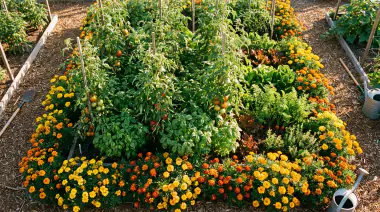
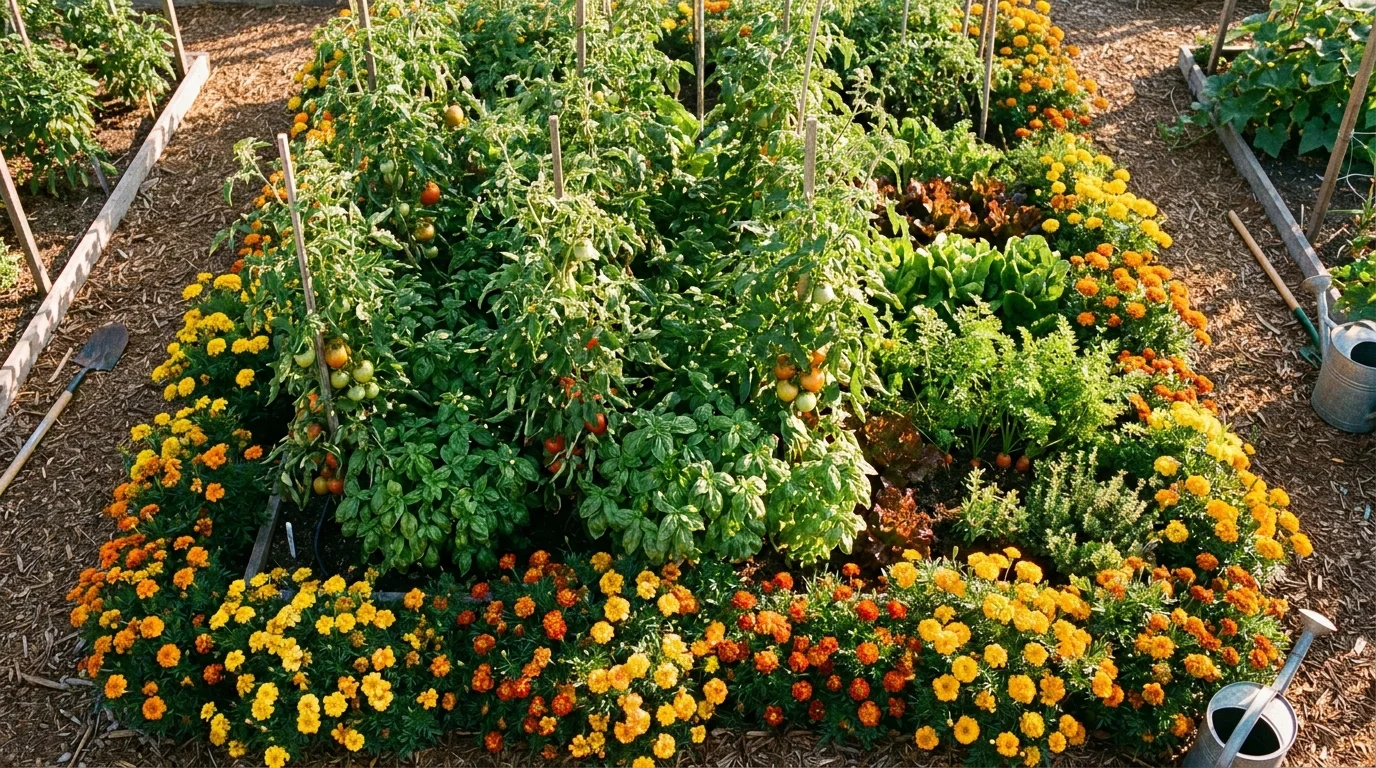
My third garden year, I planted tomatoes and fennel next to each other because both liked sun and I had the space. By August, the tomato plants closest to the fennel were stunted, pale, and producing nothing while the ones on the far side of the bed loaded up with fruit. I had read about companion planting but treated it like folk wisdom — charming, maybe, but not something that actually affected yields. That fennel taught me otherwise.
Companion planting is not mysticism. It is biology you can see with your eyes. Some plants release chemicals through their roots that inhibit neighbors — allelopathy. Some attract predatory insects that eat pests plaguing nearby crops. Some fix nitrogen from the air into the soil, feeding heavy-feeding neighbors. Some provide physical shade or wind protection. And some simply repel pests with their scent before those pests find the crop you are trying to protect.
This guide gives you a complete companion planting chart for every common vegetable and herb, explains the science behind why each pairing works or fails, and shows you how to layout a garden bed that uses companion planting to reduce pest pressure, improve yields, and minimize the need for sprays and interventions.
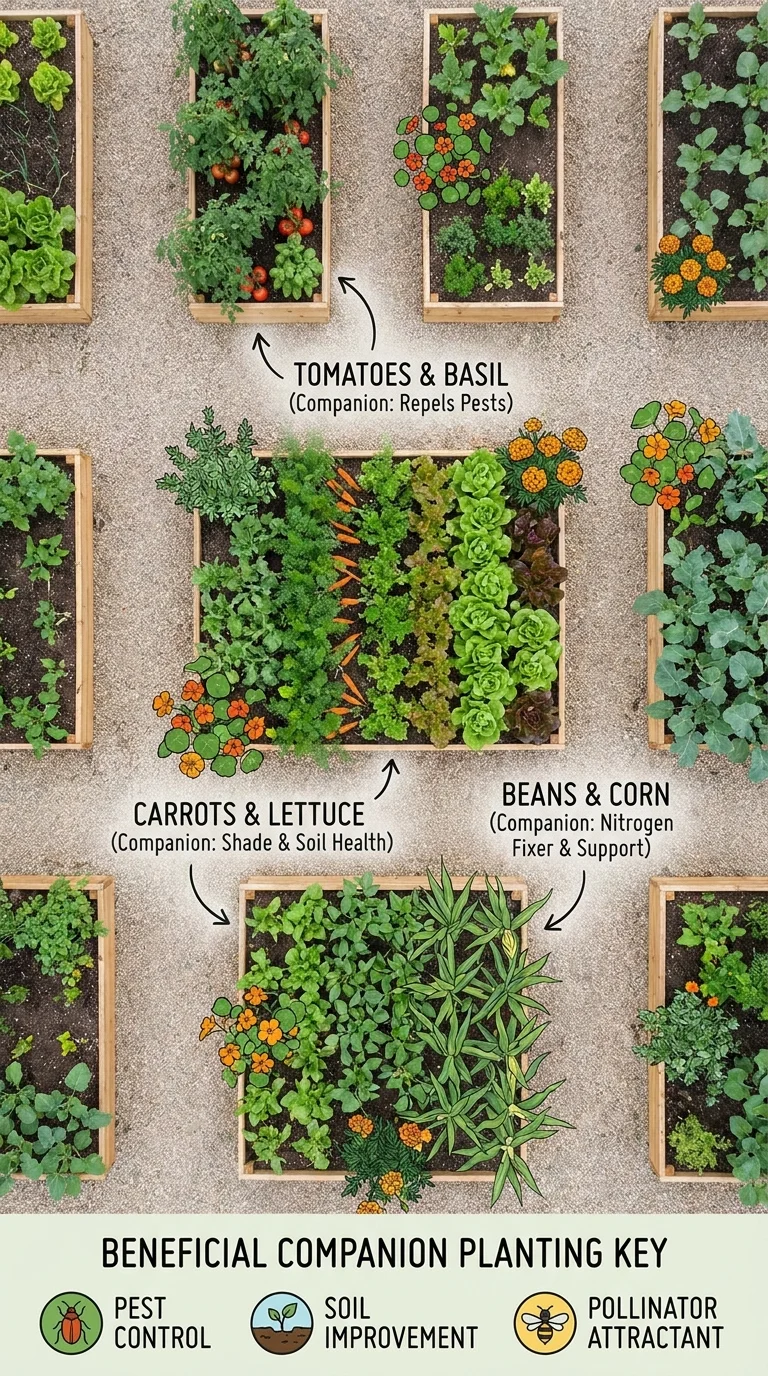
Quick Answer: The most beneficial companion planting pairings include basil with tomatoes (repels aphids and hornworms), marigolds with almost everything (repel nematodes and whiteflies), beans with corn (fix nitrogen that corn needs), lettuce with tall plants (gets beneficial shade), and nasturtiums as trap crops (aphids prefer nasturtiums over vegetables). Never plant beans near onions or garlic, tomatoes near brassicas, potatoes near tomatoes, or fennel near anything. Use the full chart below to plan your beds.
At a Glance
| Fact | Details |
|---|---|
| Main benefit | Pest reduction, improved pollination, better soil |
| Scientific basis | Allelopathy, nitrogen fixation, beneficial insect attraction |
| Spacing rule | Plant companions within 1 to 3 feet of each other |
| Worst companions | Fennel with most crops, beans with onions, tomatoes with brassicas |
| Best all-around companion | Marigolds — repel nematodes, whiteflies, and many pests |
| Three Sisters | Corn + beans + squash — proven, productive, ancient |
| Herb companions | Basil, dill, parsley, and cilantro benefit most vegetables |
| Flowers to plant | Marigolds, nasturtiums, borage, calendula, sweet alyssum |
The Science Behind Companion Planting
Understanding why companion planting works helps you make informed decisions rather than following rules blindly. Four main mechanisms drive companion planting success.
Pest Deterrence Through Aromatic Compounds
Many herbs and flowers release volatile organic compounds that repel or confuse pests. Basil contains estragole and linalool, which deter aphids and thrips. Marigolds produce limonene and pyrethrin, natural insecticides that repel nematodes, whiteflies, and many beetles. Rosemary and sage emit strong scents that mask the smell of nearby vegetables, making it harder for pests to locate their preferred host plants.
This is why interplanting herbs throughout a vegetable garden reduces pest pressure more effectively than growing herbs in a separate bed. The aromatic compounds need to be in close proximity — within 1 to 3 feet — to confuse pests searching for dinner.
Nitrogen Fixation by Legumes
Beans, peas, and other legumes host Rhizobium bacteria on their root nodules that convert atmospheric nitrogen into plant-available forms. This benefits neighboring plants that need nitrogen — heavy feeders like corn, lettuce, and squash. The nitrogen-fixing benefit is modest but real, especially when legumes are rotated through beds and their roots are left in soil after harvest to decompose.
Beneficial Insect Attraction
Flowering herbs and companion flowers attract predatory insects that eat garden pests. Dill and fennel attract parasitic wasps that lay eggs in caterpillars. Sweet alyssum attracts hoverflies whose larvae devour aphids. Borage attracts bees for pollination and predatory wasps for pest control. Nasturtiums serve as trap crops — aphids prefer nasturtiums over vegetables, concentrating pests where you can easily remove them.
Physical and Structural Benefits
Some companion pairings work through physical support or microclimate modification. Corn provides a trellis for pole beans. Tall sunflowers shade heat-sensitive lettuce. Ground-cover plants like strawberries or creeping thyme mulch soil, retain moisture, and suppress weeds around taller plants. These structural companions create a multi-layered garden that uses space efficiently.
Complete Companion Planting Chart
Tomatoes
Best Companions:
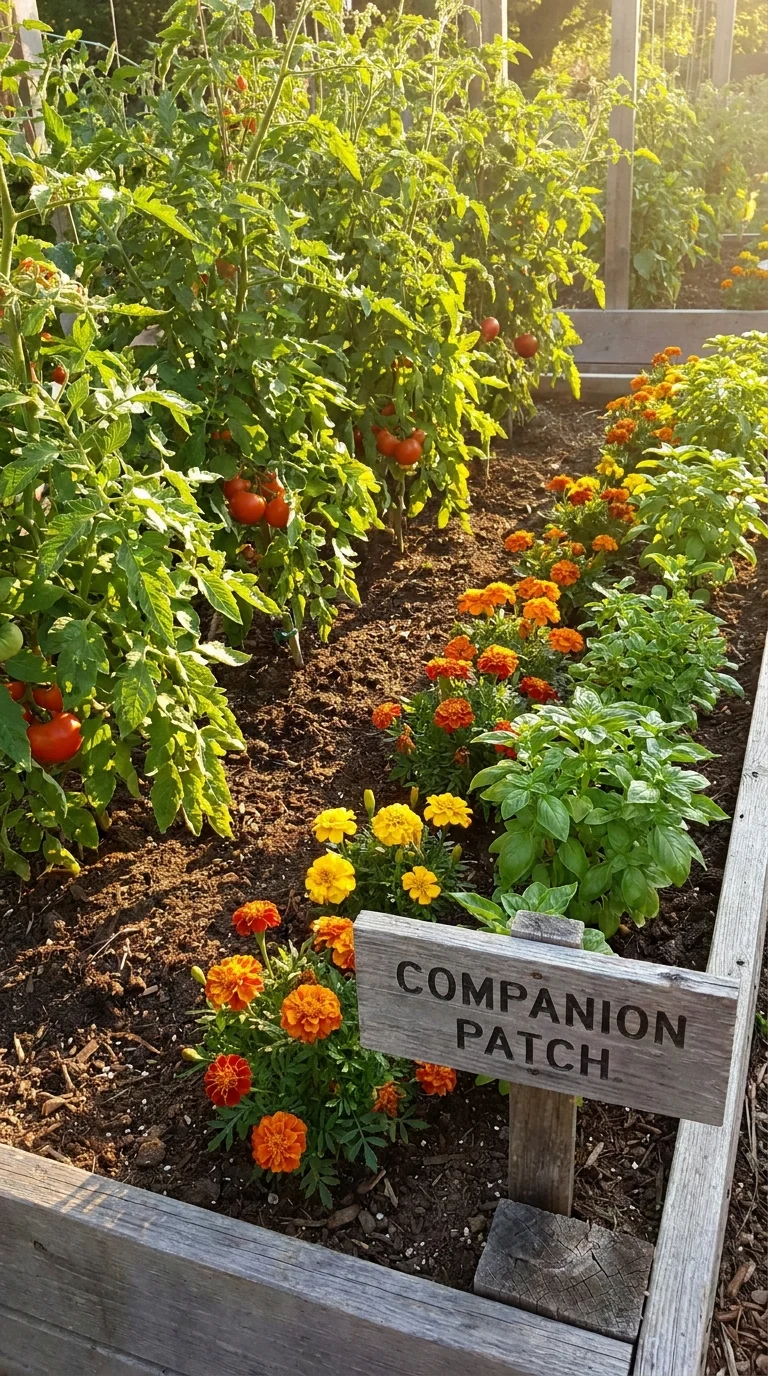
- Basil — Repels aphids, hornworms, and whiteflies. May improve flavor. Plant within 1 to 2 feet.
- Marigolds — Repel nematodes and whiteflies. Plant throughout the tomato bed.
- Parsley — Attracts beneficial insects that prey on tomato pests.
- Carrots — Loosen soil around tomato roots, improving drainage and root growth.
- Borage — Attracts pollinators and may deter hornworms. Self-sows readily.
- Chives — Repel aphids. Plant around the base of tomato plants.
Bad Companions:
- Brassicas (cabbage, broccoli, kale) — Compete for nutrients and may stunt tomato growth.
- Fennel — Inhibits growth of most nearby plants through allelopathy.
- Walnut trees — Produce juglone, which is toxic to tomatoes.
- Corn — Attracts the same worm pests as tomatoes.
Peppers
Best Companions:
- Basil — Repels aphids and spider mites. Improves growth and flavor.
- Onions and garlic — Repel aphids and spider mites with their strong scent.
- Carrots — Loosen soil around pepper roots.
- Spinach — Living mulch that keeps soil cool and moist around pepper bases.
- Petunias — Repel aphids and tomato hornworms.
Bad Companions:
- Fennel — Inhibits pepper growth.
- Kohlrabi — Stunts pepper development.
- Beans (pole varieties) — Can shade peppers excessively.
Cucumbers
Best Companions:
- Beans (bush) — Fix nitrogen that cucumbers need. Plant between cucumber hills.
- Sunflowers — Attract pollinators and provide afternoon shade.
- Radishes — Trap crop for flea beetles, protecting cucumbers.
- Dill — Attracts predatory wasps that eat cucumber beetles. Do not let dill mature — it competes when large.
- Nasturtiums — Trap crop for aphids. Plant as a border around cucumber bed.
Bad Companions:
- Potatoes — May transmit diseases to cucumbers.
- Aromatic herbs (sage, mint) — Can inhibit cucumber growth when too close.
Lettuce and Leafy Greens
Best Companions:
- Tall plants (tomatoes, corn, sunflowers) — Provide beneficial afternoon shade that prevents bolting.
- Strawberries — Living mulch that keeps soil cool and moist.
- Chives — Repel aphids. Interplant throughout lettuce rows.
- Carrots — Share similar water needs without competing for light.
- Radishes — Mark rows of slow-germinating lettuce while radishes mature quickly.
Bad Companions:
- Parsley — Can inhibit lettuce growth.
- Celery — Competes for similar nutrients.
Beans (Bush and Pole)
Best Companions:
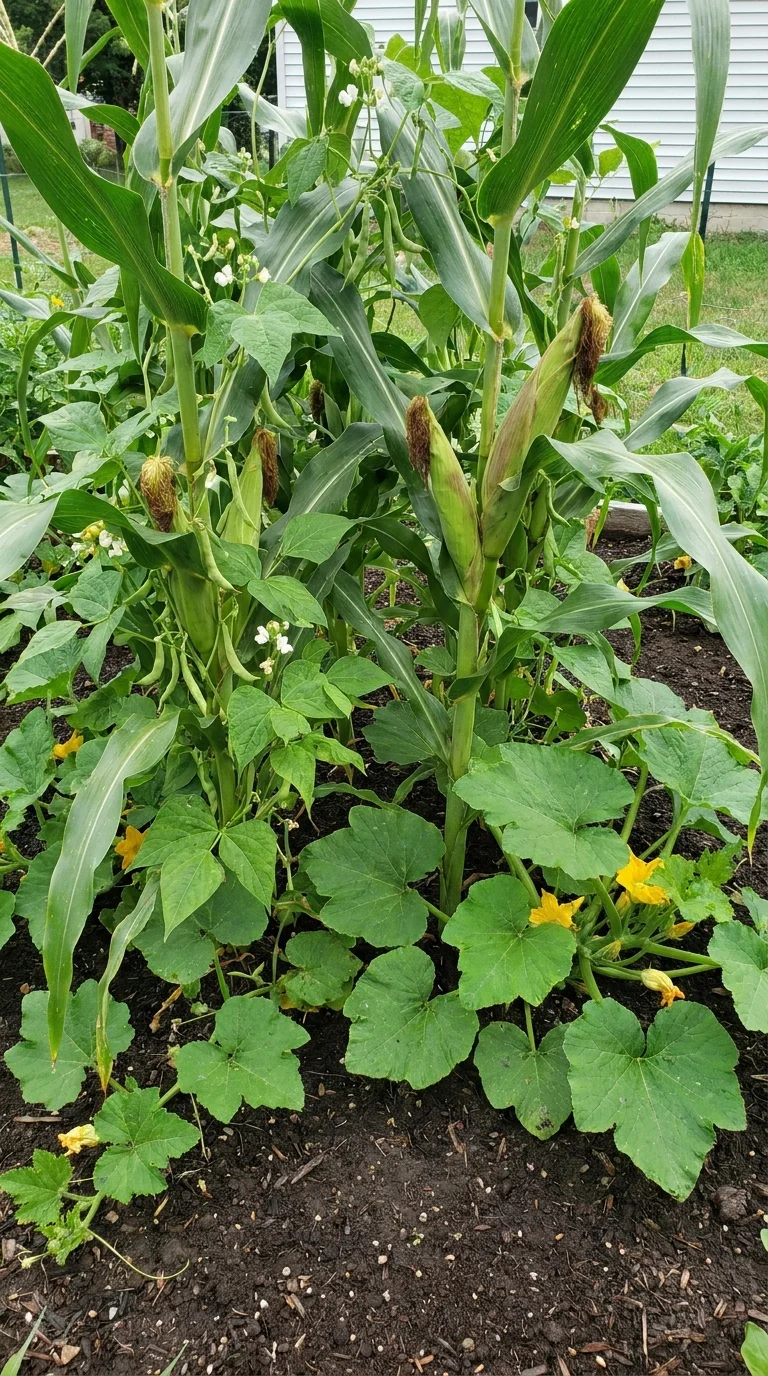
- Corn — Beans fix nitrogen that corn desperately needs. Corn provides trellis for pole beans. This is the classic Three Sisters pairing.
- Squash — Broad leaves shade soil, retain moisture, and suppress weeds around beans.
- Carrots — Share similar soil needs without competing.
- Celery — Repels bean beetles with its strong scent.
- Cucumbers — Bush beans fix nitrogen that cucumbers use.
Bad Companions:
- Onions, garlic, and shallots — Inhibit bean growth through allelopathy.
- Peppers — Pole beans can shade peppers excessively.
- Sunflowers — Can inhibit bean growth.
Carrots
Best Companions:
- Tomatoes — Tomatoes repel carrot fly. Carrots loosen soil around tomato roots.
- Lettuce — Living mulch that keeps soil moist and cool for carrots.
- Rosemary — Strong scent repels carrot fly.
- Chives — Repel carrot fly.
- Leeks — Repel carrot fly with their onion-family scent.
Bad Companions:
- Dill — Attracts the same pests as carrots when mature. Young dill is fine.
- Parsley — Competes for similar nutrients.
- Celery — Both attract the same pests.
Potatoes
Best Companions:
- Corn — Beans planted with corn fix nitrogen that benefits both corn and potatoes.
- Basil — May repel Colorado potato beetle.
- Marigolds — Repel nematodes that attack potato roots.
- Spinach — Living mulch that keeps soil cool around potato bases.
- Horseradish — Planted at bed edges, repels potato beetle.
Bad Companions:
- Tomatoes — Share the same diseases (blight, late blight) and pests.
- Sunflowers — Inhibit potato growth.
- Fennel — Inhibits potato development.
- Cucumbers — May transmit diseases to potatoes.
Squash
Best Companions:
- Corn — Provides structure for climbing squash vines in the Three Sisters method.
- Beans — Fix nitrogen that squash needs. Bush beans work best.
- Nasturtiums — Trap crop for squash bugs and aphids.
- Marigolds — Repel squash vine borers.
- Dill — Attracts predatory wasps that eat squash bugs.
Bad Companions:
- Potatoes — Compete for similar nutrients.
- Other squash varieties — Cross-pollination affects seed saving but not fruit quality. However, spacing different squash varieties apart reduces disease spread.
Herbs as Universal Companions
Most herbs benefit nearby vegetables through pest deterrence and beneficial insect attraction. The strongest performers:
Basil — Best with tomatoes, peppers, and asparagus. Repels aphids, thrips, flies, and mosquitoes.
Rosemary — Best with beans, carrots, and cabbage. Repels bean beetles, carrot fly, and cabbage moths.
Chives — Best with tomatoes, carrots, and lettuce. Repels aphids and Japanese beetles.
Parsley — Best with tomatoes, asparagus, and roses. Attracts swallowtail butterflies and beneficial insects.
Cilantro — Best with brassicas and tomatoes. Attracts predatory wasps and hoverflies.
Thyme — Best with cabbage, tomatoes, and strawberries. Repels cabbage worm and spider mites.
The Three Sisters — The Original Companion Planting System
The Three Sisters method, developed by Indigenous peoples of the Americas, plants corn, beans, and squash together in a mutually beneficial arrangement. Corn provides a natural trellis for pole beans to climb. Beans fix nitrogen from the air, feeding the nitrogen-hungry corn. Squash spreads along the ground, its broad leaves shading soil to retain moisture and suppress weeds, while its prickly vines deter raccoons from reaching the corn.
To plant Three Sisters, create mounds 4 feet in diameter and 12 inches high, spaced 4 feet apart. Plant four corn seeds in the center of each mound. When corn is 6 inches tall, plant four bean seeds around the base. When beans sprout, plant two squash seeds at the edge of the mound. The squash grows outward while corn and beans grow upward.
This system produces three crops from one mound with minimal inputs. It is proof that companion planting is not folk wisdom — it is agricultural science that predates modern research by centuries.
For garden bed planning, see my vegetable garden layout planning guide.
How to Layout a Companion Planting Garden
Step 1: Group by Water and Sun Needs
Start by grouping plants with similar requirements. Tomatoes, peppers, and squash all want full sun and regular water. Lettuce and spinach want partial shade and consistent moisture. Beans and corn want full sun but are more drought-tolerant. Keep same-need plants together so you can water and manage them efficiently.
Step 2: Place Main Crops First
Identify your primary crops — the vegetables you eat most and want the largest harvests of. Place them in the best spots (most sun, best soil, easiest access for harvesting). Then arrange their companions around them using the chart above.
Step 3: Add Herb and Flower Borders
Plant herbs and companion flowers along bed edges and in gaps between vegetable groups. Marigolds as a border around the entire bed repel nematodes and many flying pests. Basil between tomato plants deters aphids. Nasturtiums at bed corners serve as trap crops for aphids and squash bugs.
Step 4: Separate Incompatible Plants
Keep incompatible plants in separate beds or at least on opposite ends of the same bed. Tomatoes and potatoes should never share a bed because they attract the same diseases. Beans and onions should be in different sections. Fennel should be isolated or container-grown because it inhibits most nearby plants.
Step 5: Plan for Succession
Companion planting works best with succession planning. After early radishes are harvested, plant fall lettuce in their spot. After spring peas finish, plant heat-loving basil where the peas were. This keeps the bed productive all season while maintaining the companion planting benefits.
Common Companion Planting Mistakes
- Planting too close. Companions benefit each other within 1 to 3 feet, but crowding causes airflow problems and disease. Give each plant room to reach its mature size.
- Ignoring water needs. A drought-tolerant herb next to a moisture-loving lettuce creates a watering conflict. Group by water needs first, then arrange companions.
- Planting fennel near anything. Fennel inhibits most garden plants through allelopathy. Keep it in its own container or bed.
- Using companion planting as a replacement for good garden care. Companion planting reduces pest pressure but does not eliminate it. You still need to scout, water, feed, and manage your garden.
- Expecting miracles. Companion planting improves yields and reduces problems incrementally. It is one tool in a complete gardening approach, not a magic solution.
Related Articles
- How to Grow Tomatoes
- How to Grow Peppers
- How to Grow Lettuce
- How to Grow Cucumbers
- Vegetable Garden Layout Planning
- How to Get Rid of Aphids Naturally
- Garden Pest Control for Beginners
Sources & References
- University of Minnesota Extension — Companion Planting — https://extension.umn.edu/
- Cornell University — Companion Planting for Vegetables — https://www.grow vegetables.cornell.edu/
- Missouri Botanical Garden — Companion Planting — https://www.missouribotanicalgarden.org/
- Oregon State University Extension — Companion Planting — https://extension.oregonstate.edu/
- Royal Horticultural Society — Companion Planting — https://www.rhs.org.uk/
