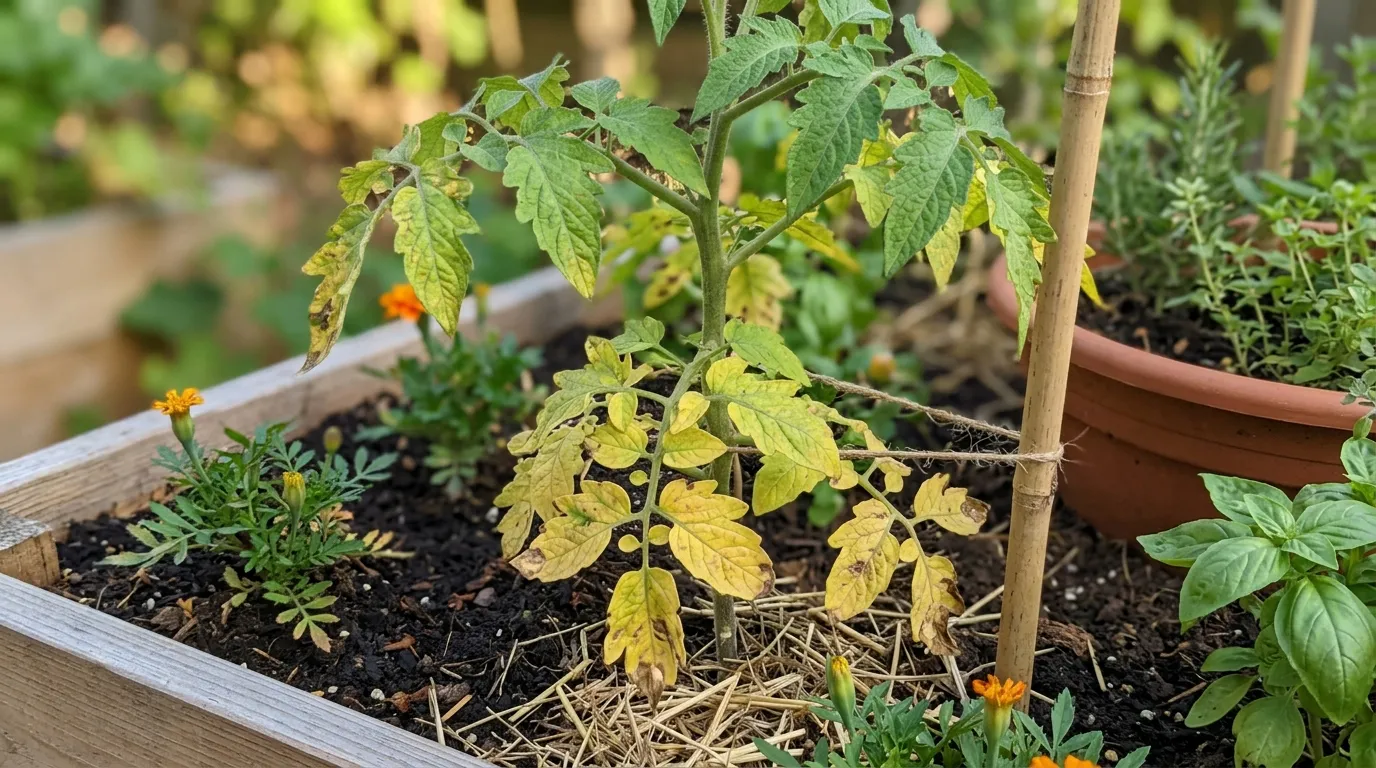
Every spring, someone sends me a photo of a tomato seedling with leaves the color of a bruise and asks what nutrient they are missing. The answer is usually none. The plant is cold. Below about 60°F, tomato roots slow down so much that they cannot pull phosphorus out of the soil, even when the soil is full of it. The plant responds by producing purple anthocyanin pigments, the same compounds that color a blueberry or a purple basil leaf.
I used to misread this every year. I would add bone meal, then a phosphorus bloom booster, then more compost, and nothing changed until the weather warmed up. The purple faded on its own, which should have told me what the real cause was. Since then I have learned to check the soil temperature before I check the fertilizer bag.
That said, not every purple leaf is a cold-soil story. Some varieties are naturally purple. Some plants have root damage. A few have a real phosphorus shortage, and a few have pests or herbicide damage. This guide separates those cases, shows what to do, and explains when purple is a warning rather than a phase.
Quick Answer: Purple tomato leaves are usually caused by cold soil below 60°F, which blocks phosphorus uptake even when phosphorus is present. Warm the root zone with black plastic, row cover or a cloche, water moderately, and wait for new growth. Add phosphorus only if a soil test shows a real deficiency. If purple comes with yellowing, stunting or wilting in warm weather, check the roots and look for pests.
At a Glance
| Fact | Details |
|---|---|
| Most common cause | Cold soil below 60°F |
| Mechanism | Phosphorus lockout, not shortage |
| Typical timing | Spring, after transplanting |
| Recovery | New growth greens up in 7–14 days |
| Soil test target | pH 6.0–6.8, adequate P |
| Real P deficiency | Rare in compost-amended soil |
| When to worry | Purple plus yellowing, stunting or wilting |
The short answer: cold soil, not hungry soil
Phosphorus moves slowly in soil and is taken up by roots through an active process that depends on temperature. When soil is cold, root metabolism slows and phosphorus uptake drops. The plant still has plenty of phosphorus around its roots; it just cannot get it in.
The visible result is anthocyanin accumulation. Young leaves and stems take on a purple or bronze tint, often starting at the leaf margins and veins. The plant looks deficient because it is, functionally, but the fix is warmth, not more fertilizer.
This is why purple leaves are so common in early spring and so rare in July. It is also why the color often disappears after a warm week without any intervention.
Cause 1: Cold soil and cold air
This is the default explanation from March through May. Night temperatures below 50°F and soil below 60°F are enough to produce purple leaves within a few days of transplanting.
The fix is to warm the root zone:
- Black plastic mulch. Lay it over the bed two weeks before planting. It raises soil temperature by several degrees.
- Row cover or fleece. Drape it over hoops at night and remove it during the day. It keeps both air and soil warmer.
- Cloches or walls of water. Useful for a few early plants.
- Plant later. The simplest fix. Wait until soil at 4 inches is consistently above 60°F.
- Water less. Wet soil warms more slowly than moist soil. Keep young plants evenly moist, not soggy.
Do not apply phosphorus in response to cold-soil purple. It will not be taken up any faster, and excess phosphorus can lock out zinc and iron later.
Cause 2: The variety
Some tomato varieties naturally produce purple pigments in their stems, leaves or fruit. Purple-stemmed seedlings are common in varieties with anthocyanin expression, and the color is not a sign of trouble.
Look at the pattern. Natural pigmentation is usually uniform on stems and the undersides of leaves, appears early, and does not come with yellowing, curling or stunted growth. The plant grows normally and fruits on schedule.
If the plant is otherwise healthy, do nothing. This is cosmetic.
Cause 3: A real phosphorus deficiency
True phosphorus deficiency is uncommon in garden soil that has been amended with compost, but it can happen in sandy soil, in soil with a very low pH, or in a container filled with unfertilized mix.
The signs overlap with cold-soil purple, which is what makes it confusing. A real deficiency usually shows:
- Purple that persists in warm weather
- Stunted growth and thin stems
- Dark green or bronze leaves, sometimes with purple undersides
- Poor flowering and fruit set
- A soil test showing low phosphorus
The fix is a soil test, not a guess. If phosphorus is genuinely low, add bone meal or rock phosphate for the long term, and use a liquid phosphorus feed for a quick correction. Do not apply phosphorus every year without testing; it builds up in soil and can cause other imbalances.
Cause 4: Root damage or overwatering
Roots that are damaged cannot take up phosphorus, even in warm soil. Overwatering, poor drainage, compaction and root rot all produce the same result: purple leaves on a plant that looks otherwise unwell.
Check the roots. Lift a plant carefully or look at the drainage holes of a container. Healthy roots are white or tan and firm. Damaged roots are brown, mushy or sparse.
If the roots are rotting, reduce watering, improve drainage, and consider repotting into fresh mix. Do not feed a plant with damaged roots; it cannot use the nutrients and the salts may make things worse.
Cause 5: Intense light or UV stress
Young seedlings grown under very strong lights or moved suddenly into full sun can develop purple or bronze leaves. The pigments act as a sunscreen. This is usually temporary and affects the most exposed leaves.
Harden seedlings off gradually, and raise lights if the leaves are bleaching or curling. The new growth will be normal.
Cause 6: Pests and herbicide drift
Two less common causes are worth knowing.
Psyllids can transmit a disease called tomato purple leaf disorder in some regions. The leaves turn purple or yellow, growth is stunted, and you may see small insects or their honeydew. This is regional and not the first thing to suspect.
Herbicide drift from lawn weed killers can cause twisting, strapping and purple or yellow discoloration. The damage is usually uniform across exposed plants and appears after a neighbor sprays. There is no cure; remove affected plants if growth stops.
The diagnosis table
| Pattern | Likely cause | What to do |
|---|---|---|
| Purple leaves and stems in cool spring soil | Cold-soil phosphorus lockout | Warm the soil, wait |
| Uniform purple stems, healthy growth | Variety | Nothing |
| Purple in warm weather, stunted, poor fruit | True phosphorus deficiency | Soil test, amend |
| Purple plus wilting, brown roots | Root damage or rot | Fix drainage, repot |
| Purple on exposed leaves after moving to sun | Light stress | Harden off, shade briefly |
| Purple plus curling, after herbicide | Drift damage | Remove if growth stops |
What to do, step by step
Step 1: Measure the soil temperature
Use a soil thermometer at 4 inches, in the morning, for three days. If it is below 60°F, cold is your answer. Stop there and warm the bed.
Step 2: Warm the root zone
Black plastic, row cover, cloches or a warmer spot. This is the only fix that addresses the cause. Give it a week and check the new leaves.
Step 3: Check moisture
Dig 2 inches down. It should be moist, not soggy. If it is wet, back off watering and improve drainage. If it is bone dry, water deeply.
Step 4: Test pH and phosphorus
If the purple persists after the soil warms, test pH and phosphorus. Tomatoes prefer pH 6.0 to 6.8. At pH below 5.5 or above 7.5, phosphorus availability drops.
Step 5: Feed only if the test says so
If phosphorus is low, add bone meal at 1 cup per plant for slow release, or use a liquid phosphorus feed at label rate for a quick fix. If phosphorus is adequate, do not add more.
What not to do
Do not add phosphorus blindly. Excess phosphorus is hard to remove and can lock out zinc and iron.
Do not overwater to “flush” the plant. Wet, cold soil makes the problem worse.
Do not remove purple leaves. They are still photosynthesizing. Remove only leaves that are yellow, brown or diseased.
Do not fertilize a plant with damaged roots. Fix the roots first.
When to worry
Purple alone is usually benign. Worry when it comes with any of these:
- Yellowing between the veins, especially on new leaves
- Stunted growth that does not improve after a warm week
- Wilting despite moist soil
- Brown, mushy roots
- Poor flowering or fruit set
- Purple that appears in midsummer heat
Those signs point to root disease, a real nutrient imbalance or pest damage, and they need a different response than a cold snap.
Frequently Asked Questions
Q: Why are my tomato leaves turning purple?
A: Cold soil is the most common cause. Below about 60°F, tomato roots cannot take up phosphorus efficiently, and the plant accumulates purple anthocyanin pigments. True phosphorus deficiency is rare in amended soil, and some varieties naturally have purple stems or leaves.
Q: Is purple on tomato leaves a phosphorus deficiency?
A: Usually not. It looks like one, but the cause is cold soil locking out phosphorus that is already present. Warm the soil and wait; adding more phosphorus rarely fixes it. A soil test is the only way to confirm a real deficiency.
Q: Will purple tomato leaves turn green again?
A: Yes, once the soil warms above 60°F and the roots recover, new growth emerges green. Older purple leaves may stay tinted, but they can still photosynthesize. Judge recovery by the new leaves at the top of the plant.
Q: Should I add bone meal for purple tomato leaves?
A: Only if a soil test shows low phosphorus. Bone meal releases slowly and will not help a cold-soil problem this season. Warm the root zone first, then test before adding anything.
Q: When should I worry about purple tomato leaves?
A: Worry if the purple comes with yellowing, stunting, wilting or poor fruit set, or if it appears in warm weather. That points to root damage, disease or a real nutrient problem rather than a cold snap.
Related Articles
- Tomato Leaves Turning Yellow
- How to Grow Tomatoes
- Best Soil for Tomatoes
- Best Fertilizer for Tomatoes
- How to Test Soil pH at Home
- How to Prepare Soil for Planting
- Vegetable Garden Fertilizer: N-P-K Explained & How to Feed
- Vegetable Garden Fertilizer: N-P-K Explained & How to Feed
Sources & References
- University of Minnesota Extension — https://extension.umn.edu/vegetables
- Cornell Vegetables — https://www.vegetables.cornell.edu/
- Clemson HGIC — https://hgic.clemson.edu/
- University of California IPM — https://ipm.ucanr.edu/
- Penn State Extension — https://extension.psu.edu/