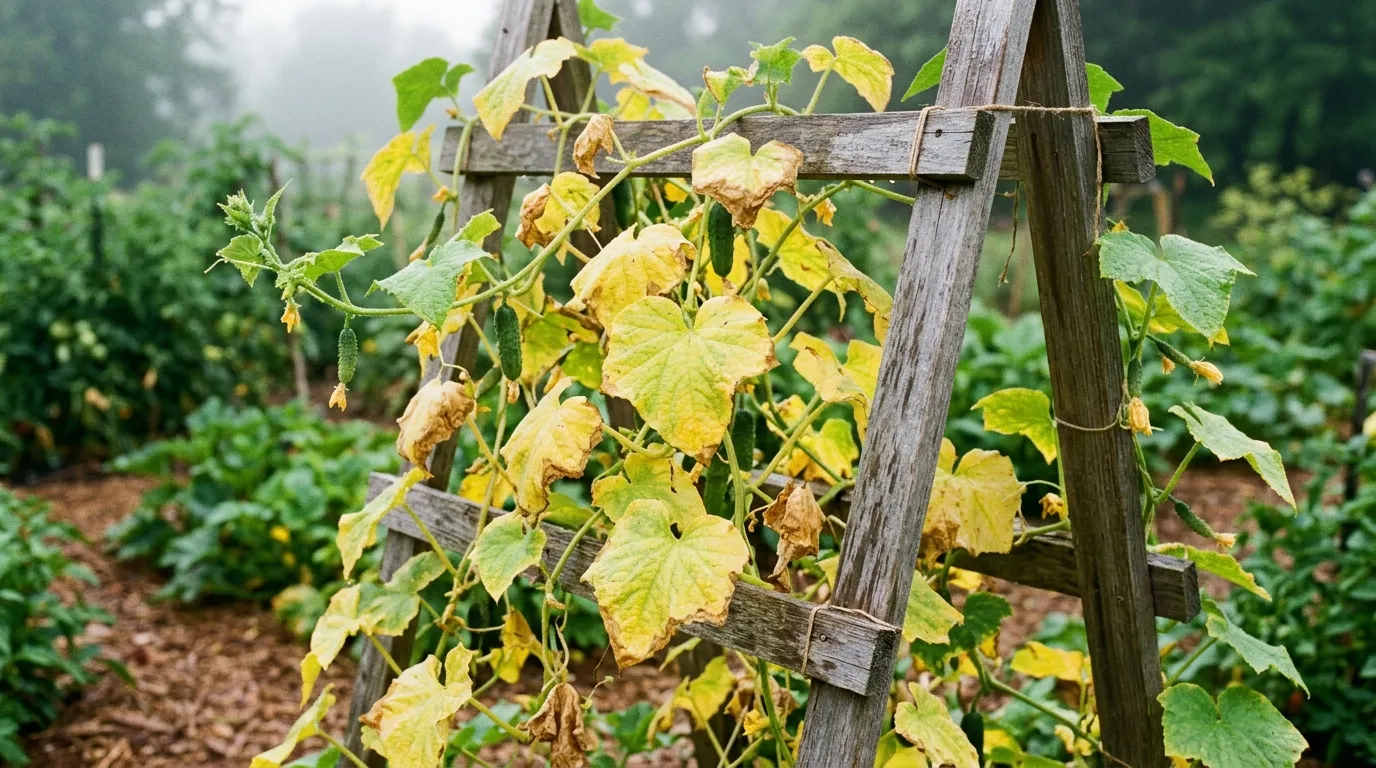
The first time I saw a cucumber leaf turn white, I assumed the plant was dying. It was a single leaf near the bottom of the trellis, dusted with what looked like flour, and within ten days half the canopy had the same pale film. I sprayed it with everything I had, including a milk mixture I had read about at midnight, and the spread slowed but never stopped. The plant produced a few more cucumbers and then gave up in August.
The second time, on a different plant, the white was not powder at all. It was a papery patch on the upper leaves after I moved a pot from a shady corner into full sun. That plant was not diseased. It was sunburned. I had wasted two weeks treating a sunscald like a fungus.
That is the trap with white cucumber leaves: the color is the same, but the causes are completely different, and the treatments do not overlap. Powdery mildew needs airflow and a fungicide. Sunscald needs shade and time. Magnesium shortage needs a nutrient. Spider mites need water and soap. If you treat the wrong one, you lose weeks you do not have in a cucumber season.
This guide shows you how to tell them apart in about two minutes, then what to do for each. It is the checklist I use now before I spray anything.
Quick Answer: Look at where the white is and how it behaves. Powder on the upper surface that wipes off is powdery mildew. Papery white patches on leaves that were suddenly exposed to sun are sunscald. White or yellow tissue between green veins on older leaves is magnesium shortage. Fine white speckles plus webbing underneath are spider mites. Match the treatment to the pattern, not to the color.
At a Glance
| Pattern | Cause | First fix |
|---|---|---|
| White powder on top, wipes off | Powdery mildew | Remove worst leaves, improve airflow, potassium bicarbonate |
| Papery white patches, dry | Sunscald | Shade cloth, gradual hardening |
| White between green veins, older leaves | Magnesium shortage | Epsom salt foliar, soil test |
| Fine white speckles, webbing | Spider mites | Water jet, insecticidal soap |
| White margins after cold nights | Cold damage | Row cover, wait for warmth |
| White bumps underneath | Edema | Reduce watering, improve airflow |
Rule out the easy one first
Before you diagnose, do three things.
Wipe the white with your finger. If it comes off like flour and leaves green tissue underneath, it is powdery mildew. If the tissue itself is white and papery, it is damage, not a fungus.
Look at the underside of the leaf. Powdery mildew is mostly on top. Downy mildew shows gray or purple fuzz underneath, with yellow angular patches on top. Spider mites leave fine webbing and tiny moving specks.
Check the location. Lower, shaded leaves are where powdery mildew starts. Upper, exposed leaves are where sunscald appears. Older leaves are where magnesium shortage shows first.
Cause 1: Powdery mildew
Powdery mildew is the most common white-leaf problem on cucumbers, squash and melons. It is a fungal disease that grows on the leaf surface, sending up a white, powdery layer of spores. It does not need free water to germinate, which is why it spreads in dry, warm weather with humid nights.
It usually starts on the oldest, most shaded leaves near the soil. From there it moves upward and outward. Affected leaves yellow, curl and die. Fruit can still ripen, but the plant loses photosynthetic area and yields drop.
What it looks like
- White or gray powder on the upper leaf surface
- Starts on lower, shaded leaves
- Yellowing underneath the powder as tissue dies
- Spreads upward and to neighboring plants
- Leaves may curl or become brittle
How to treat it
- Remove the worst leaves. Any leaf more than half covered is not contributing much. Cut it off and put it in the trash, not the compost.
- Open the canopy. Prune crowded leaves and train vines so air moves through. Powdery mildew thrives in still air.
- Water at the base. Overhead watering spreads spores and keeps leaves wet. Water in the morning so any splash dries by noon.
- Spray potassium bicarbonate. Mix 1 tablespoon per gallon of water with a few drops of mild soap. Spray both sides of the leaves every 7 to 10 days. It changes the leaf surface pH and slows the fungus.
- Try neem oil or sulfur. Neem at label rate every 7 days can help early. Sulfur works but can burn leaves above 85°F, so use it in cooler weather.
- Milk spray is optional. A 1:9 milk-to-water mix is a common home remedy. The evidence is modest, but it is harmless and may slow spread. Do not rely on it alone.
What not to do
Do not compost infected leaves. Do not overhead water in the evening. Do not crowd the plants to get more vines. Do not expect a heavily mildewed leaf to turn green again; the goal is to protect new growth.
Cause 2: Sunscald
Sunscald is physical damage, not disease. It happens when a leaf that has been shaded is suddenly exposed to strong sun. The tissue overheats and dies, leaving a white or papery patch. It is common after moving a pot, pruning a shade plant, or setting out transplants without hardening them off.
What it looks like
- White, papery patches on the upper, exposed leaves
- Sharp boundary between white and green tissue
- No powder, no fuzz, no webbing
- Often appears within a day or two of a move or a prune
- Affected patches do not spread to new leaves
How to treat it
There is no spray that repairs sunscald. The damaged tissue is dead. The goal is to protect the rest of the plant while it adapts.
- Shade the plant for a few days. Use a 30 to 40 percent shade cloth, or move the pot back to partial shade.
- Increase exposure gradually. Add an hour of sun per day over a week.
- Keep watering steady. Damaged leaves lose water faster, so do not let the plant dry out.
- Leave lightly damaged leaves on. They can still photosynthesize. Remove only leaves that are fully white and crispy.
Sunscald on fruit is more serious. A white, sunken patch on a cucumber is permanent and the fruit will rot. Harvest and discard affected fruit, and shade the plant so new fruit is protected.
Cause 3: Magnesium shortage
Magnesium is at the center of the chlorophyll molecule, so a shortage shows as yellowing or whitening between the veins. On cucumbers, it often appears on older leaves first because the plant moves magnesium to new growth.
What it looks like
- White or yellow tissue between green veins
- Older, lower leaves affected first
- Veins stay green, creating a patterned look
- Leaves may cup or become brittle
- Often worse in sandy soil, after heavy watering, or in pots
How to treat it
- Confirm the pattern. Interveinal white on older leaves is magnesium. Uniform white powder on top is not.
- Spray Epsom salt. Mix 1 tablespoon per gallon of water and spray the leaves every two weeks, two or three times. This is a quick foliar fix.
- Add magnesium to the soil. Dolomitic lime supplies magnesium and calcium, but it raises pH. Use it only if your pH is below 6.5. Epsom salt in the soil is another option at 1 tablespoon per square foot.
- Check watering and pH. Overwatering leaches magnesium, and pH outside 6.0 to 7.0 can lock it up. Fix the cause, not just the symptom.
Do not use Epsom salt as a general tonic. It will not fix mildew, mites or sunscald, and excess magnesium can interfere with calcium uptake.
Cause 4: Spider mites
Spider mites are tiny arachnids that suck sap from the underside of leaves. They thrive in hot, dry weather and in dusty, sheltered spots. Their feeding leaves fine white or yellow speckles, which can merge into a pale, bronzed leaf.
What it looks like
- Fine white stippling on the leaf surface
- Yellowing or bronzing of the whole leaf
- Fine webbing on the underside and between leaves
- Tiny moving specks, visible with a hand lens
- Worst on hot, dry, dusty edges of the garden
How to treat it
- Blast the undersides with water. A strong jet every few days dislodges mites and raises humidity, which they dislike.
- Spray insecticidal soap. Cover the undersides thoroughly, and repeat every 3 to 5 days for two weeks to catch newly hatched mites.
- Remove heavily infested leaves. Put them in the trash.
- Keep the plant watered. Drought stress makes mites worse.
- Avoid broad-spectrum insecticides. They kill the predators that keep mites in check.
Other causes worth knowing
Cold damage. A cold night can leave white or papery margins on exposed leaves. It usually appears after a temperature drop and does not spread. Protect with row cover and wait for new growth.
Herbicide drift. If a neighbor sprays weed killer, cucumber leaves can cup, strap or bleach white. There is no fix. Remove affected plants if growth stops.
Edema. Small white bumps on the underside of leaves come from water retention, usually after overwatering in cool, humid weather. Improve airflow and let the soil dry slightly between waterings.
The two-minute diagnosis
| Question | If yes | If no |
|---|---|---|
| Does the white wipe off like powder? | Powdery mildew | Go to next question |
| Is the white tissue papery and dry? | Sunscald | Go to next question |
| Is it between green veins on older leaves? | Magnesium shortage | Go to next question |
| Are there speckles and webbing underneath? | Spider mites | Check cold, herbicide, edema |
Prevention that works for all four
Most white-leaf problems come from the same three conditions: still air, wet leaves and stressed plants. Fix those and you prevent more than you treat.
- Trellis and prune. Air movement is the best mildew prevention there is.
- Water at the base, in the morning. Keep the canopy dry.
- Mulch. It keeps soil moisture even and prevents splash.
- Space plants. One cucumber per 10-gallon pot, 12 to 18 inches apart in beds.
- Feed moderately. Excess nitrogen produces soft, disease-prone leaves.
- Inspect weekly. Look at the underside of five random leaves. Early detection is the whole game.
When to remove the plant
If more than half the canopy is mildewed and new growth is stunted, the plant is no longer productive. Remove it, bag it, and plant a fresh crop elsewhere if the season allows. Do not leave diseased vines in the bed over winter; powdery mildew survives on plant debris.
With mites, if the infestation is severe and the plant is near the end of its season, removal is often kinder than a long spray campaign. Clean up the area and let the next crop start fresh.
Frequently Asked Questions
Q: Why are my cucumber leaves turning white?
A: The four common causes are powdery mildew (white powder on the leaf surface), sunscald (papery white patches after sudden sun), magnesium shortage (white or yellow between green veins) and spider mites (fine white stippling plus webbing). The pattern and location tell you which one you have.
Q: Is white powder on cucumber leaves always powdery mildew?
A: Almost always, yes. Powdery mildew looks like talcum powder dusted on the upper leaf surface and spreads from shaded lower leaves upward. Downy mildew is different: yellow angular patches on top and gray fuzz underneath.
Q: Can cucumber leaves recover from powdery mildew?
A: Leaves that are heavily coated will not recover. Remove them to slow the spread and treat the remaining foliage with potassium bicarbonate or neem. New growth can stay healthy if you improve airflow and keep the canopy dry.
Q: Does Epsom salt fix white cucumber leaves?
A: Only if the cause is magnesium shortage. Epsom salt does nothing for powdery mildew, sunscald or mites. Confirm the pattern first: magnesium shortage shows as white or yellow tissue between green veins on older leaves.
Q: Should I cut off white cucumber leaves?
A: Remove leaves that are more than half affected, especially if they are mildewed, and put them in the trash rather than the compost. Keep healthy leaves, even if they have a small spot, because the plant needs them to make fruit.
Related Articles
- How to Grow Cucumbers
- Cucumber Leaves Turning Yellow
- Powdery Mildew on Vegetable Plants
- How to Treat Powdery Mildew
- Spider Mites on Houseplants
- Fertilizer for Cucumbers in Pots
- Vegetable Garden Fertilizer: N-P-K Explained & How to Feed
Sources & References
- University of Minnesota Extension — https://extension.umn.edu/vegetables
- Cornell Vegetables — https://www.vegetables.cornell.edu/
- University of California IPM — https://ipm.ucanr.edu/
- Clemson HGIC — https://hgic.clemson.edu/
- Penn State Extension — https://extension.psu.edu/