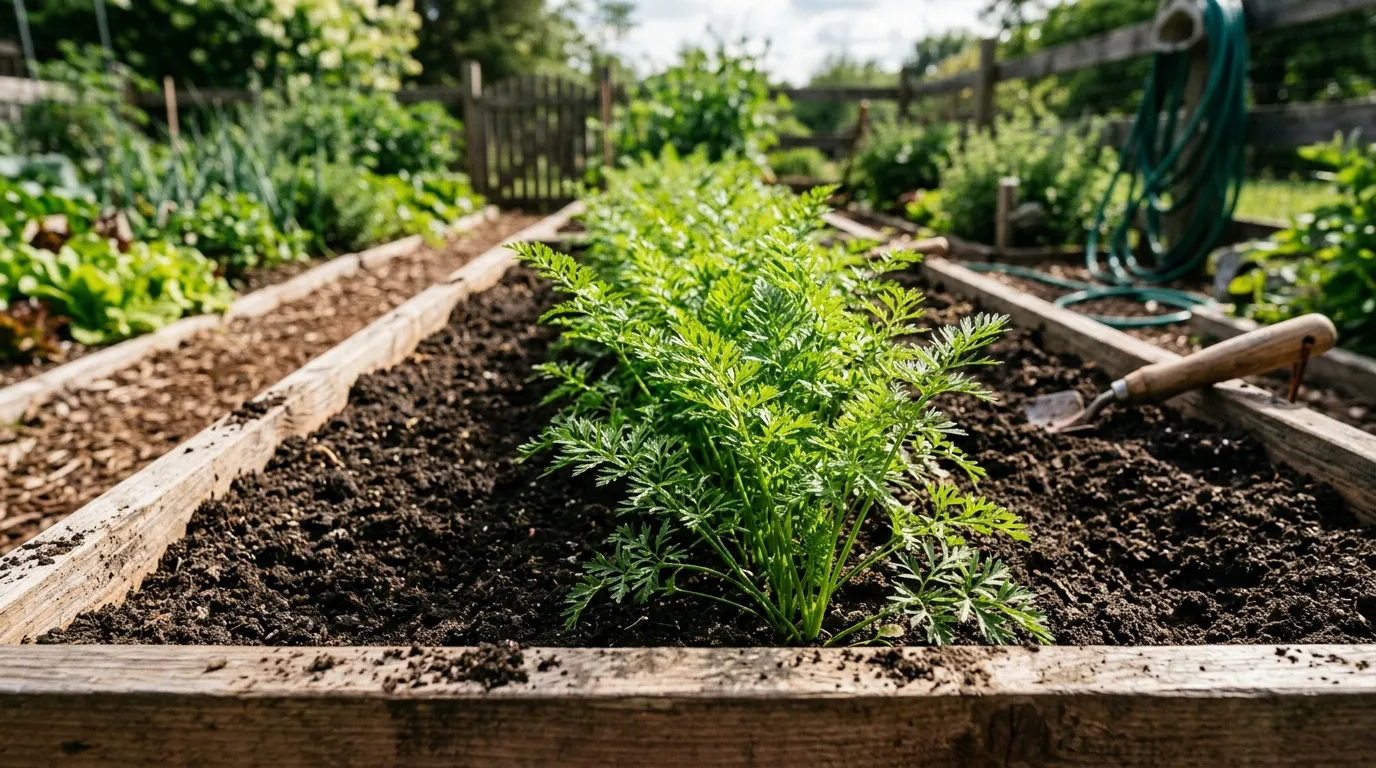
Root vegetables are the quiet overachievers of the garden, and also the easiest to ruin with kindness. I learned this the year I spread a wheelbarrow of fresh horse manure over the carrot bed in spring, certain I was building the soil of my dreams. The tops grew waist-high. The carrots, when I finally dug them, looked like a collection of pale, hairy fingers that had been in a fight. Some were forked. Some were twisted. A few had split down the middle.
The manure was not poison. It was simply too much nitrogen, delivered too fresh, in a bed that needed depth and softness more than richness. Root crops are not heavy feeders. They are structural crops. What they want is a deep, loose, stone-free seedbed with moderate phosphorus and potassium, and nitrogen kept on a short leash.
This guide explains the ratio I use now, the crop-by-crop differences, and the mistakes that cause forked carrots, woody beets and radishes that bolt instead of bulbing. It is written for a normal backyard bed, raised bed or large container. If you have been disappointed by root crops, the fix is usually in the soil preparation, not the fertilizer bag.
Quick Answer: Mix a low-nitrogen fertilizer such as 5-10-10 into the bed at about ½ cup per 10 square feet, along with 2 to 3 inches of finished compost. Do not use fresh manure. Keep nitrogen low all season, water evenly, and prepare the soil 8 to 12 inches deep so the roots can grow straight. Side-dress only if leaves are pale, and then use a half-strength liquid feed.
At a Glance
| Fact | Details |
|---|---|
| Best base feed | 5-10-10 or 0-10-10 |
| Preplant rate | ½ cup per 10 square feet |
| Nitrogen | Low — avoid fresh manure |
| Soil depth | 8–12 inches, loose and stone-free |
| pH | 6.0–6.8 (beets to 7.0) |
| Compost | 2–3 inches, well finished |
| Side-dress | Only if leaves are pale |
| Water | 1 inch per week, even |
Why root vegetables are different
Leafy crops such as lettuce and spinach are grown for their leaves, so nitrogen is the main event. Fruiting crops such as tomatoes and peppers need a balance that shifts toward potassium as fruit develops. Root crops are grown for a storage organ that grows underground. Their ideal is a modest, steady supply of phosphorus and potassium, with just enough nitrogen to build a healthy canopy.
When nitrogen is abundant, the plant does what comes naturally: it builds leaves. The root stays small, or it grows tops at the expense of fill. When nitrogen is short but phosphorus and potassium are adequate, the plant builds a normal canopy and then sends sugar down into the root. That is exactly what you want.
There is a second, physical difference. Root crops must push a taproot through the soil. Any obstruction — a stone, a clod, a layer of compacted subsoil, a pocket of fresh manure — deflects the root and produces a fork or a twist. No fertilizer can correct a physical problem. This is why bed preparation matters more for carrots than for almost any other crop.
What each nutrient does
Nitrogen builds leaves. A little is necessary early. Too much produces rank tops, small roots, and in carrots, hairy roots and poor color. Fresh manure is the most common source of excess nitrogen in root beds.
Phosphorus supports root development and energy transfer. It is the most important nutrient for root fill, and it moves slowly in soil, so it needs to be mixed into the root zone before planting.
Potassium supports starch storage, skin quality and keeping ability. Root crops use a fair amount, especially beets and parsnips.
Calcium affects cell structure and root quality. It moves with water, so even moisture is more important than adding calcium.
Boron is a micronutrient that matters for beets and turnips. A shortage causes black heart, a dark, corky core. Boron is needed in tiny amounts and is easy to over-apply, so add it only if a soil test shows a deficiency.
Crop-by-crop notes
| Crop | Nitrogen need | Soil depth | Key note |
|---|---|---|---|
| Carrots | Very low | 10–12 in | Stones and fresh manure cause forking |
| Beets | Low | 8–10 in | Sensitive to boron shortage |
| Radishes | Low | 6–8 in | Too much nitrogen causes leaf, not root |
| Turnips | Low | 8–10 in | Fast crop; rich soil makes tops |
| Parsnips | Very low | 12 in | Slow germination; avoid fresh manure |
| Rutabaga | Low | 10–12 in | Needs steady water for sweet roots |
Carrots are the most sensitive to soil structure. Beets are the most sensitive to boron. Radishes are the fastest and the most likely to bolt in heat. Parsnips are the slowest and the most likely to fork in a rough bed.
Preparing the bed
This is the part that determines whether you get straight roots or a puzzle. Start two to three weeks before planting.
First, remove stones larger than a marble from the top 10 inches. Do not just rake them off the surface; dig them out. A stone at 6 inches will deflect a carrot just as surely as one at the surface.
Second, loosen the soil deeply without turning it into a flour-like powder. Fork it to 10 or 12 inches, break up clods, and let it settle. If you are using a raised bed, make sure the mix is fine and free of chunks of bark or undecomposed compost.
Third, spread 2 to 3 inches of finished compost and mix it into the top 6 to 8 inches. Compost supplies gentle nutrients and improves water holding without the nitrogen punch of fresh manure.
Fourth, apply ½ cup of 5-10-10 per 10 square feet and rake it in evenly. If your soil test shows adequate phosphorus, you can use a lower-phosphorus blend, but avoid anything high in nitrogen.
Finally, water the bed and let it settle for a few days before sowing. Freshly dug soil is fluffy and can settle unevenly, which produces uneven germination and forked roots.
The feeding schedule
Root crops are simple to feed because there are only two moments that matter: before planting, and a possible rescue early in the season.
Before planting
Mix the base fertilizer into the top 6 to 8 inches. Do not band it in a concentrated line under the seed; root crops are sensitive to salt concentration, and a band can burn the taproot.
If you are using an organic blend such as 4-4-4, use about twice the volume because the nutrient concentration is lower. If you are using bone meal, apply 1 cup per 10 square feet and mix it in well.
Three to four weeks after sowing
This is the only point where a light nitrogen feed may be justified. If the leaves are pale and growth is slow, apply fish emulsion at half strength. Do not use granular nitrogen. The goal is to correct a shortage, not to push growth.
Most gardeners will not need this step. If the bed was prepared with compost and a balanced base, the plants will have enough.
After the canopy is established
Stop feeding. From this point, the plant should be moving energy into the root. Nitrogen now produces tops and small roots. Water steadily and keep weeds down.
If you are growing beets and the leaves look healthy but the roots are small, check spacing. Beets need 3 to 4 inches between plants. Crowding produces small roots regardless of fertility.
How much fertilizer per bed size
| Bed size | 5-10-10 | Compost | Notes |
|---|---|---|---|
| 4 × 4 ft (16 sq ft) | ¾ cup | 2–3 in | Mix into top 8 in |
| 4 × 8 ft (32 sq ft) | 1½ cups | 2–3 in | Divide into two passes |
| 10 sq ft | ½ cup | 2–3 in | Standard rate |
| 1 large container (15 gal) | 2 tbsp | 1 handful | Use a deep pot, 12 in+ |
Do not exceed these rates. More fertilizer does not produce bigger roots; it produces more leaves and a higher risk of salt injury.
Organic options
Compost is the best base for root crops. It improves structure, holds moisture, and supplies nutrients slowly. Make sure it is finished; undecomposed material creates air pockets that deflect roots.
Bone meal is a slow phosphorus source, usually 3-15-0. It is ideal for root crops because it releases phosphorus over months without a nitrogen spike. Mix 1 cup per 10 square feet into the bed.
Rock phosphate is even slower and lasts for years. Use it if your soil test shows a real phosphorus deficit, and apply it a season ahead if possible.
Kelp meal supplies potassium and trace minerals. A light application before planting supports root fill without pushing leaves.
Wood ash supplies potassium and raises pH. Use it sparingly, no more than a light dusting per square foot, and only if your pH is below 6.5. Too much ash can push pH above the ideal range.
Blood meal is high nitrogen and should be avoided for root crops unless a soil test shows a serious shortage. If you must use it, apply it at half rate and only in the first few weeks.
The mistakes that ruin root crops
Fresh manure. The classic cause of forked carrots and hairy roots. It is too rich in nitrogen and salts, and it can carry weed seeds. Compost it for a year before using it, and even then keep it away from carrots.
Too much nitrogen. Produces huge tops and small roots. If your carrots look like small shrubs, stop feeding and check what you added to the bed.
Stones and clods. Physical obstruction causes forking. Sift the top 8 inches if your soil is stony.
Shallow beds. Carrots and parsnips need 10 to 12 inches of loose soil. A 6-inch raised bed will produce short, stubby roots.
Crowding. Root crops need space to fill out. Thin carrots to 2 to 3 inches and beets to 3 to 4 inches.
Irregular watering. Dry spells followed by heavy water cause splitting and woody texture. Water about 1 inch per week, evenly.
Reading the leaves and roots
| Symptom | Likely cause | Fix |
|---|---|---|
| Huge tops, small roots | Too much nitrogen | Stop feeding, water deeply |
| Forked or twisted carrots | Stones, clods, fresh manure | Improve seedbed next season |
| Hairy roots | Fresh manure or high nitrogen | Use compost only |
| Black, corky core in beets | Boron shortage | Soil test; add a tiny amount of borax |
| Pale leaves, slow growth | Nitrogen shortage or cold soil | Half-strength fish emulsion |
| Split roots | Irregular watering | Mulch and water evenly |
| Woody, strong flavor | Over-mature or drought stress | Harvest younger, water steadily |
The most common mistake is adding more fertilizer when roots are small. In root crops, small roots usually mean too much nitrogen, crowding or compaction, not hunger.
Watering and pH
Root crops need about 1 inch of water per week. Water deeply and evenly. Mulch with straw or compost to keep the surface from crusting, which can prevent seedlings from emerging.
Keep pH between 6.0 and 6.8. Beets tolerate up to 7.0. If your pH is low, add lime in the fall before planting. If it is high, add elemental sulfur and give it time to act. Do not try to adjust pH in the same week you plant.
Frequently Asked Questions
Q: What is the best fertilizer for root vegetables?
A: A low-nitrogen blend such as 5-10-10 or 0-10-10, mixed into the bed before planting at about half a cup per 10 square feet. Root crops need phosphorus and potassium for root fill, but too much nitrogen grows leaves and small roots.
Q: Should I use manure on carrots and beets?
A: Only well-composted manure, and preferably none in the year you plant. Fresh manure is high in soluble nitrogen and salts, and it causes forked, hairy roots in carrots and excessive leaf growth in beets.
Q: Why are my carrots forked and deformed?
A: Forking is usually physical: stones, clods, fresh manure or compacted layers deflect the taproot. It is rarely a fertilizer deficiency. Prepare a deep, fine seedbed and keep nitrogen low.
Q: Do root vegetables need fertilizer during the season?
A: Usually not. If the leaves are pale and growth is slow, a half-strength liquid feed early is enough. Side-dressing with nitrogen later in the season produces tops at the expense of the root.
Q: What is the best pH for root vegetables?
A: Most root crops prefer pH 6.0 to 6.8. Beets tolerate slightly higher pH, around 6.5 to 7.0. Keep the range steady; large swings affect phosphorus availability and root quality.
Related Articles
- How to Grow Carrots
- Why Are My Carrots So Small?
- How to Grow Potatoes
- Best Fertilizer for Vegetable Gardens
- NPK Ratios for Vegetables
- How to Improve Garden Soil
- Vegetable Garden Fertilizer: N-P-K Explained & How to Feed
Sources & References
- University of Minnesota Extension — https://extension.umn.edu/vegetables
- Cornell Vegetables — https://www.vegetables.cornell.edu/
- Clemson HGIC — https://hgic.clemson.edu/
- University of California IPM — https://ipm.ucanr.edu/
- Penn State Extension — https://extension.psu.edu/