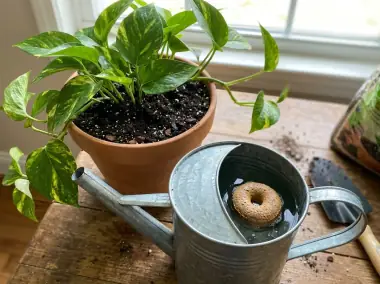
Fungus gnats are small flying insects that raise their young in potting soil. Adults are annoying; the larvae are the real problem, chewing roots and spreading disease in houseplants and seedlings. One of the most effective fixes is beneficial nematodes for fungus gnats - living organisms that hunt the larvae underground. This guide covers the right species, storage and application, how they compare to BTI products like mosquito dunks, and the mistakes that make them fail. It is a specific piece of a broader garden pest control for beginners program. If you are still figuring out whether you have fungus gnats at all, start with our guide to what fungus gnats are.
Quick Answer: Buy Steinernema feltiae nematodes, refrigerate them until use, and apply within a few days of arrival. Water the soil first, mix the nematodes into lukewarm, non-chlorinated water at about 1-2.5 million per 10 square feet (or per liter of soil), pour it on in the evening, and keep the soil evenly moist for two weeks. Repeat every 7-14 days for 2-3 rounds, keeping soil between 55 and 85 F. For stubborn infestations, pair them with BTI (mosquito bits) - nematodes kill fast, BTI finishes the job.
At a Glance
| Fact | Detail |
|---|---|
| Best species | Steinernema feltiae |
| Rate | 1-2.5 million nematodes per 10 sq ft (about 1 liter of soil) |
| Soil temperature | 55-85 F (13-29 C); ideal 60-75 F (16-24 C) |
| Water needs | Evenly moist soil for 7-14 days after application |
| Storage | Refrigerator only, never freezing, use within 2-4 weeks |
| Repeat schedule | Every 7-14 days, 2-3 rounds total |
| How they kill | Enter larva, release symbiotic bacteria, kill in 24-48 hours |
| Safety | Safe for humans, pets, kids, and pollinators |
| Cost | Roughly $10-25 per treatment pack |
What Are Beneficial Nematodes?
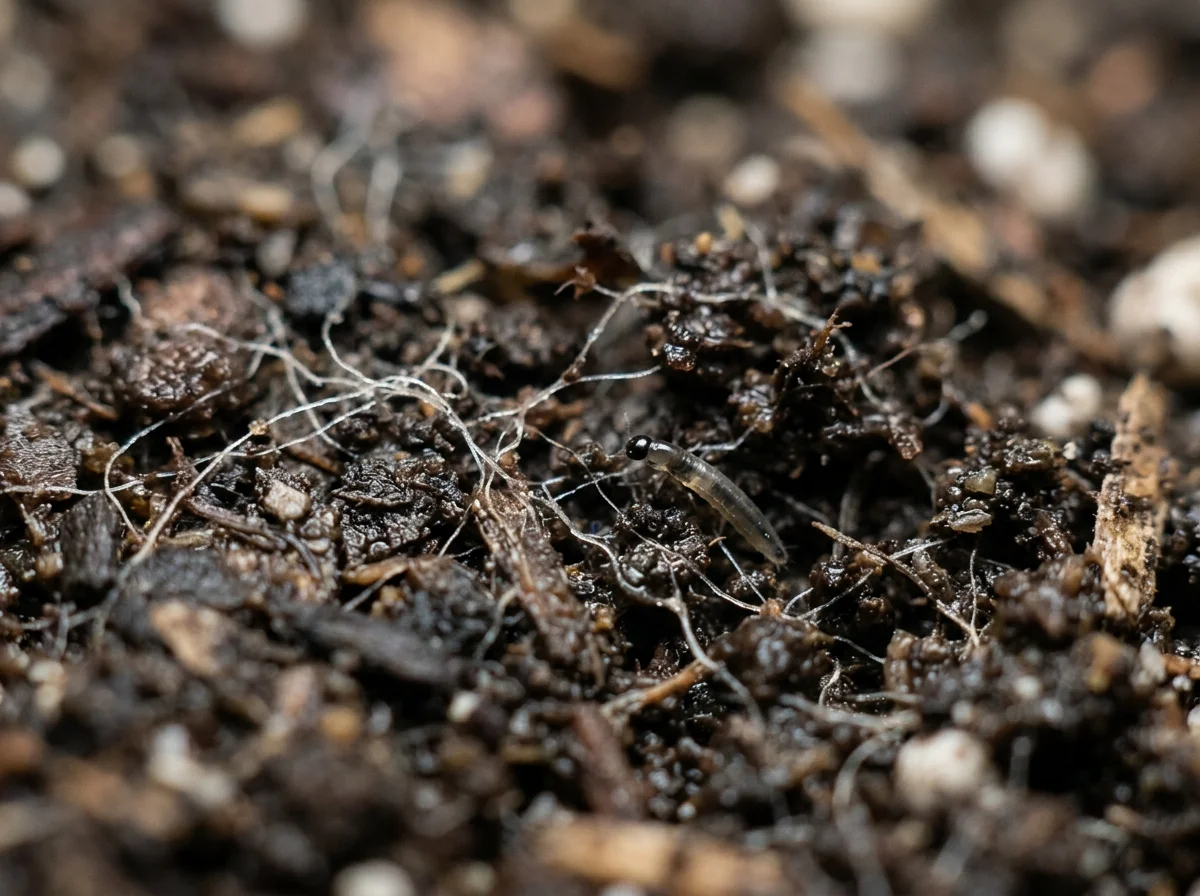
Beneficial nematodes are microscopic roundworms (about 1/4 mm) that you cannot see. They are not the plant-parasitic nematodes of field crops, and they do not infect people or pets. Entomopathogenic species are predators of soil-dwelling insect larvae.
Think of them as a self-replicating cleanup crew. Once you pour them into moist soil, they move through the water film between soil particles, sense carbon dioxide and vibrations from larvae, and actively hunt them down. A single infected larva can produce thousands of new nematodes, so a successful application keeps working for weeks [1] (Source: University of California IPM).
Steinernema feltiae: The Right Species for Fungus Gnats
Not all nematodes target the same pests, and picking the wrong species is the most common buying mistake.
Species Comparison
| Species | Fungus gnat effectiveness | Temperature range | Notes |
|---|---|---|---|
| Steinernema feltiae | Excellent - the gold standard | 50-86 F (10-30 C), best 60-75 F | Hunts larvae in the top 2-4 inches of soil where gnat larvae live |
| Steinernema carpocapsae | Moderate | 55-86 F (13-30 C), best 65-80 F | Ambusher; better for wax moths and cutworms than gnats |
| Heterorhabditis bacteriophora | Low to moderate | 62-86 F (17-30 C) | Prefers warmer, deeper soil; spotty results on gnats |
| Steinernema riobrave | Poor for gnats | Warm soils, 60-95 F | Citrus weevil and white grub specialist |
Steinernema feltiae wins because fungus gnat larvae live in the top 1-3 inches of soil where this species is most active, and it tolerates the cooler soil temperatures common in homes in winter. If a product does not name the species on the label, do not buy it.
How Nematodes Kill Fungus Gnat Larvae
The kill happens only after the nematode invades the larva - there is no spraying effect. In order:
- Locate. Nematodes detect carbon dioxide and movement from a gnat larva and swim toward it.
- Enter. They penetrate the larva through its mouth, anus, or breathing spiracles.
- Release bacteria. Once inside, each nematode releases symbiotic bacteria (Xenorhabdus or Photorhabdus species, depending on the nematode).
- Kill. Those bacteria multiply and kill the larva within 24-48 hours by causing septicemia.
- Host. The nematodes feed, mature, and reproduce inside the dead larva.
- Exit. Thousands of new infective juveniles leave the cadaver to hunt fresh larvae.
The corpse does not rot or smell unpleasant - it becomes a brown “mummy” over a few days. Once prey runs out, the nematode population crashes.
What You Need Before You Apply
Nematodes are a live product, so buying and handling matter as much as application.
Product Forms
| Form | How it is used | Shelf life |
|---|---|---|
| Sponge pack | Soak sponges in water, pour the water over soil | 2-4 weeks refrigerated |
| Clay paste | Stir paste into water, apply as drench | 2-4 weeks refrigerated |
| Pre-mixed pouch or bottle | Mix into larger volume of water | Use within days of receipt |
| Granules/carrier mix | Scatter on moist soil surface and water in | Shortest; apply immediately |
Always check the packed-on or expiration date; a fridge-fresh pack from a reputable supplier beats a big-box pack that sat in shipping for months.
Storage Rules
- Refrigerate at 34-40 F (1-4 C), never freeze.
- No direct sunlight or radiators.
- Use within 7 days of delivery for the best kill rate - the product is alive, so plan to apply the week it arrives.
How to Apply Beneficial Nematodes
Application technique makes or breaks results. Follow these steps in order.
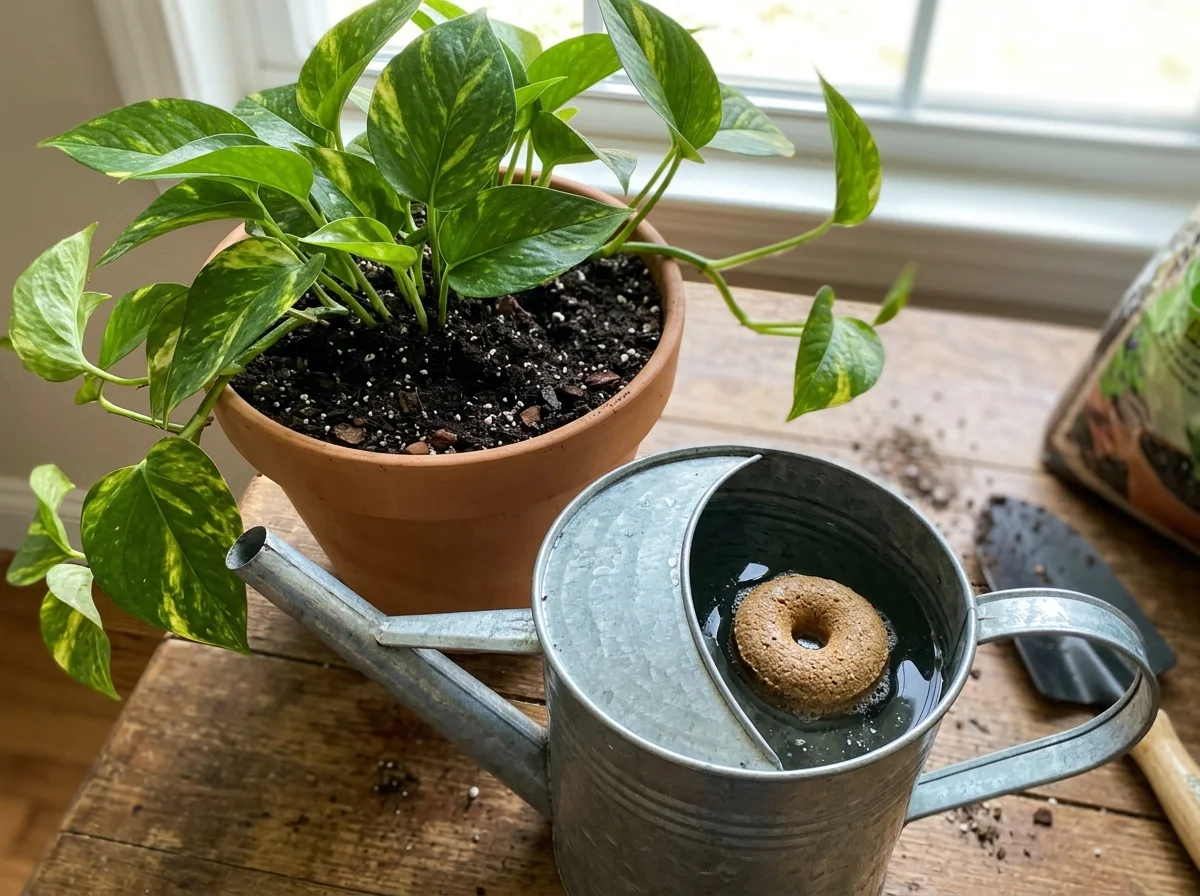
Step 1: Water first. Water the soil so it is damp through the top few inches; nematodes need a water film to move.
Step 2: Prepare lukewarm, dechlorinated water. Use water between 60 and 75 F (16-24 C); if your tap water is chlorinated, let it sit 24 hours or use distilled/rainwater.
Step 3: Mix the dose. 1-2.5 million nematodes per 10 square feet (about 1 square meter) of surface, or roughly 1 million per liter of pot volume.
Step 4: Stir constantly. Agitate the watering can every few minutes so the nematodes do not settle.
Step 5: Apply in the evening. UV light kills nematodes, so apply at dusk or on a heavily overcast day and water in gently.
Step 6: Keep soil moist. For 7-14 days keep the top inch or two damp, not soggy - the same principle in our houseplant watering guide. Dry spells wipe out the nematodes.
Step 7: Skip harsh chemicals. No fertilizer flush or strong neem in the first week.
Step 8: Repeat. Apply a second and third round 7-14 days apart to catch newly hatched larvae; two to three rounds typically ends a moderate infestation.

Beneficial Nematodes vs BTI
BTI (Bacillus thuringiensis israelensis) sold as mosquito bits or mosquito dunks is the other biological control popular for fungus gnats. They work differently, so the choice matters.
Side-by-Side Comparison
| Factor | Beneficial nematodes (S. feltiae) | BTI (mosquito bits/dunks) |
|---|---|---|
| How it works | Actively hunts and enters larvae | Bacteria eaten by larvae; toxins destroy gut |
| Speed | Larvae die in 24-48 hours | Larvae die in 24-72 hours |
| Residual | Lives in soil for weeks; reproduces | 1-4 weeks, needs reapplication |
| Application | Water drench, evening, moist soil | Soak dunks in water and drench soil |
| Temperature | 55-85 F (13-29 C) | Works across a broader range |
| Cost per treatment | $10-25 for ~100 sq ft | $5-15 for months of bits |
| Best for | Fast knockdown of active larvae | Ongoing prevention and long residual |
| Safety | Safe for all non-targets | Safe for pets, kids, pollinators |
Both kill only the larval stage, so pair them with sticky traps for adults - our complete guide to getting rid of fungus gnats covers trap placement. Many growers run BTI every 1-2 weeks and add nematodes twice a season; others use nematodes for a severe outbreak and BTI to maintain. They do not compete with each other, so using both is safe.
Safety for Pets, Kids, and Beneficial Insects
Beneficial nematodes have one of the best safety profiles of any pest control:
- Humans and pets: Cannot infect mammals or birds; contact with treated soil is no risk.
- Pollinators and beneficials: Safe for bees, butterflies, ladybugs, and earthworms.
- Edibles: Safe on vegetables and herbs with no pre-harvest interval.
Only caution: avoid inhaling the powder during mixing - wear a dust mask or mix outdoors.
Why Nematodes Sometimes Fail
Visible gnats a week after treatment does not always mean dead nematodes - adults from earlier pupae keep emerging for weeks. Check the list below before reordering.
| Symptom | Likely cause | Fix |
|---|---|---|
| No change in larvae | Product arrived dead or frozen | Test product; reorder fresh |
| Gnats return in 10-14 days | No repeat round; eggs hatched | Apply second and third round |
| Soil was dry for days | Nematodes died of desiccation | Keep evenly moist for 2 weeks |
| Applied at noon in sun | UV killed them on surface | Apply at dusk; water in |
| Soil hot (>85 F) | Heat shock | Treat at night, add water |
| Tap water straight from tap | Chlorine killed them | Dechlorinate water first |
| Product weeks old | Expired stock | Use fresh product each round |
If none of these fit, give it another full round. Dense, high-moisture potting mix can also buffer nematodes, which is why a second round matters.
Cost Expectations
- Household pack (10 million): $10-25, covers about 20-40 pots or 100 sq ft.
- Larger pack (50 million): $25-45, about 500 sq ft - good for a greenhouse.
- Budget for 2-3 applications per flare-up, so a full infestation cycle usually costs $20-70.
- BTI dunks: $5-15 for a pack that lasts months with weekly use.
Size the purchase to the space; a tiny trial pack on a 200 sq ft bed under-doses the soil and wastes the money.
Common Mistakes
- Buying the wrong species. S. feltiae for fungus gnats; generic “nematodes” may be for grubs. The fix: confirm the label says Steinernema feltiae.
- Letting the product freeze or bake in a hot garage. The fix: refrigerate and plan to apply the week it arrives.
- Mixing into hot or cold water. The fix: use lukewarm 60-75 F water.
- Applying to dry soil. The fix: water first; keep soil damp for two weeks.
- Spraying at noon in direct sun. The fix: dusk application, immediate watering.
- Using chlorinated tap water straight from the tap. The fix: let water sit 24 hours or use distilled water.
- One and done. The fix: plan 2-3 rounds at 7-14 day intervals.
- Overwatering into a swamp. The fix: damp, not soggy - roots need air, and gnats love wet soil.
Troubleshooting
- Gnats still flying after two rounds: pupae keep emerging; dry the surface between waterings and add sticky traps.
- No larva kill after 5 days: product may have arrived dead; reorder fresh and check storage.
- Soil stays wet too long: cut back watering and improve drainage; wet soil invites gnats back.
- Leaves wilt after application: likely overwatered; let the top inch dry slightly, then keep lightly moist.
- Nematodes seem to vanish: they disappear once the larvae are gone - that is success, not failure.
Frequently Asked Questions
Q: Which nematodes work best for fungus gnats?
A: Steinernema feltiae is the best choice for fungus gnats because it stays active at cooler soil temperatures, hunts larvae in the top layers of soil, and targets exactly the stage that damages roots.
Q: How often do I apply nematodes for fungus gnats?
A: Apply every 7 to 14 days for 2 to 3 rounds. Nematodes only kill larvae present at application, so repeat treatments break the lifecycle and stop new generations from emerging.
Q: Are beneficial nematodes safe for pets and kids?
A: Yes. Entomopathogenic nematodes only infect insects, so they are safe around children, pets, birds, and beneficial insects like bees and ladybugs.
Q: Why did my nematodes fail?
A: The most common reasons are dead product from freezing or heat, expired stock, applying to dry soil, watering with chlorinated water, or using them in soil that is too hot or too cold.
Q: Do nematodes work better than BTI for fungus gnats?
A: Nematodes kill larvae faster and actively hunt through the soil, while BTI is a bacteria that must be eaten by larvae and has longer residual effect. Many growers use both together for the best results.
Q: Can I store leftover nematodes?
A: Only in the refrigerator, never in the freezer, and only until the expiration date - usually 2 to 4 weeks. Stored nematodes lose strength quickly, so use a fresh batch for each round.
Q: What temperature do nematodes need?
A: Keep soil between 55 and 85 F (13-29 C), with 60-75 F (16-24 C) ideal for Steinernema feltiae. Below 55 F they slow down, and above 85 F most species die off.
Q: How much do beneficial nematodes cost?
A: Expect $10 to $25 for a 10-million packet that covers roughly 100 square feet or 20-40 pots, with larger greenhouse-size packs running $30 to $60.
Related Articles
- What Are Fungus Gnats?
- How to Get Rid of Fungus Gnats
- Garden Pest Control for Beginners
- Garden Pest Identification
- How to Water Houseplants
- How Often to Water Vegetables
- How to Prepare Soil for Planting
- How to Fix Yellow Leaves
