Fungus gnats are the most maddening houseplant pest, and diatomaceous earth is one of the first things most people reach for - often with disappointing results. The powder works, but only under specific conditions, and most failures come down to one thing: moisture.
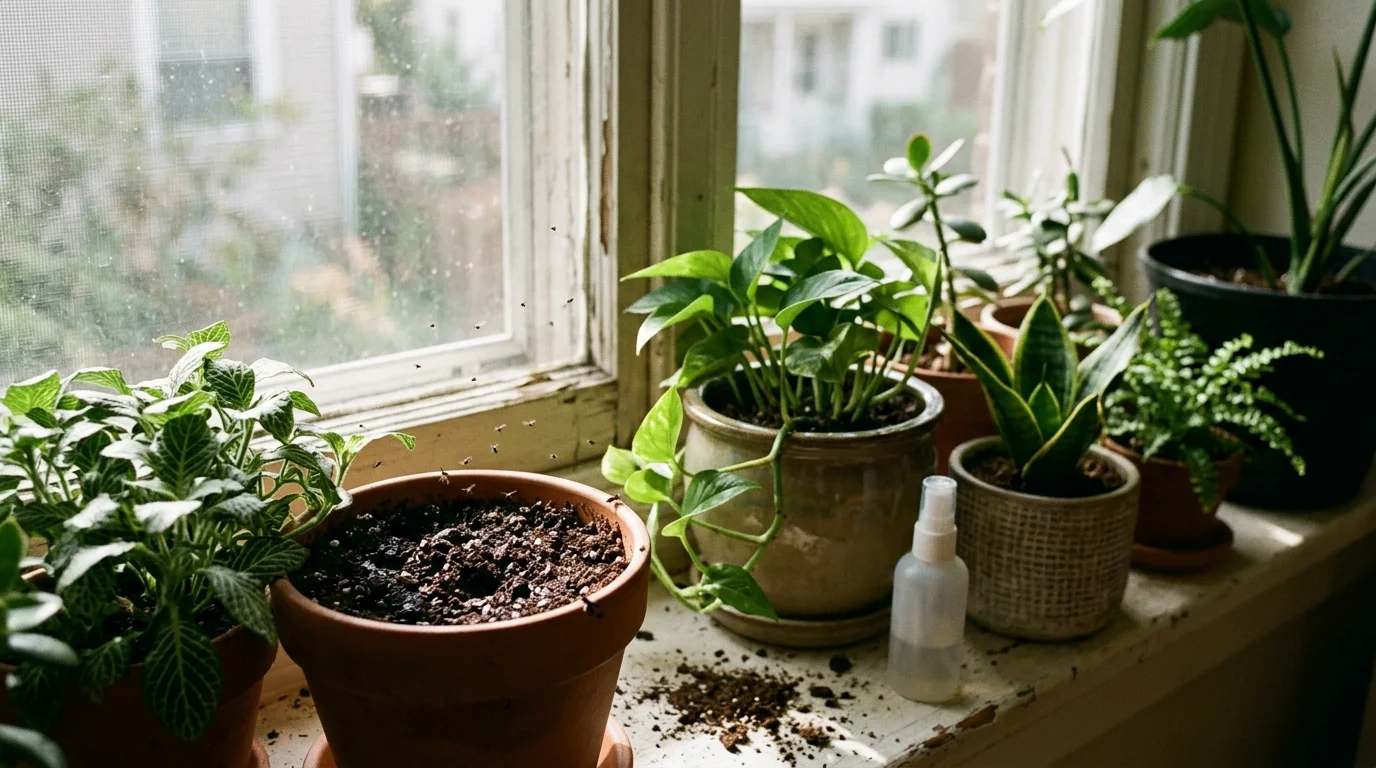
This guide explains exactly how diatomaceous earth for fungus gnats works, why it fails when wet, how to apply it so it actually kills, and the full 5-step routine that ends an infestation for good. It complements our complete guide on how to get rid of fungus gnats and our explainer on what fungus gnats are.
Quick Answer: Yes, food-grade diatomaceous earth kills fungus gnats - both adults and larvae - on contact by scraping holes in their waxy outer coating and drying them out. The catch: it only works bone-dry, on a thin surface layer, and must be reapplied after every watering. It knocks down the visible gnats but cannot end the breeding cycle alone, so pair it with dry soil, yellow sticky traps, and a BTI drench.
At a Glance
| Fact | Detail |
|---|---|
| What DE is | Fossilized diatom skeletons; a fine, sharp silica powder |
| How it kills | Abrades the waxy cuticle, then insects desiccate and die |
| Time to kill | 24 to 48 hours of dry contact |
| Works on | Adults and larvae that cross the dry layer |
| Fails when | Wet, caked, thickly piled, or buried by new soil |
| Reapply | After every watering; usually 2 to 3 times per week |
| Safety | Wear goggles and mask; respiratory irritant; food-grade only |
| Best use | One layer in a full 5-step routine, not a standalone fix |
What Is Diatomaceous Earth?
Diatomaceous earth, usually shortened to DE, is a powder made from the fossilized remains of diatoms - single-celled algae whose shells, or frustules, are built from silica [1] (Source: Environmental Protection Agency). Those shells preserve a hard, honeycombed silica skeleton that looks smooth under a magnifier but is jagged at the scale of an insect’s body.
A gnat’s body is sealed with a thin waxy cuticle that locks moisture in. When a fungus gnat or its larvae crawls across food-grade DE, the microscopic edges cut and abrade that waxy layer. The insect’s body loses water faster than it can replace it, a process called desiccation, and the gnat or larva dies from dehydration within 24 to 48 hours [2] (Source: University of California Integrated Pest Management). DE does not poison the insect; it physically destroys its waterproofing. That is why gnats cannot build resistance to it the way they sometimes do with chemical sprays.
Two types of diatomaceous earth exist, and mixing them up causes real harm:
| Type | Processed? | Where it is safe | Why |
|---|---|---|---|
| Food-grade DE | Not heated; settled only | Plants, soil, homes, stored grain | Safe once settled if food-grade labeled; still an irritant while airborne [3] (Source: National Pesticide Information Center) |
| Pool-grade (filter-grade) DE | Heat-treated, calcined | Pool filter canisters only | Transformed into crystalline silica; hazardous to inhale and can burn foliage; never use on plants or around pets |
Why DE Only Works Dry - The #1 Reason It Fails
DE is a desiccant: its killing power comes from being thirsty and abrasive. As soon as the powder gets wet - from watering, condensation, rain, or high humidity - the particles cake together, the sharp edges soften, and insects can cross it without friction or water loss. Once dry again, a caked crust does not fully reactivate; you need to rake it up and reapply.
The numbers are brutal: a surface layer of DE exposed to a typical houseplant watering can lose most of its effectiveness for several days. In warm, humid rooms above 60% relative humidity, even a “dry” layer between waterings starts clumping overnight. This single fact explains the majority of “DE for gnats didn’t work” stories on forums [4] (Source: Colorado State University Extension).
There is a second trap: piling DE too thick. A layer deeper than about 1/8 inch actually cushions insects - they walk on the loose upper surface and never touch the abrasive packed layer near the soil. Thin means a barely-there dusting.
Food-Grade vs Pool-Grade: Never Skip This Check
Buy DE labeled “food-grade,” sold for garden pest control or barn/livestock use. The bag should state it is suitable for use where animals and people live. Swimming-pool filter DE is calcined - heated to drive off impurities - which converts amorphous silica into crystalline silica, a serious lung hazard. Pool-grade dust on houseplant soil can also scorch leaf undersides on anything it drifts onto. If all you have is pool-grade DE, do not improvise: use yellow sticky traps and a BTI drench instead.
Does Diatomaceous Earth Kill Fungus Gnats Adults and Larvae?
Yes to both, with caveats:
- Adults. Female gnats land on moist soil to lay eggs. A dry DE barrier stops many of them on contact and kills the ones that linger. Traps and traps plus DE together collapse the adult population quickly.
- Larvae. Larvae stage in the top inch or two of soil and are the real plant-damagers. DE only reaches the fraction of larvae living in the upper half inch that crawl through the dusting. Eggs and deeper larvae survive, and adults keep emerging from them.
That is the core limitation of DE for gnats: it kills on contact but does not end the breeding cycle. Treat it as the visible-layer knockdown step inside a bigger routine, described below.
How to Apply Diatomaceous Earth on Potting Soil
- Let the top 2 inches of soil dry out before applying.
- Break up the surface crust so there are no damp clumps hiding gnats.
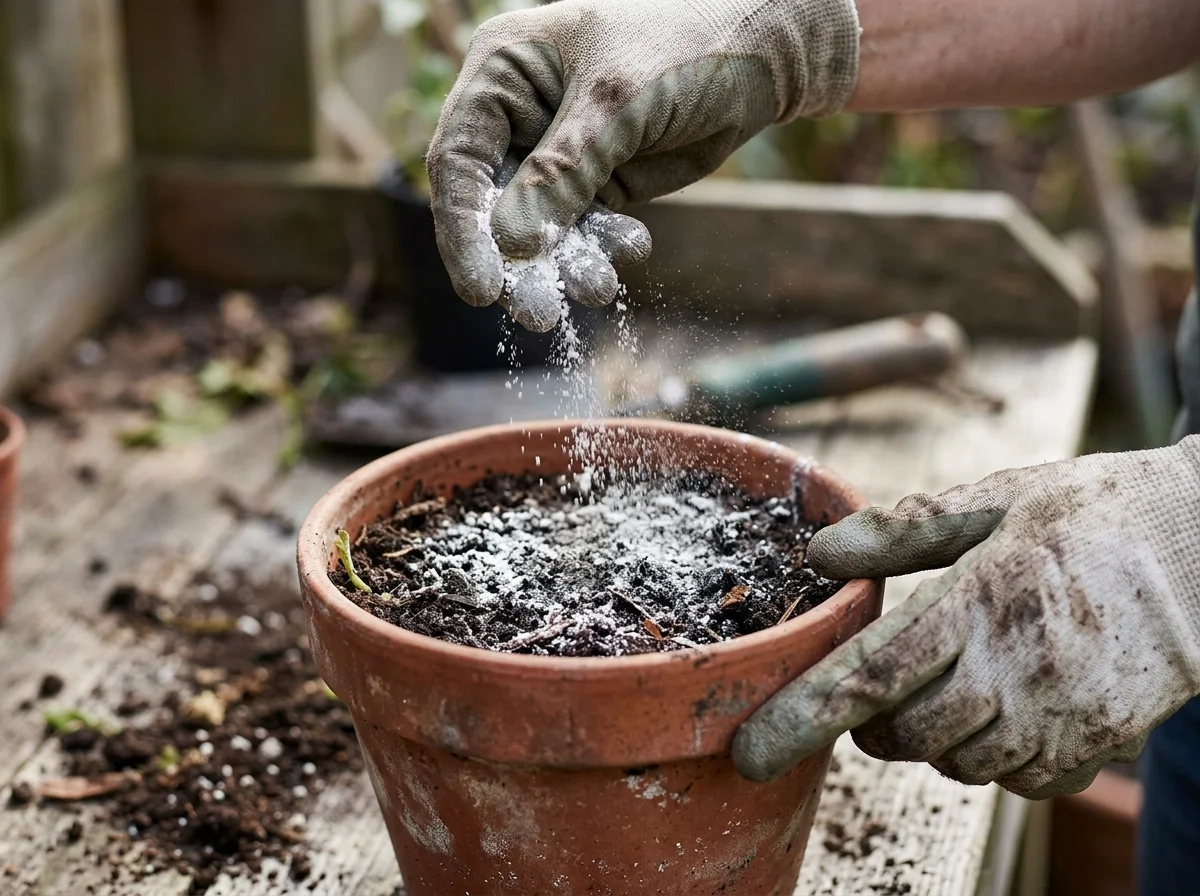
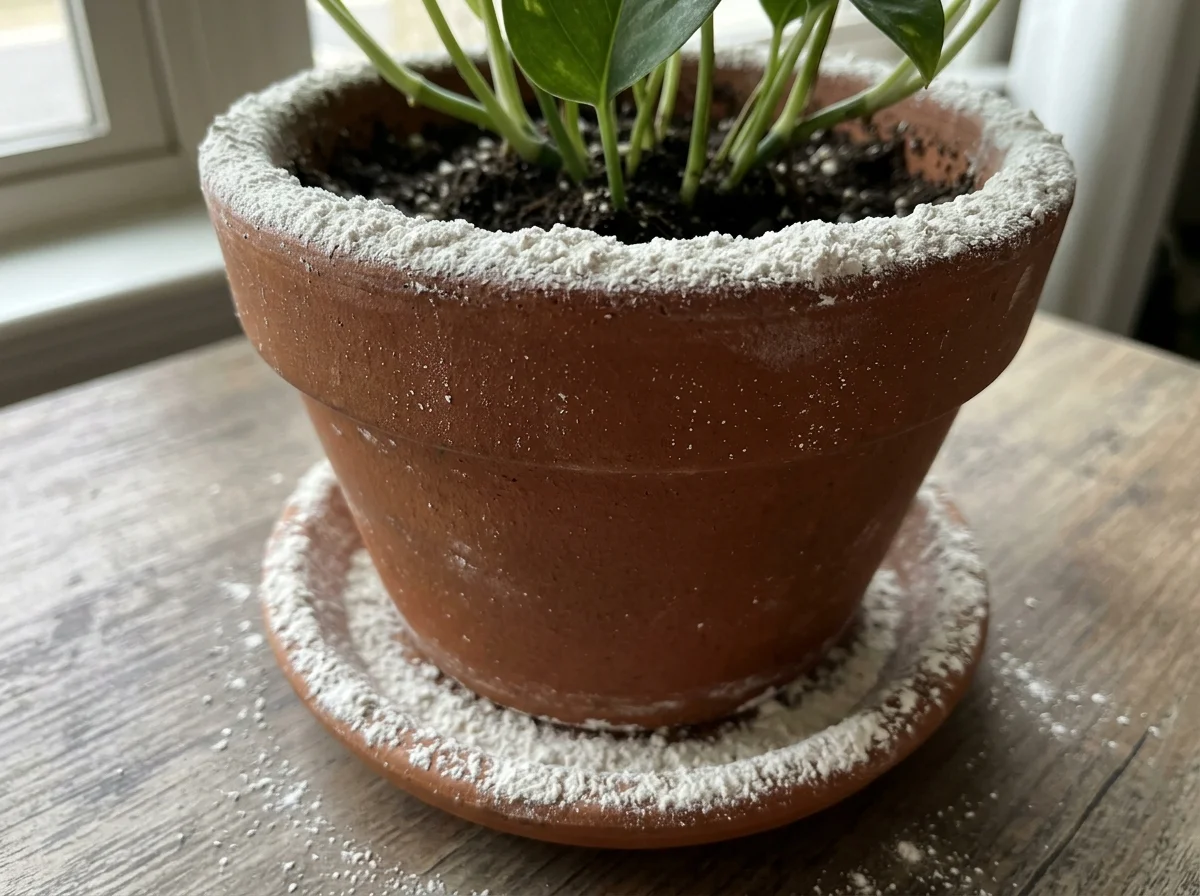
- Dust a fine, even layer over the soil surface - visible as a light white sheen, not a snow drift.
- Ring the pot rim and saucer with DE; adults and crawling larvae cross both.
- Stir the very top of the soil lightly after watering dries, then redust.
| Application mistake | Result | Fix |
|---|---|---|
| Thick layer | Insects walk on loose powder, never abrade | Sift a paper-thin dusting |
| Wet before application | No killing power from the start | Dry first; apply bone-dry |
| Never reapplied | Crusted layer is dead weight | Redust after every watering |
| Piled in saucers holding water | Instantly inactivated | Empty saucers; dust the dry ring only |
| Applied to roots or buried | Wasted product | Keep DE on the surface and rim only |
Reapplication: The Watering Problem and the Bottom-Watering Workaround
Watering is the friction point. Every time you water from above, you bury and cake the layer. Two workarounds keep the barrier alive:
- Bottom watering. Set the pot in a tray of water for 15 to 30 minutes so moisture wicks up through the drainage holes. The top layer of soil - and the DE dusting - stays dry, so the barrier survives untouched. See our guide on how to water houseplants for bottom-watering technique.
- Controlled top watering. Water carefully at the soil’s edge, then wait 1 to 2 hours for the top layer to dry, then redust. Used together with letting the top 2 inches dry between waterings, this keeps infestations starving in roughly one to two weeks [5] (Source: University of Florida IFAS Extension).
A light spray of water to settle the dust after application does not work - the whole point is that wetting it disables it. Apply dry, keep the top surface dry, and let the powder do its job.
Safety: Goggles and a Mask Are Not Optional
DE is one of the safer pest tools for homes, but respirable silica dust is a respiratory irritant. Inhaling clouds of it can irritate the nose, throat, and lungs, and chronic overexposure is a long-term concern for people who apply it daily without protection [6] (Source: National Pesticide Information Center).
- Wear a well-fitting dust mask (an N95 is ideal) and goggles when applying.
- Brush DE off leaves, not onto them, and keep air moving indoors.
- Wait for dust to settle before letting pets or children back into the room.
- Store the bag sealed and away from humid storage rooms.
The 5-Step Integrated Routine That Finishes Gnats for Good
DE is one layer of the plan. This five-step routine breaks the full life cycle - eggs in the soil, larvae feeding, adults flying [7] (Source: University of Maryland Extension).
Step 1: Let the top 2 inches dry. Fungus gnat larvae need consistently moist soil and fungi to eat. Let the top 2 inches of potting mix dry between waterings for one to two weeks. This alone slows or stops breeding. Our guide on fixing an overwatered plant explains how to reset watering habits without drowning the roots.
Step 2: Dust the surface with food-grade DE. As above - thin layer on soil, pot rim, and saucer; reapply after each watering; bottom-water when possible.
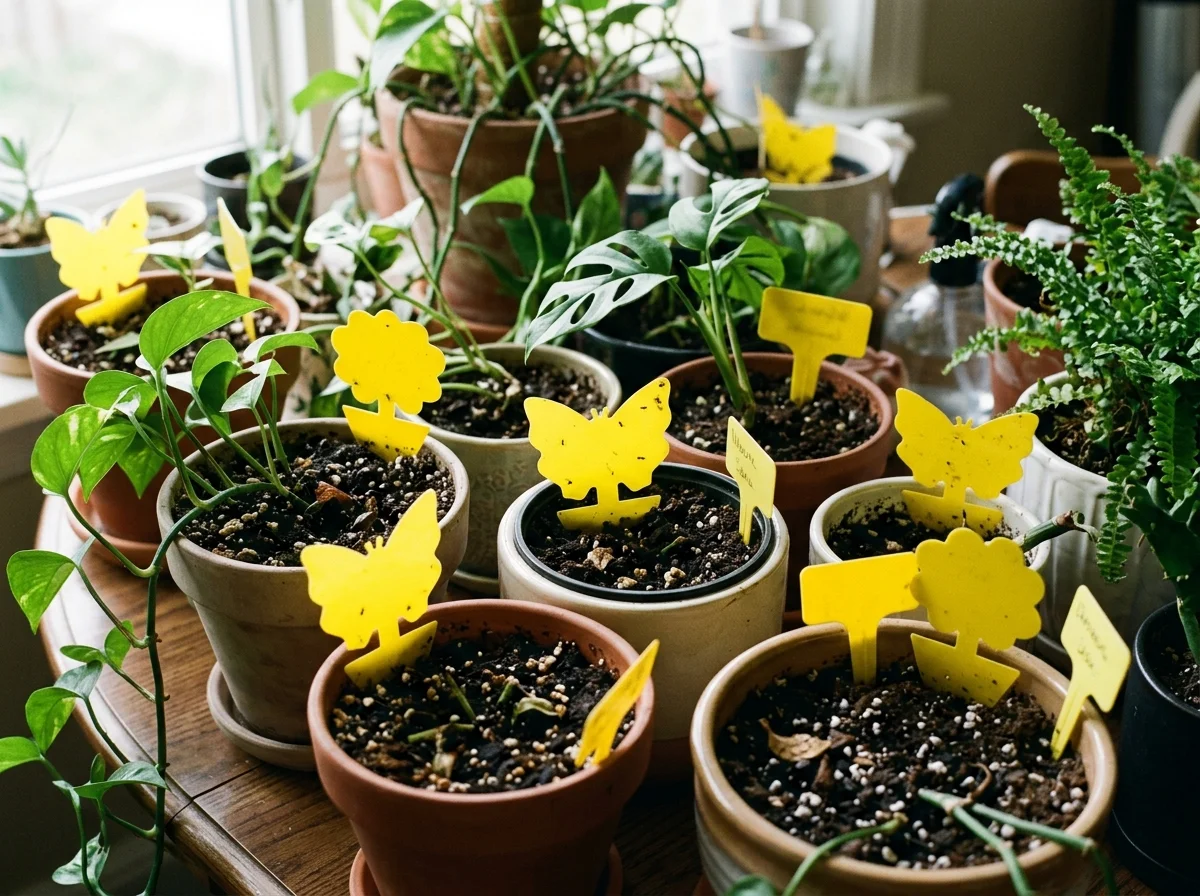
Step 3: Trap the adults with yellow sticky traps. Adult gnats are drawn to bright yellow. Place one trap per large pot or two pots’ worth of small ones, just above the soil. Adults die within a day on the adhesive and the traps double as a monitoring tool - one or two stuck gnats means the population is tapering off.
Step 4: Drench with BTI to kill larvae below the surface. Bacillus thuringiensis israelensis (BTI) is a bacteria toxic only to gnat and mosquito larvae. Soak a piece of mosquito dunk in water for 30 minutes, then use that water to water the soil every week for 3 to 4 weeks. BTI reaches the larvae DE cannot and is the underground half of the attack.
Step 5: Repot severely infested plants. If an infestation has survived four weeks, strip the plant, wash the roots gently, discard the old mix, and repot in fresh, well-draining potting mix. This removes eggs, larvae, and the fungal food source in one move. Our repotting guide walks through the process.
| Method | Kills adults | Kills larvae | Works when wet | Residual effect | Difficulty |
|---|---|---|---|---|---|
| Food-grade DE | Yes, on contact | Top layer only | No | None when wet | Easy, but constant reapplication |
| Yellow sticky traps | Yes | No | Yes | Ongoing while sticky | Very easy |
| BTI / mosquito dunk drench | No | Yes | Designed to be wet | Weeks between drenches | Easy |
| Hydrogen peroxide soil drench | No | Yes, partially | Applied wet | One-time reaction | Easy, but burns roots if overused |
How Long Does Diatomaceous Earth Take to Work?
Adults crossing a dry DE layer die in 24 to 48 hours. Newly emerged gnats will keep appearing for 7 to 14 days because pupae already in the soil are unaffected. Combined with dry soil, sticky traps, and weekly BTI, expect a visible population drop in 1 to 2 weeks and near-elimination in 3 to 4 weeks, matching the fungus gnat life cycle [8] (Source: Royal Horticultural Society).
When DE Is the Wrong Tool
- Chronic overwatering. If the soil never dries, DE cakes every day and you are burning money. Fix watering first - our guide on how to fix an overwatered plant helps.
- Fuzzy or hairy leaves. African violets, jade, and begonias cannot take DE dust on foliage; use it on soil only, or skip it and lean on BTI.
- Continuous rain or high-humidity rooms. Greenhouses, bathrooms, and summer rooms above 60% humidity re-wet the layer overnight. Sticky traps plus BTI outperform DE there.
- Severe infestations. When dozens of gnats swarm daily, DE plus traps is a band-aid. Repot and restart with BTI.
- Outdoor borders in rainy climates. Reapplication after every rain is impractical; reserve DE for patio pots in dry spots.
Common Mistakes
- Using pool-grade DE. Swap to food-grade immediately; pool-grade can injure lungs and scorch leaves.
- Applying thick layers. A heavy dusting cushions gnats; use a barely-visible film.
- Forgetting to reapply after watering. The powder cakes and stops working; redust every time the top layer dries out.
- Treating DE as a cure-all. It kills on contact but leaves eggs and deep larvae; pair it with BTI and sticky traps.
- Getting it on leaves and roots. Brush it off foliage and keep it at the surface; it abrades soft tissue.
- No goggles or mask. Always protect eyes and airways; the dust irritates both.
Troubleshooting
- Gnats still everywhere after a week of DE: the layer is wet or too thick; dry the top inch, rake off the old crust, redust thinly, and add sticky traps.
- New gnats appearing after two weeks: pupae in the soil are emerging; that is normal - keep trapping and drenching with BTI weekly.
- White crust on the soil surface: DE is caked from moisture; scrape it off and switch to bottom watering for two weeks.
- Gnats gone, then back in a month: a fresh batch of eggs arrived in new potting mix or a gift plant; quarantine new plants and repeat the routine.
- Soil surface dry but gnats present: check saucers, overwatered neighbors, and uncovered organic compost tea; one wet pot is enough.

Frequently Asked Questions
Q: Does diatomaceous earth kill fungus gnats?
A: Yes. Food-grade diatomaceous earth kills adult fungus gnats and larvae on contact by cutting their waxy outer coating and drying them out, usually within 24 to 48 hours of direct contact.
Q: Does diatomaceous earth work for fungus gnat larvae?
A: Yes, if the larvae move across a dry dusting in the top half inch of soil. Larvae that burrow deeper, below the layer DE can reach, survive, which is why it works best inside a full routine.
Q: How often should I apply diatomaceous earth for gnats?
A: Reapply a thin layer every time you water, because moisture kills its effectiveness. Expect to refresh the top layer two or three times a week during heavy watering periods.
Q: Is diatomaceous earth safe for pets?
A: Food-grade DE is low in toxicity, but the dust is a respiratory irritant for dogs, cats, and people. Keep pets away until the dust settles, and never use pool-grade DE around animals or plants.
Q: Can I use diatomaceous earth on fuzzy or hairy leaves?
A: No. DE scratches the soft leaf hairs on fuzzy plants like African violets, jade, and begonias and can leave a chalky film that blocks light. Apply it to the soil surface only, or choose BTI for those plants.
Q: Can I use diatomaceous earth outdoors?
A: Yes, but rain, dew, and irrigation wash or cake it, so it needs frequent reapplication and is nearly useless in greenhouse beds that stay humid. Outdoors, focus on covering pot saucers and dry beds.
Q: How long does diatomaceous earth take to work on gnats?
A: Adults that walk through a dry layer die within a day or two. Visible population drops usually show within one to two weeks when DE is combined with dry soil, sticky traps, and a BTI drench.
Q: Should I use pool-grade diatomaceous earth for gnats?
A: Never. Pool-grade DE is heat-treated calcined silica that is much finer, much more dangerous to breathe, and burns plant leaves. Always use food-grade DE labeled for garden or pest use.
Related Articles
- Fungus Gnats: How to Identify and Get Rid of Them
- How to Get Rid of Fungus Gnats
- Garden Pest Control for Beginners
- How to Water Houseplants
- How to Fix an Overwatered Plant
- How to Repot Indoor Plants
- How to Fix Yellow Leaves
- Common Plant Problems
Sources & References
- University of Maryland Extension - Fungus Gnats
- University of California IPM - Fungus Gnats
- Colorado State University Extension - Fungus Gnats
- University of Florida IFAS Extension - Fungus Gnats
- National Pesticide Information Center - Diatomaceous Earth
- Royal Horticultural Society - Fungus Gnats
- Environmental Protection Agency - Diatomaceous Earth
