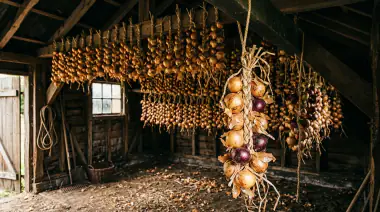

Onions are the crop that taught me that feeding is a calendar, not a recipe. For two seasons I fed my onion bed the same way I fed tomatoes — a good balanced dose at planting and a top-up whenever the leaves looked tired — and I harvested handsome green tops attached to bulbs the size of golf balls. The plants were not starving. They were confused. I had kept them in leaf mode exactly when they needed to switch to bulb mode.
The switch is the whole story with onions. In the first half of the season, nitrogen builds the leaf area that will manufacture the sugars for the bulb. In the second half, that nitrogen becomes a liability. If it is still available when the bulb starts to swell, the plant keeps pushing leaves and thick necks instead of firm, storage-ready bulbs. The timing of the last feed matters more than the strength of the first.
This guide covers the schedule I use now: what to put in the bed before planting, when to side-dress, how much per square foot in a raised bed, and how to read the leaves when something is wrong. It also explains why the variety you choose matters more than any fertilizer bag, because no feeding program can override day length.
Quick Answer: Mix about ¼ cup of 10-10-10 per 10 square feet into a raised bed before planting, along with 2 to 3 inches of compost. Side-dress with nitrogen at three weeks and again at six weeks, using ¼ cup per 10 feet of row. Stop all nitrogen when the tops begin to yellow and fall over, about four to six weeks before harvest, and keep watering steadily until the necks soften.
At a Glance
| Fact | Details |
|---|---|
| Best base feed | 10-10-10 or 5-5-5 |
| Preplant rate | ¼ cup per 10 square feet |
| Side-dress | ¼ cup per 10 feet of row |
| First side-dress | 3 weeks after planting |
| Second side-dress | 6 weeks after planting |
| Stop nitrogen | When tops start to fall |
| Soil pH | 6.0–6.8 |
| Water | About 1 inch per week |
| Harvest | 90–120 days, depending on type |
Why onions are a timing crop
An onion is a biennial. In its first year it builds leaves, then stores energy in a bulb so it can flower the following spring. Everything we do in the garden is aimed at making that first-year bulb as large and firm as possible.
Nitrogen drives leaf growth. That is exactly what you want for the first six to eight weeks, because every extra leaf is a solar panel that will feed the bulb later. But once the bulb begins to swell, the plant needs to stop making new leaves and start moving sugar downward. Nitrogen at that moment restarts the leaf program. The result is a thick, soft neck, a smaller bulb, and poor storage.
The signal to stop is visible. The tops stop standing straight up and begin to yellow at the tips. The bulb shoulders start to push out of the soil. That is the moment to switch to water only.
Day length matters more than fertilizer
Before you worry about N-P-K, check your variety. Onions are classified by the number of daylight hours that trigger bulbing:
- Long-day onions need 14 to 16 hours of daylight. They are the right choice for northern latitudes with long summer days.
- Short-day onions bulb at 10 to 12 hours. They suit southern gardens and mild winters.
- Intermediate or day-neutral types bulb around 12 to 14 hours and are more flexible.
If you plant a long-day variety in a southern garden, it will make leaves all summer and never bulb, no matter how you feed it. If you plant a short-day variety in the north, it may bulb too early, before it has enough leaf area to size up. Match the variety to your latitude first, then tune the fertilizer.
What each nutrient does for onions
Nitrogen builds leaves and pushes early growth. It is the nutrient that most affects final bulb size, but only when it is supplied early and withdrawn on time. Too much late nitrogen is worse than too little.
Phosphorus supports root development and early establishment. Onions are not heavy phosphorus feeders, but cold spring soil can lock it up, so it needs to be in the bed before planting.
Potassium supports bulb filling, skin quality and storage life. It becomes more important as the bulb swells.
Sulfur is what gives onions their pungency. The same sulfur compounds that make you cry also help the bulb resist rot in storage. Most soils have enough, but sandy soils low in organic matter can run short.
Calcium is linked to cell strength and neck quality. It moves with water, so steady irrigation matters more than adding calcium to the soil.
The feeding schedule by stage
| Stage | Timing | What to apply | Why |
|---|---|---|---|
| Bed preparation | 2 weeks before planting | ¼ cup 10-10-10 per 10 sq ft + 2–3 in compost | Builds the reserve for early growth |
| Establishment | 3 weeks after planting | ¼ cup per 10 ft row | Supports leaf growth |
| Active growth | 6 weeks after planting | ¼ cup per 10 ft row | Keeps leaves building |
| Bulb initiation | Tops start to yellow | No nitrogen | Lets the plant switch to storage |
| Bulb swelling | 2–3 weeks later | Water only, or kelp at half strength | Supports size without soft necks |
If you garden in a cold climate with a short season, the second side-dress may be the last one. If you garden where onions overwinter, the schedule shifts: feed in late winter as growth resumes, then stop when the days lengthen and bulbs begin to form.
Preparing the bed
Onions do best in loose, well-drained soil with plenty of organic matter. Their roots are shallow and weak compared with tomatoes or squash, so compacted soil is a real limitation.
For a raised bed, spread 2 to 3 inches of finished compost over the surface and work it into the top 6 to 8 inches. Then apply ¼ cup of 10-10-10 per 10 square feet and rake it in evenly. Do not leave fertilizer in a pile; onion roots are shallow and can burn.
Check pH before planting. Onions prefer 6.0 to 6.8. If your pH is below 5.5, add lime in the fall before the season you plan to plant. If it is above 7.0, add elemental sulfur according to the label and give it a few weeks to act.
Plant sets, transplants or seedlings shallowly. The bulb should sit just at the soil surface, not buried. Deep planting produces thick necks and small bulbs.
The step-by-step feeding schedule
Step 1: Two weeks before planting
Mix the compost and base fertilizer into the bed. Water it in and let the bed settle. If you are using a granular organic feed such as 4-4-4, use about twice the volume because the nutrient concentration is lower.
Do not add fresh manure. It is too rich in soluble nitrogen, can carry weed seeds, and may introduce disease. Finished compost is the safer choice.
Step 2: Three weeks after planting
Scratch ¼ cup of 10-10-10 per 10 feet of row into the surface beside the plants, not on top of them. Water gently. The roots are shallow, so the fertilizer needs to be within the top few inches.
If the leaves are pale and the plants are not growing, a liquid fish emulsion at half strength is a gentler alternative. Apply it in the morning and water it in.
Step 3: Six weeks after planting
Repeat the side-dress. By now the plants should be standing tall with five to seven leaves. This is the last nitrogen application for most gardeners.
If you are growing overwintering onions, this is the point to stop and let them go dormant. Resume feeding in late winter when new growth appears.
Step 4: When the tops start to fall
Stop nitrogen. The bulb shoulders will begin to push out of the soil, and the tops will yellow at the tips. This is the signal that the plant is moving sugar into storage.
Keep watering, but reduce the amount slightly. Do not stop watering completely until the tops have fallen and the necks have softened. Dry soil at this stage can stop bulb filling early.
Step 5: Harvest and cure
Lift the bulbs with a fork when about half the tops have fallen. Do not pull them by the stem; you will tear the neck and open the bulb to rot. Leave them on the surface to dry for a few days if the weather is dry, then move them to a shaded, airy place to cure for two to three weeks.
Curing is part of the feeding story. A bulb that was pushed with late nitrogen will have a thick, soft neck that never dries properly. That is why the last feed matters as much as the first.
How much fertilizer per bed size
| Bed size | Base 10-10-10 | Compost | Side-dress per application |
|---|---|---|---|
| 4 × 4 ft (16 sq ft) | ⅓ cup | 2–3 in | ⅓ cup per 10 ft row |
| 4 × 8 ft (32 sq ft) | ¾ cup | 2–3 in | ⅓ cup per 10 ft row |
| 10 ft row | ¼ cup per 10 sq ft | 2–3 in | ¼ cup |
| 1 container (5 gal) | 1 tbsp | 1 handful | 1 tsp every 3 weeks |
Onions are not usually grown in small containers, but they can be. Use a pot at least 8 inches deep and keep the mix evenly moist. Container onions need more frequent, weaker feeding because the nutrients leach out quickly.
Organic options
Compost is the backbone. Onions respond well to generous compost because it improves soil structure and supplies a steady, low level of nutrients.
Blood meal is a fast nitrogen source, usually 12-0-0. Use it early, at about 1 tablespoon per square foot, and water it in. Do not use it after the bulbs begin to swell.
Fish emulsion is a gentler liquid nitrogen feed at around 5-1-1. Apply at half strength every two weeks during the leaf-building stage.
Bone meal is a slow phosphorus source. Mix 1 cup per 10 square feet into the bed before planting if your soil test shows low phosphorus.
Kelp meal supplies potassium and trace minerals. A light application at bulb initiation supports sizing without pushing leaves.
Wood ash supplies potassium and raises pH. Use it only if your pH is below 6.0, and never more than a light dusting. Onions do not need much.
Signs you are over-feeding
- Thick, soft necks at harvest. Late nitrogen. The bulbs will not store well.
- Huge tops, small bulbs. Too much nitrogen relative to phosphorus and potassium.
- Burnt leaf tips after feeding. Fertilizer burn. Water heavily to leach the salts.
- Delayed maturity. The tops stay green and upright past the normal harvest window.
- Split or doubled bulbs. Often a sign of uneven growth from excess nitrogen and irregular water.
If you over-feed early, you can sometimes correct it by stopping nitrogen immediately and watering deeply. If you over-feed late, there is no fix; harvest, cure carefully, and use those bulbs first because they will not keep.
Signs you are under-feeding
Pale, thin leaves, slow growth and small bulbs with thin skins are the classic signs. Onions are not dramatic about hunger; they simply grow slowly. If the plants have been in the ground for a month and still look like thin blades, a half-strength liquid feed will usually wake them up.
Do not confuse slow growth with a nutrient problem. Cold soil, compacted soil and weed competition all slow onions down. Check those first.
Watering and pH
Onions need about 1 inch of water per week, including rain. Water deeply once or twice a week rather than lightly every day. Shallow watering encourages shallow roots and makes the plants more vulnerable to drought.
Stop watering about a week before harvest if the weather is dry, so the necks can begin to dry. In wet weather, harvest promptly and cure under cover.
Keep pH between 6.0 and 6.8. At that range, phosphorus and micronutrients are available and the soil biology that supports onion roots is active.
Frequently Asked Questions
Q: What is the best fertilizer for onions?
A: Use a balanced feed such as 10-10-10 at planting, then side-dress with nitrogen every three to four weeks until the bulbs begin to swell. Stop nitrogen at that point and let potassium and phosphorus finish the bulbs.
Q: When should I stop fertilizing onions?
A: Stop nitrogen about four to six weeks before harvest, when the tops start to yellow and fall over. Late nitrogen keeps the necks thick and soft, which makes bulbs store badly and rot in the cellar.
Q: How much fertilizer do onions need in raised beds?
A: Mix about a quarter cup of 10-10-10 per 10 square feet into the bed before planting, plus two to three inches of compost. Side-dress with a quarter cup per 10 feet of row at three weeks and again at six weeks.
Q: Why are my onions all tops and no bulbs?
A: Too much nitrogen, too little sun, or the wrong day-length type for your latitude. Onions bulb in response to day length, not fertilizer. If the variety needs more hours of daylight than your summer provides, no amount of feeding will make a bulb.
Q: Do onions need sulfur fertilizer?
A: Onions use sulfur to build the pungent flavor compounds that also improve storage. Most soils supply enough, but a sulfur shortage shows as pale, thin leaves. Compost and balanced fertilizer usually cover it; avoid heavy applications that lower pH too far.
Related Articles
- How to Store Onions
- Best Fertilizer for Vegetable Gardens
- NPK Ratios for Vegetables
- Heavy Feeder Vegetables
- When to Fertilize Vegetables
- How to Improve Garden Soil
- Vegetable Garden Fertilizer: N-P-K Explained & How to Feed
Sources & References
- University of Minnesota Extension — https://extension.umn.edu/vegetables
- Cornell Vegetables — https://www.vegetables.cornell.edu/
- Clemson HGIC — https://hgic.clemson.edu/
- University of California IPM — https://ipm.ucanr.edu/
- Penn State Extension — https://extension.psu.edu/