Spider mites on houseplants are easy to miss until damage is everywhere. One week your calathea looks dusty, the next its leaves are bronzed and strung with silk. This guide covers early signs, a 30-second test, and a 3-step routine that breaks their cycle, plus our overview of common plant problems.
Quick Answer: To get rid of spider mites on houseplants, isolate the plant, blast it with a shower or sink sprayer focusing on leaf undersides, then spray insecticidal soap or neem oil over tops and undersides until dripping. Repeat every 5-7 days for 3-4 weeks, raise humidity to 50-60%, wipe leaves weekly, and hold fertilizer until clean new growth appears.
At a Glance
| Fact | Detail |
|---|---|
| Pest | Two-spotted spider mite, Tetranychus urticae (arachnid) |
| Size | About 0.4 mm, like salt; 8 legs, oval body |
| First signs | White or yellow specks (stippling), dull leaves, fine silk |
| Confirmation | Tap leaf over white paper; crawling dots are mites |
| Loves | Air above 75°F (24°C), humidity below 40% |
| Cure | Shower blast plus soap or neem, every 5-7 days, 3-4 weeks |
| Humidity goal | 50-60%; group plants, use pebble trays |
What Spider Mites Actually Are
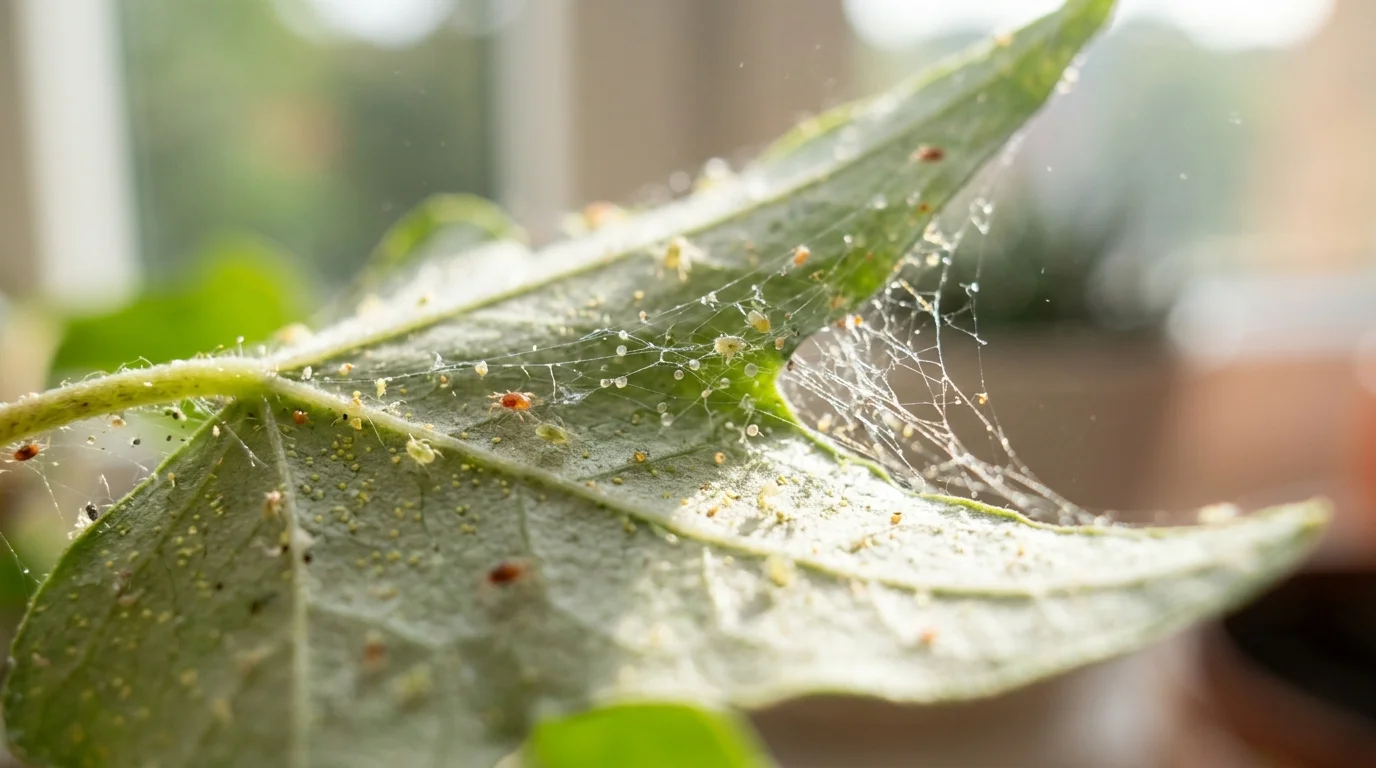
Spider mites on indoor plants are almost always the two-spotted spider mite, Tetranychus urticae. They are not insects but tiny 8-legged arachnids, about 0.4 millimeters long [1] (Source: University of Minnesota Extension).
Adults are pale green with two dark back spots. Eggs are clear to amber on leaf undersides. One female lays over 100 eggs in 2 to 4 weeks, so light problems explode fast.
At 75-80°F (24-27°C), egg to adult takes 5 to 20 days, with hatch in 3 to 5 days [2] (Source: University of California IPM). Outdoors winter resets them; indoors generations overlap on one leaf. They pierce leaf cells and suck the contents, leaving white dots that merge into bronze patches.
Early Signs of Spider Mites on Houseplants
You will see damage before you ever see the mites. Check for spider mite webs on plants last, because visible webbing is a late sign, not an early one.
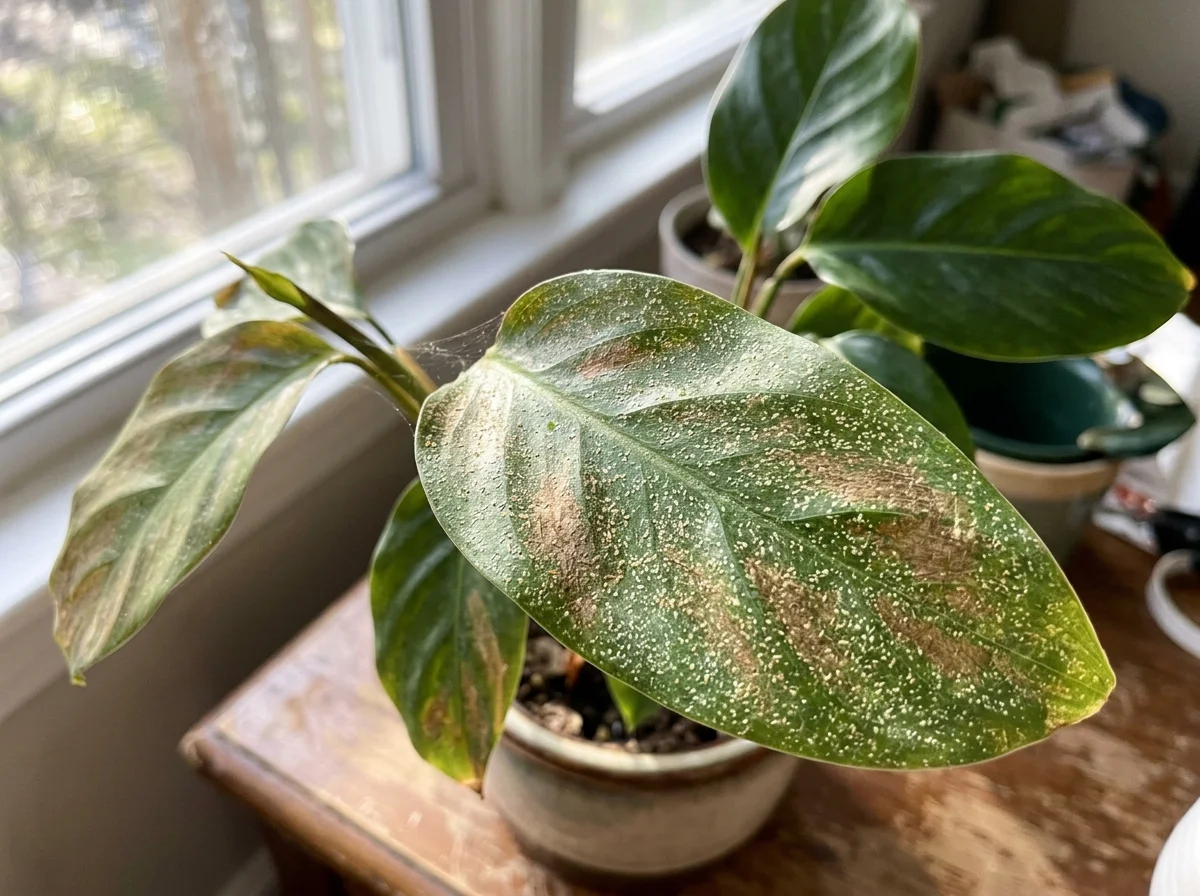
- Stippling: tiny white or yellow specks. The most reliable early sign. Hold the leaf to good light and look for hundreds of pinprick pale dots. On citrus and ficus it looks like flour dust.
- Dull, dusty leaves. Leaves lose shine and look gray or papery, even after watering. A glossy palm turning flat is a warning.
- Bronzing leaves. Dying patches along midribs and edges turn tan or bronze. Bronzed tissue never turns green again.
- Fine webbing. Check where leaves meet stems and between crowded new leaves. Mite silk is far finer than spider webs. Obvious webs mean high populations.
- Leaf drop and stunted growth. Damaged leaves yellow, curl, crisp, and fall; new leaves emerge small. A croton can drop 20 leaves in a week.
Unsure if speckles are pests or care issues? Our how to fix yellow leaves guide rules out watering causes first.
The Paper Test: Confirm Mites in 30 Seconds
Spider mites on houseplants are nearly invisible without magnification, so use the white paper test recommended by extension services [1] (Source: University of Minnesota Extension).
- Hold white paper under a suspect leaf.
- Tap the leaf top firmly 3 to 4 times.
- Watch fallen specks 10 to 15 seconds; crawling pepper-dust dots are mites.
Test 3 to 5 leaves per plant, including lower leaves where infestations start. Test neighbors too. If leaves touch, assume mites already crossed over.
A 10x hand lens, about $8 to $12, shows oval bodies and pearl-like eggs along veins. Repeat the paper test weekly to confirm treatment is working.
Why They Explode in Hot, Dry Indoor Air
Spider mites love what heated homes become in winter: warm, dry, and still. Heating drops humidity to 20-30%, while mites breed fastest below 40% humidity and above 75°F (24°C). Dry air speeds hatch to 3 to 5 days [3] (Source: Clemson University Cooperative Extension).
Three habits make it worse. Plants 2 to 3 feet from heat vents sit in 80°F dry air. Skipping leaf cleaning for 4 to 6 weeks lets dust and eggs build up, since no rain washes indoor leaves. Winter over-fertilizing pushes soft growth that mites pierce easily.
Drought stress adds to it, warming leaves and weakening defenses. Keep moisture steady with our how to water houseplants guide. Raising humidity to 50-60% will not kill mites alone, but it slows breeding. Treat humidity as a brake pedal, not a cure.
Most Vulnerable Houseplants
Any plant can host spider mites on indoor plants, but thin-leaved tropicals get hit first. Check these every 1 to 2 weeks in winter.
| Plant | Why mites target it | Damage pattern |
|---|---|---|
| Palms (parlor, majesty) | Frond crevices near warm windows | Speckled fronds, brown tips, silk between leaflets |
| Calathea and maranta | Thin leaves needing humidity | Fading pattern, bronzed curling edges |
| English ivy | Dense dry winter growth | Gray speckled leaves, tip webs, drop |
| Croton | Big leaves, soft fertilized flush | Dulling color, lower leaf drop |
| Ficus (fiddle-leaf, benjamina) | Large leaf area, draft stress | Pinpricks above, bronzing below |
| Citrus and hibiscus | Tender indoor flush | Distorted leaves, bud drop, webbed buds |
New plants are the top way mites enter. Quarantine every newcomer 14 to 21 days, at least 6 feet from other plants, and paper-test twice. For tougher picks, see our best low-maintenance indoor plants list.
Step 1: Isolate and Blast With Water
Start with water, not chemicals. A thorough rinse knocks off 60-80% of mites and webbing at once and exposes survivors for spraying.
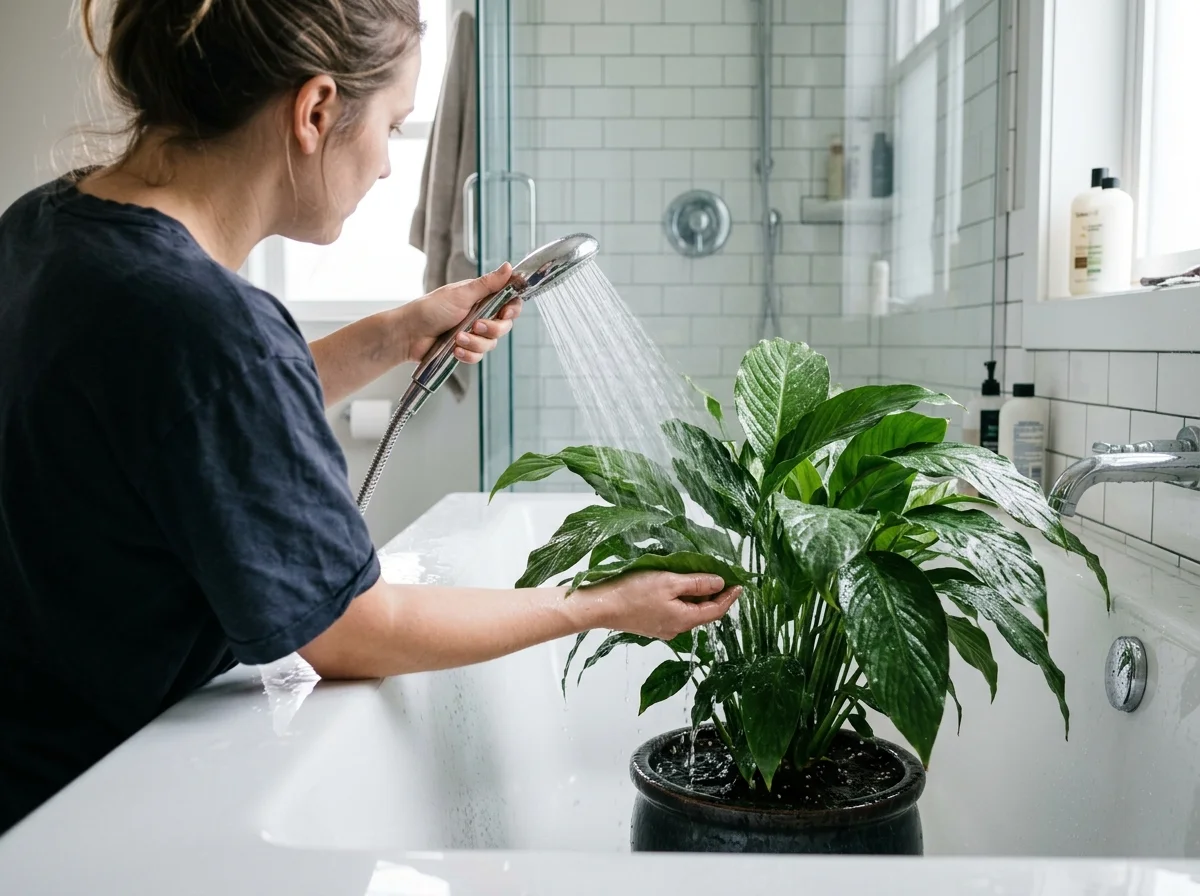
- Isolate at once. Move the plant to a shower or tub without brushing healthy leaves.
- Prune the worst leaves. If a leaf is over 70% bronzed or matted in silk, snip it, bag it, and trash it.
- Blast 2 to 3 minutes. Use a shower or sink sprayer on medium pressure, holding leaves up to hit undersides. Cover soil with plastic wrap.
- Work crevices. Spray upward into midribs, petiole joints, and between palm leaflets.
Drip-dry in isolation and keep it from the group for 3 to 4 weeks. For fragile plants, wipe tops and undersides with a damp cloth. Water alone never ends it, but it makes Step 2 far more effective.
Step 2: Treat With Soap or Neem Oil
Once dry, 1 to 2 hours after rinsing, apply the main treatment. For spider mite treatment on houseplants, insecticidal soap or neem oil beats general insecticides, because mites are arachnids many insect formulas miss [2] (Source: University of California IPM).
Insecticidal soap: Ready-to-use houseplant soap, or 2.5 tablespoons castile soap per gallon. Spray to dripping, especially undersides. Contact only.
Neem or horticultural oil: Label rate, usually 1 to 2 tablespoons neem per gallon plus 1 teaspoon mild soap, shaking often. Smothers mites and eggs. Test one leaf for 48 hours on calathea or ferns; never spray above 85°F.
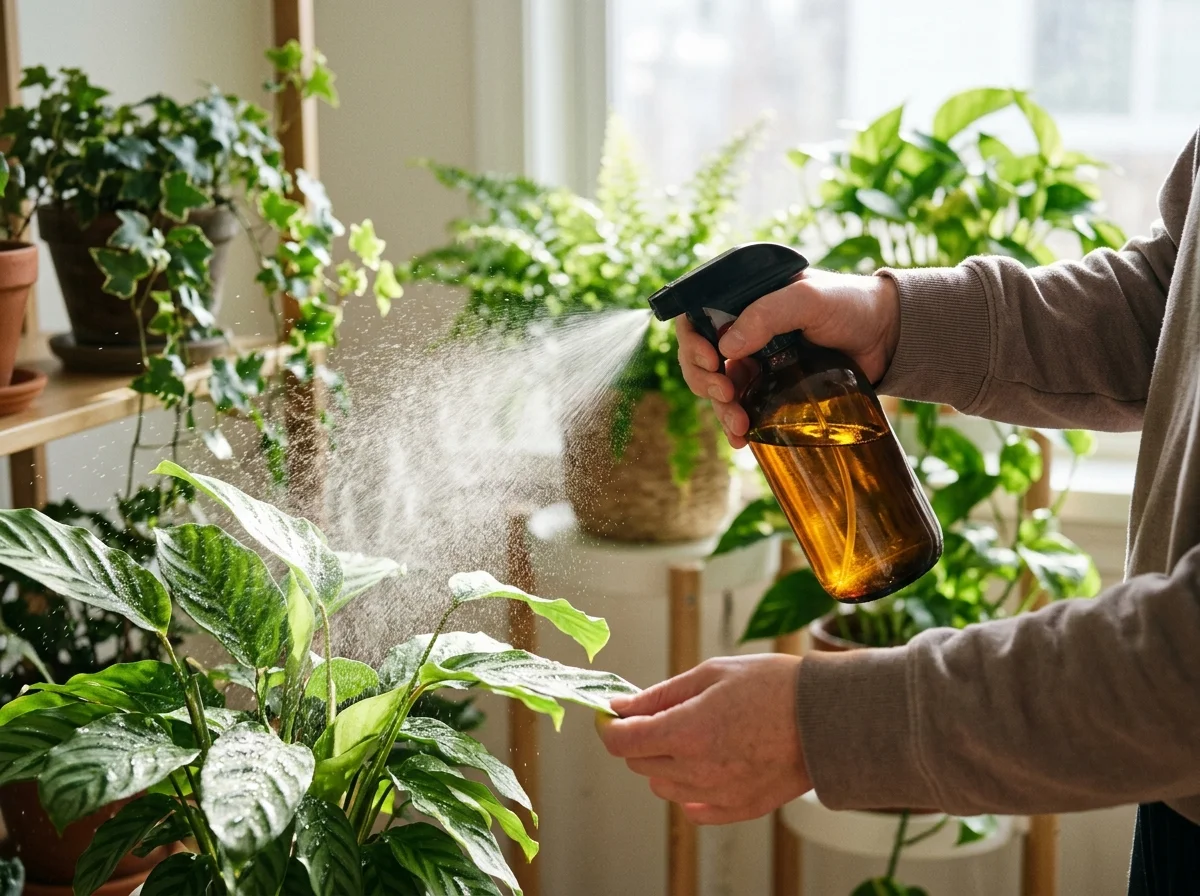
Spray evenings, cover tops, undersides, stems, and new growth, and keep from sun until dry in 2 to 4 hours. See our garden pest control for beginners guide for product help.
Treatment Options Compared
| Option | Best for | Pros | Cons |
|---|---|---|---|
| Water blast | First step, all cases | Free, 60-80% knockdown | Misses some eggs |
| Insecticidal soap | Light to moderate cases | Low toxicity, cheap | Contact only |
| Neem / horticultural oil | Moderate cases | Smothers eggs | Can burn leaves |
| Diluted 70% alcohol 1:1 | Spot treatment | Precise instant kill | Dries leaves |
| Miticide labeled for mites | Severe cases, last resort | Strongest knockdown | Toxicity, resistance risk |
Save miticides for last resort. Broad insecticides with carbaryl or pyrethroids can flare mites by killing predators [4] (Source: Colorado State Extension). Use only products labeled for spider mites.
Step 3: Repeat Every 5-7 Days for 3-4 Weeks
This step decides everything. No home spray kills all eggs. At 72-78°F survivors hatch in 3 to 5 days and lay eggs by day 7 to 10. One spray kills adults today and leaves a fresh generation next week.
Treat every 5 to 7 days for 3 to 4 weeks, or 4 to 6 total treatments, catching each hatch before it breeds.
4-Week Spider Mite Treatment Plan
| Timing | Action | Check |
|---|---|---|
| Day 0 | Isolate, prune, shower 2-3 min, spray soap or neem | Paper test to confirm |
| Day 5-7 | Shower or wipe, re-spray undersides | Fresh vs old damage |
| Day 12-14 | Shower or wipe, re-spray, check neighbors | Mites should be fewer |
| Day 19-21 | Shower or wipe, re-spray, wash sill | No webs or moving dots |
| Day 26-28 | Final spray if mites remain; if clean, wait 7 days | Two clean tests = done |
Skip fertilizer throughout. Resume half-strength feed only after 2 to 3 weeks of clean new leaves. A 14-day gap restarts the count.
Rubbing Alcohol and Pruning for Light Cases
Caught early, with stippling on 2 to 3 leaves and no webbing, spot treatment plus pruning can contain spider mites on indoor plants.
Rubbing alcohol: Mix 70% isopropyl alcohol 1:1 with water. Dab clusters on undersides with a swab, discarding swabs as you go. Rinse thin leaves after 1 to 2 hours. Test one leaf for 48 hours first. Never drench whole plants.
Pruning: Remove leaves over half bronzed, cutting at the petiole base with alcohol-wiped scissors. Never remove more than 25-30% at once. Bag and trash waste.
Both are helpers, not replacements. Follow with at least 2 to 3 weekly soap or oil sprays.
Humidity and Prevention That Works
Spraying fails if conditions still favor mites. Aim to keep humidity up and catch the next introduction early.
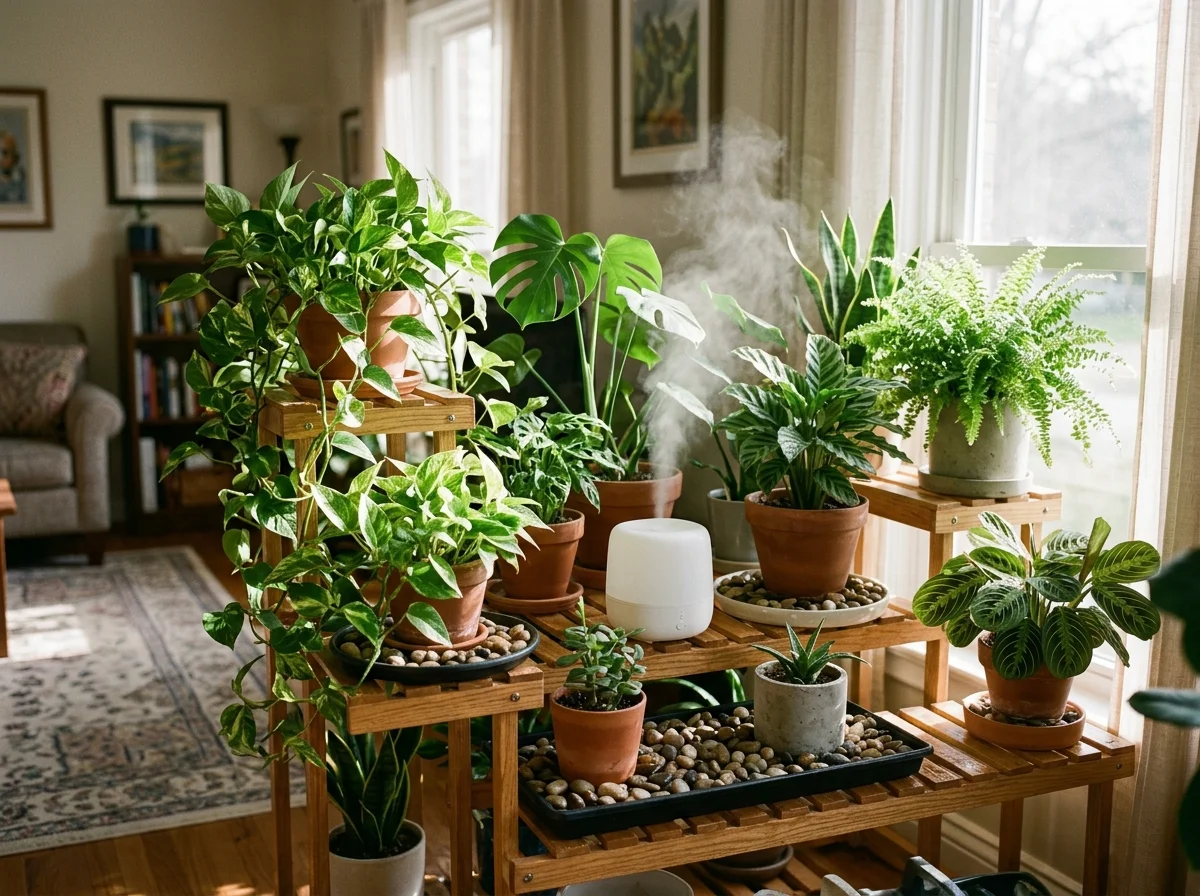
- Hold 50-60% humidity. Group plants, use pebble trays with water below pebble tops, and run a humidifier 6 to 8 hours daily in dry rooms.
- Wipe leaves every 1 to 2 weeks. Damp microfiber top and bottom removes eggs. Rotate a third of big collections weekly.
- Mist only as backup. Morning mist helps 20 to 30 minutes; let leaves dry by evening.
- Space pots and quarantine. Keep 2 to 3 inches apart, isolate newcomers 14 to 21 days, and paper-test day 1 and 14. See our common plant problems guide.
When to Throw the Plant Away
Sometimes discarding one plant saves twenty. Do it if over 70% of leaves are bronzed or webbed, live mites persist after 4 weekly treatments with stunted growth, or the plant was already rotting with no growth in 6 to 8 weeks.
Bag the plant and pot before carrying past others. Do not compost it or reuse soil. Scrub reusable pots with hot soapy water plus a 1:10 bleach rinse.
Common Mistakes
- Spraying only once. The fix: 4 to 6 sprays every 5-7 days for 3-4 weeks.
- Spraying tops only. The fix: lift each leaf; spray undersides to dripping.
- Fertilizing a stressed plant. The fix: hold feed 3-4 weeks; resume half strength later.
- Using broad insecticides. The fix: use soap, oil, or labeled miticide, not carbaryl [4] (Source: Colorado State Extension).
- Regrouping too soon. The fix: isolate 4 weeks plus 7 clean days.
- Misting instead of treating. The fix: humidity supports; showering plus spraying cures.
Troubleshooting
- Webbing back in 3 days: coverage missed; re-shower and re-spray undersides.
- Brown edges after neem: oil burn; move from sun 48 hours, use low rate next time.
- Mites on every plant: treat the whole shelf on the same cycle; wash shelves.
Frequently Asked Questions
Q: How do I know if my houseplant has spider mites?
A: Look for tiny white or yellow speckles called stippling, fine webbing where leaves meet stems, and moving dots on white paper after tapping a leaf over it.
Q: How do I get rid of spider mites on indoor plants fast?
A: Isolate the plant, blast leaf undersides with a strong shower, then spray insecticidal soap or neem oil. Repeat every 5 to 7 days for 3 to 4 weeks.
Q: Does neem oil kill spider mites on houseplants?
A: Yes, neem oil kills spider mites on contact and disrupts feeding when coverage is thorough. Coat leaf undersides fully and reapply every 5 to 7 days for 4 treatments.
Q: Will spider mites spread to other houseplants?
A: Yes, they spread by crawling, on air currents, and when leaves touch. Isolate infested plants at once and check neighbors weekly with the paper test.
Q: Why do spider mites keep coming back?
A: Eggs survive the first spray and hatch in 3 to 5 days in warm rooms. Repeat treatment every 5 to 7 days for 3 to 4 weeks to break the cycle.
Q: Can a plant recover from spider mites?
A: Yes, most recover if half the leaves are still green and firm. Give bright indirect light, steady watering, and no fertilizer for 3 to 4 weeks.
Q: Does misting prevent spider mites?
A: Misting alone does not prevent them, but 50 to 60 percent humidity slows them. Combine grouping, pebble trays, and weekly leaf wiping.
Q: Should I throw away a plant with spider mites?
A: Discard it if over 70 percent of leaves are bronzed or webbed, or growth stays stunted after 4 weeks of treatment. Bag it before moving it.
Related Articles
- Common Plant Problems
- How to Fix Yellow Leaves
- How to Water Houseplants
- Best Low-Maintenance Indoor Plants
- Garden Pest Control for Beginners
- How to Fix Overwatered Plant
- How to Repot Indoor Plants
- How to Get Rid of Fungus Gnats
