Grow lights for indoor plants solve the one problem a windowsill cannot: winter, north-facing rooms, and offices that never get enough usable sunlight. A good fixture does more than keep leaves alive. It keeps variegation sharp, stems compact, herbs productive, and seedlings stocky instead of stretched.
The catch is that most grow-light shopping advice is written for commercial growers or cannabis setups. This guide translates it for houseplants: how much light your plants actually need, which fixture type makes sense, how far to hang it, how long to leave it on, and how to tell within two weeks whether the setup is working.
Quick Answer: For most indoor plants, use a full-spectrum white LED that delivers roughly 150 to 300 PPFD for 12 to 14 hours per day. Hang it 12 to 24 inches above the canopy, connect it to a timer, and adjust the height or dimmer based on how the plant responds. Low-light plants need less; herbs, succulents, and fruiting plants need more.
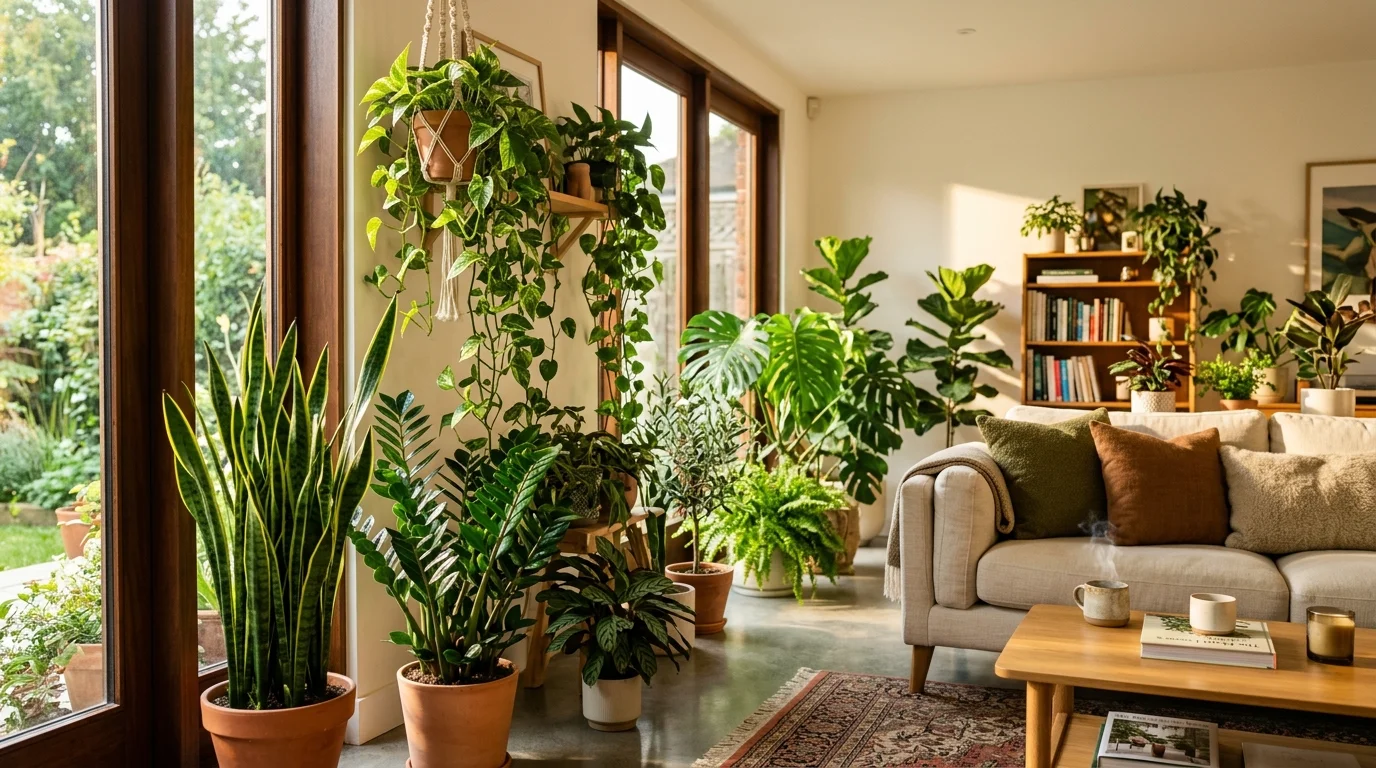
Do You Actually Need a Grow Light?
A grow light is worth buying when a plant is not just surviving but visibly stretching, fading, or stalling. Look for these clues:
- Leggy growth. New stems are long, thin, and widely spaced, with small leaves at the tips. The plant is reaching for light.
- Pale or yellow-green new leaves. Healthy new growth should be at least as deep in color as the older leaves, unless the plant is naturally variegated.
- No new growth for months. Many houseplants slow down in winter, but a plant that never pushes a new leaf through spring is light-starved.
- Variegation fading. White, cream, or pink markings disappear when a plant is kept too dark.
- Flower buds dropping or herbs losing flavor. Herbs and flowering plants need more energy than foliage plants.
- A room with no window, or a window that gets less than 2 to 3 hours of direct sun. Reflected light from a bright wall helps, but it is rarely enough for high-light plants.
You do not need a grow light for every plant. A pothos or snake plant can live in a dim corner for years. But if you want that plant to grow well rather than merely endure, light is the first thing to fix, before fertilizer or a new pot.
How Plants Measure Light (Skip the Marketing Watts)
Grow-light labels are full of numbers that do not mean what beginners assume. Here is the short version.
PAR, PPFD, and DLI
- PAR (photosynthetically active radiation) is the part of the light spectrum plants use for photosynthesis, roughly 400 to 700 nanometers.
- PPFD (photosynthetic photon flux density) measures how much usable light reaches a surface each second, in micromoles per square meter per second (µmol/m²/s). It is the number to compare between fixtures.
- DLI (daily light integral) is the total light delivered over a full day, in moles per square meter per day (mol/m²/day). It combines intensity and duration, and it is the best single number for matching a light to a plant.
A fixture can have a high PPFD at the center and almost nothing at the edges. That is why a PPFD map, not a single peak number, matters for a shelf or a group of plants.
The DLI formula
If you know the average PPFD and the hours of light, you can estimate DLI:
DLI = PPFD × hours × 0.0036
For example, 200 PPFD for 12 hours gives 200 × 12 × 0.0036 = 8.64 mol/m²/day. Running the same light for 14 hours gives about 10.1. Raising the light to double the distance cuts the PPFD to roughly one quarter, which is why hanging height changes results so quickly.
Lumens and Kelvin are not plant measurements
Lumens tell you how bright a light looks to the human eye. They do not tell you how much useful plant light you are getting. Kelvin (2700K, 4000K, 6500K) describes color temperature, not intensity. A 6500K “daylight” bulb can still be too weak for a monstera, and a warm 3000K LED can grow plants perfectly well.
For houseplants, a full-spectrum white LED in the 4000K to 6500K range is the most practical choice. It looks like normal room lighting, so you can read plant color accurately, and it provides both blue and red wavelengths in usable proportions.
DLI Targets for Common Indoor Plants
Use these ranges as starting points, then adjust based on growth. A plant that is already happy in a bright window may need only a small boost; a windowless shelf needs a real fixture.
| Plant group | Examples | PPFD target | DLI target | Photoperiod |
|---|---|---|---|---|
| Low-light foliage | Snake plant, ZZ plant, cast iron plant, pothos | 50–150 | 3–6 | 8–12 hours |
| Medium-light foliage | Monstera, philodendron, peace lily, calathea | 150–300 | 6–12 | 12–14 hours |
| High-light foliage and herbs | Fiddle-leaf fig, rubber plant, basil, mint, rosemary | 300–500 | 12–20 | 12–16 hours |
| Succulents and fruiting plants | Aloe, jade, echeveria, peppers, tomatoes | 400–700+ | 18–30 | 12–16 hours |
These are estimates, not laboratory prescriptions. A low-light plant can often tolerate more light if it is introduced gradually. A high-light plant will never thrive on a 5-watt novelty bulb, no matter how long the timer runs.
Types of Grow Lights Compared
| Type | Best for | Strengths | Weaknesses |
|---|---|---|---|
| Full-spectrum LED | Most houseplants, shelves, herbs, seedlings | Efficient, low heat, dimmable, long lifespan, white light is easy to work under | Higher upfront cost; quality varies wildly |
| Fluorescent T5/T8 | Seedlings, low- to medium-light shelves | Cheap, thin, low heat, widely available | Tubes fade with age; limited coverage and penetration |
| CFL bulbs | One or two small plants | Very cheap, easy to fit in a desk lamp | Low output, poor coverage, not for high-light plants |
| HID (MH/HPS) | Large collections, grow tents, high-light crops | Very high output, proven results | Hot, bulky, ballast and ventilation required, high running cost |
| Blurple LED | Budget supplemental light | Cheap, compact | Unpleasant color, hard to judge plant health, often overstated specs |
For a normal home with a shelf, a console table, or a few large plants, a white full-spectrum LED is the right default. Fluorescent tubes still work well for seed starting and low-light shelves. HID belongs in a dedicated grow space, not a living room.
How to Choose Grow Lights for Indoor Plants: 8-Point Checklist
- Look for actual wattage and a PPFD chart. Ignore “1000W equivalent” claims. A 30-watt LED can outperform a cheap 100-watt blurple panel. The manufacturer should publish PPFD at specific heights and coverage.
- Match the footprint to your shelf. A 2-foot bar light covers about 2 feet of shelf length. A 2×2 panel covers roughly a 2×2 to 3×3 foot area at a useful height.
- Choose full-spectrum white light. It is easier on the eyes, easier for judging pests and leaf color, and works for every growth stage.
- Get a dimmer if possible. Dimming lets you use one fixture for cuttings, mature plants, and different shelf heights without moving it every week.
- Check the heat output. LEDs still produce heat at the driver and fixture. A light that runs cool at the leaves is safer in a closed shelf or a small room.
- Plan for adjustable height. Hooks, chains, clip mounts, or a adjustable stand make more difference than most spec-sheet upgrades. Plants grow; lights should move.
- Use a timer. A $10 timer prevents the two most common mistakes: forgetting to turn the light off and leaving it on for 20 hours.
- Buy certified and warrantied. Look for UL or ETL listing, a grounded plug, and a warranty from a brand that publishes real specifications. Avoid unbranded panels with exposed wiring.
Distance, Coverage, and the Hand Test
Light intensity drops fast with distance. Under the inverse-square law, doubling the distance from a point source reduces intensity to about one quarter. A fixture that gives 400 PPFD at 12 inches may give only 100 PPFD at 24 inches.
Use these starting heights, then adjust:
| Plant stage or group | Starting distance from canopy |
|---|---|
| Seedlings and cuttings | 24–36 inches |
| Low-light foliage | 18–24 inches |
| Medium-light foliage | 12–18 inches |
| High-light foliage and herbs | 12–18 inches |
| Succulents under a high-output LED | 8–12 inches, only with dimming or a PPFD check |
The hand test: hold the back of your hand at leaf level under the light for 30 seconds. It should feel comfortably warm, like sunlight, not hot. If you would not hold your hand there for a minute, the light is too close for that plant.
Coverage matters as much as distance. A strong center hotspot can burn one plant while leaving the edges of the shelf in shade. Rotate pots a quarter turn each week, and keep the tallest plants at the edges rather than directly under the fixture.
Photoperiod: How Long to Leave Grow Lights On
Most indoor plants need a clear day-night rhythm:
- Low-light foliage: 8 to 12 hours.
- Most tropical houseplants: 12 to 14 hours.
- Herbs and seedlings: 14 to 16 hours.
- Succulents and high-light plants: 12 to 16 hours, with intensity doing more work than marathon hours.
Never run lights 24 hours a day. Plants need a dark period to regulate hormones and flowering, and constant light prevents a normal day-night cycle. It can also cause yellowing, stress, and poor root growth, and it wastes electricity.
Short-day plants need special treatment. Poinsettias, Christmas cacti, kalanchoe, and some chrysanthemums form flowers when nights are long. If you are trying to rebloom one, keep the light period at 10 to 12 hours and make sure a room lamp does not interrupt the dark period. Our poinsettia care guide walks through that schedule.
Step-by-Step: Set Up Grow Lights for Indoor Plants
Step 1: Measure the light you already have
Watch your plant’s current spot for a week. Note how many hours of direct sun it gets and whether the leaves cast sharp shadows at noon. A phone light-meter app is rough but useful for comparing corners. If the plant is already compact and pushing new growth, a small supplemental light may be all you need.
Step 2: Group plants by light needs
Do not put a fern and a succulent under the same fixed fixture. Group low-light plants together, medium-light plants together, and high-light plants together. This lets you set one height and schedule per shelf instead of compromising for every pot.
Step 3: Choose the fixture and coverage
For a shelf, a 1- or 2-foot LED bar is usually enough. For a 2×2 foot area, choose a panel rated for that footprint. For a single large plant, a clip-on or stand light with a dimmer is more flexible than a fixed ceiling fixture.
Step 4: Mount it at the right height
Hang the light above the tallest leaf, not above the pot rim. Use chains, adjustable hooks, or a stand so you can raise it as the plant grows. Keep the fixture level; a tilted light creates an uneven hotspot.
Step 5: Set the timer
Start with 12 hours for established houseplants, 14 for herbs and seedlings, and 8 to 10 for low-light plants. Set the timer for the same block every day. A consistent schedule is more effective than occasional long sessions.
Step 6: Monitor for two to three weeks
Check new growth, leaf color, and leaf temperature. Healthy plants should produce compact growth with normal color. If leaves bleach, raise the light. If stems stretch, lower it or add an hour. Make one change at a time so you know what worked.
Step 7: Adjust watering and feeding
More light means faster growth and faster water use. A plant under a new grow light may need water sooner than it did in a dim corner. Check the soil before watering, and do not increase fertilizer until you see active new growth. Our houseplant watering guide explains how to test moisture properly.
Signs Your Grow Light Is Working (or Not)
| What you see | Likely cause | What to do |
|---|---|---|
| Long, thin stems; wide gaps between leaves | Too little light | Move the light closer, increase hours, or choose a stronger fixture |
| Small pale leaves; variegation fading | Too little light | Increase DLI gradually over 1 to 2 weeks |
| White, papery, or bleached patches on top leaves | Light burn | Raise the fixture or dim it; move the plant out of the hotspot |
| Crispy leaf edges nearest the light | Heat or low humidity | Increase distance, improve airflow, check room humidity |
| Leaves curling upward or folding | Light or heat stress | Raise the light and check leaf temperature |
| Yellow lower leaves | Usually watering, roots, or age — not automatically light | Check soil moisture and drainage before changing the light |
| Green algae on the soil surface | Wet soil plus bright light | Let the top inch dry; algae itself is not harmful |
| Compact growth, strong color, new leaves | The setup is working | Keep the schedule and raise the light as the plant grows |
What About Electricity Cost?
Grow lights are cheaper to run than most people expect. Use this formula:
Monthly cost = watts × hours per day ÷ 1,000 × your electricity rate × 30
A 100-watt LED running 12 hours a day uses 1.2 kWh per day. At 15 cents per kWh, that is about 18 cents per day, or roughly $5.40 per month. A 30-watt bar light on a shelf costs less than $2 per month at the same rate.
An older 300-watt HID fixture on the same schedule uses 3.6 kWh per day, about 54 cents per day or $16.20 per month before cooling costs. That is why LEDs dominate home setups: the savings show up every month, not just on the label.
Safety Rules for Indoor Grow Lights
- Plug fixtures into a grounded outlet or a surge protector, not a daisy chain of cheap extension cords.
- Keep water away from drivers, timers, and connections. Use a drip tray and never mist plants directly under a fixture.
- Do not exceed the fixture’s recommended coverage or daisy-chain limit.
- Keep cables out of reach of pets and children, and secure them to the shelf frame.
- Check the fixture and plug for heat damage or fraying every few months.
- Use a timer with a grounded plug and place it where it cannot get wet.
- If you use a enclosed shelf, leave space for air movement. LEDs produce less heat than HID, but a sealed cabinet can still overheat.
Best Grow Light Setups by Situation
One small plant on a desk: a dimmable full-spectrum LED bulb in an adjustable desk lamp, 12 to 18 inches above the leaves, 10 to 12 hours per day.
A bookshelf of low- to medium-light plants: one 1- or 2-foot LED bar per shelf, mounted 12 to 18 inches above the pots, on a 12-hour timer.
A windowless room or dark corner: a 2×2 LED panel with a dimmer and a published PPFD map, hung 18 to 24 inches above the canopy. Start at 50 to 60 percent power and increase over two weeks.
Herbs on a kitchen shelf: a 2-foot bar light 12 to 18 inches above the pots, 14 to 16 hours per day, with a small fan for airflow. Basil and mint grow fast and need more light than pothos.
Succulents and cacti: a higher-output LED bar or panel that reaches 300 to 500 PPFD at the canopy, 12 to 14 hours per day. Introduce it gradually to avoid sunburn-like damage.
Seedlings: a fluorescent T5 or a dimmable LED bar 24 to 36 inches above the trays, 14 to 16 hours per day. Raise the light as the seedlings grow so they stay stocky.
7 Common Grow-Light Mistakes to Avoid
- Buying by “equivalent watts.” A 1000W-equivalent label can describe a 30-watt fixture. Compare actual draw and PPFD.
- Choosing blurple because it looks scientific. White full-spectrum LEDs grow plants just as well and are far easier to live with.
- Hanging the light too high. A weak light at 3 feet delivers almost nothing to the leaves. Start closer and adjust.
- Running lights 24/7. More hours is not better after a point. Give plants a real night.
- Using one schedule for every plant. A snake plant and a basil plant have different needs. Group them accordingly.
- Skipping the timer. Inconsistent light is one of the most common reasons a grow-light setup underperforms.
- Ignoring water and airflow. Brighter light speeds growth and water use. Pair it with careful watering and a small fan, especially in closed shelves.
Quick Checklist Before You Buy
- I know whether my plants are low-, medium-, or high-light.
- The fixture’s PPFD map covers my actual shelf or pot footprint.
- The light is full-spectrum white, not blurple.
- It has a dimmer or an adjustable hanging height.
- The actual wattage and heat output suit my room.
- I have a timer and a safe, grounded place to plug it in.
- I can raise the light as my plants grow.
- I understand that light is one part of care, alongside watering, potting mix, and repotting.
A Realistic Two-Week Test
Set your light at the starting height and schedule, then leave it alone for two weeks. Take a photo of the plant on day one. At the end of week two, compare new growth. If the new leaves are larger, deeper in color, and closer together than the old ones, the setup is working. If the plant has stretched, lower the light or add an hour. If the closest leaves look washed out, raise it.
Plants respond slowly. Resist the urge to change the height, hours, and fertilizer all in the same week. One variable at a time gives you a setup you can trust by the end of the month.
Related Guides
- 15 Best Low-Maintenance Indoor Plants
- How to Water Houseplants Correctly
- How to Repot Indoor Plants
- How to Fix Yellow Leaves
- Spider Mites on Houseplants
- What Are Fungus Gnats?
- Potting Mix vs Garden Soil
Light recommendations in this guide are starting points for typical home conditions. Always follow the fixture manufacturer’s safety instructions and PPFD guidance for your specific model.